Your check engine light just came on, your truck sounds like a maraca, or you walked out to find your exhaust pipe dangling — whatever brought you here, you’re in the right place. This guide covers everything about Ford F-150 catalytic converter replacement: diagnosis, costs, legal rules, theft protection, and the full DIY procedure. Read to the end — the legal section alone could save you thousands.
What Does a Catalytic Converter Actually Do?
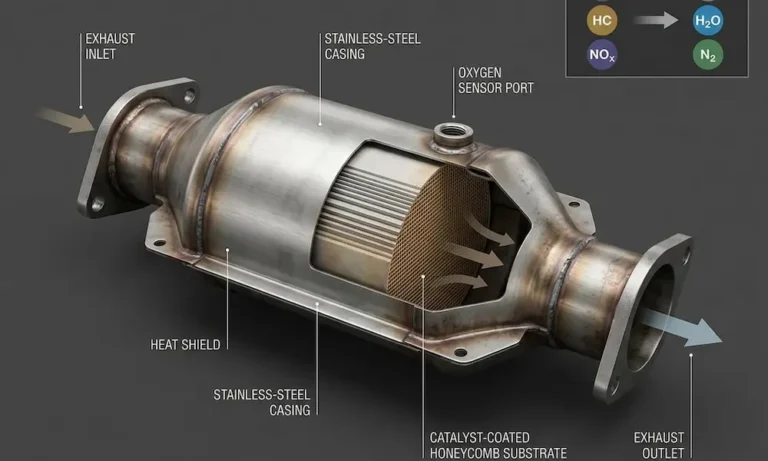
Your F-150’s catalytic converter sits right in the exhaust path, between the engine and the muffler. Its job is simple: turn toxic exhaust gases into harmless ones before they hit the atmosphere.
Inside that steel shell is a ceramic honeycomb coated with platinum, palladium, and rhodium. These precious metals trigger three simultaneous chemical reactions that neutralize:
- Nitrogen oxides → harmless nitrogen gas
- Carbon monoxide → carbon dioxide
- Unburned hydrocarbons → water vapor and carbon dioxide
Most F-150s run a dual-converter setup — one for each bank of cylinders. On the twin-turbocharged EcoBoost engines, these converters sit right after the turbocharger outlets, making them especially critical to exhaust flow.
The system works best above 600°F, which is why cold starts produce more emissions. Your engine control unit watches two oxygen sensors — one upstream, one downstream — to confirm the converter is doing its job in real time.
How to Tell Your Catalytic Converter Is Failing
Catalytic converters have no moving parts, so they don’t wear out like brake pads. They fail from heat damage, physical trauma, or chemical contamination. Here’s what each failure type looks like.
Check Engine Light and Fault Codes
The most common early sign is a P0420 or P0430 diagnostic code. These codes tell you the catalyst efficiency has dropped below the federal threshold on bank one or bank two.
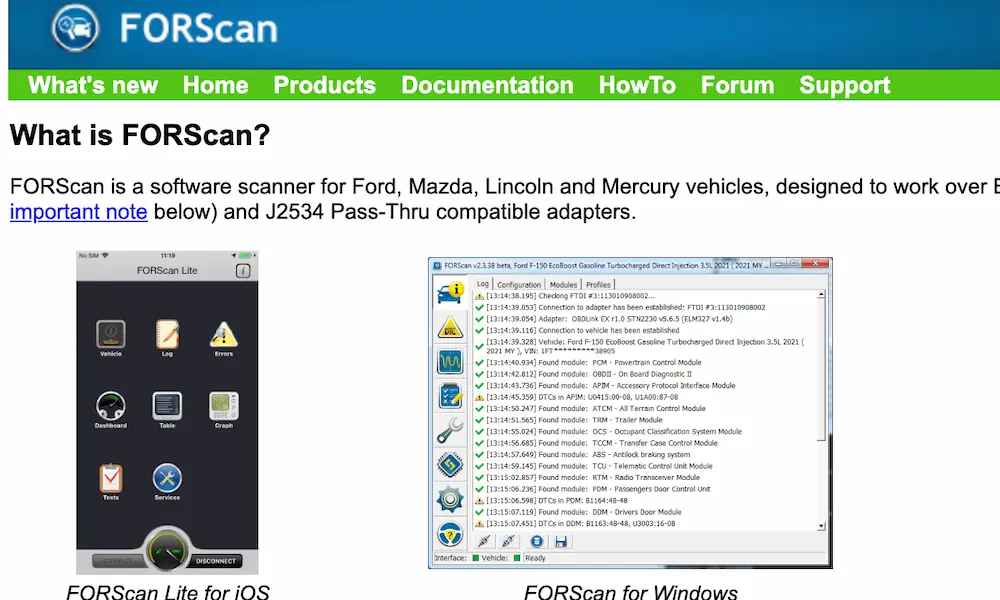
But don’t replace the converter just because you see these codes. An exhaust leak upstream of the downstream sensor can trick the system into triggering a false P0420. So can a lazy, aging oxygen sensor. Always pull live data with a scan tool first and check fuel trims before authorizing the repair.
Internal Meltdown
A misfire sends raw, unburned fuel straight into the hot converter. That fuel ignites inside the unit and superheats the ceramic honeycomb past its melting point. The matrix fuses into a solid block, completely choking exhaust flow.
The symptoms are brutal: severe power loss, inability to accelerate, and frequent stalling under load. On EcoBoost trucks, the restricted backpressure kills turbo spool completely, turning a 400-horsepower truck into a slug.
The Rattle Test
Drive slowly and listen. A rattling sound from under the truck — loudest during cold starts and idle — usually means the ceramic substrate has cracked into pieces. Those loose fragments bounce around inside the housing with every exhaust pulse.
Don’t ignore this. Ceramic fragments can migrate downstream and permanently block your resonator or muffler, turning a converter replacement into a full exhaust replacement.
What Does Ford F-150 Catalytic Converter Replacement Cost?
Expect to pay between $1,627 and $1,693 for a full replacement at a shop, with parts alone averaging around $1,486. Labor typically runs $150 to $200.
The part itself varies dramatically based on where you live:
| Converter Type | Typical Price Range | Where It’s Legal |
|---|---|---|
| Standard Federal (EPA) | $300 – $500 | Non-CARB states only |
| CARB-Compliant (Aftermarket) | $1,000 – $1,500 | California + 15 adoptive states |
| OEM Ford Replacement | $800 – $1,400 | All 50 states |
One important note: federal law mandates an emissions defect warranty covering 8 years or 80,000 miles. If your F-150’s converter fails within that window, Ford replaces it for free at an authorized dealership.
Federal and State Laws You Must Know
Replacing a catalytic converter isn’t just a mechanical job — it’s a regulated act. Get it wrong and you’re looking at serious fines.
EPA Rules Apply Everywhere
The Clean Air Act prohibits anyone from removing, bypassing, or disabling an emissions control device on a street-driven vehicle. That means you, your shop, and the parts store all share responsibility.
EPA fines can reach $5,580 per day, per non-compliant part. For shops that routinely install illegal pipes or defeat-device tunes, those fines compound fast. Criminal penalties include up to $25,000 per day and one year in federal prison.
You can only legally replace a converter if the original is stolen, physically destroyed, or proven to be failing an efficiency test. Replacing a functioning converter for a louder exhaust note is a federal violation.
California and CARB States Play by Different Rules
California requires every aftermarket replacement converter to carry a CARB Executive Order number permanently stamped on its housing. During a Smog Check, a technician verifies that number matches your truck’s exact Engine Family Number. No match? Instant fail. No registration renewal.
These states follow the same CARB rules as California:
New York, Colorado, Maine, Connecticut, Delaware, Maryland, Massachusetts, New Jersey, New Mexico, Oregon, Pennsylvania, Rhode Island, Vermont, Washington, and D.C.
If you live in any of these states, you cannot legally install a standard federal converter. The parts retailers know it too — most block shipment of non-compliant units to these zip codes automatically.
The Catalytic Converter Theft Epidemic
The platinum, palladium, and rhodium inside your F-150’s converters are worth serious money on the black market. Thieves know it.
The F-150 is a top theft target for two reasons: its high ground clearance means no jack required, and its dual converters carry a large precious metal payload. With a cordless reciprocating saw, a thief can cut both converters off in under two minutes.
What States Are Doing About It
Legislators are finally cracking down hard on the scrap yards and black-market buyers that make theft profitable.
| State | Key Law | Penalty |
|---|---|---|
| California | SB 55, AB 1519, AB 641 | Mandates VIN etching at dealerships; criminalizes defacement; redefines bulk possession as commercial dismantling |
| Texas | HB 4110 | Theft elevated to a felony; repeat offenders face 2–10 years in prison |
| Virginia | Section 18.2-146.1 | Unauthorized sale is a Class 6 felony |
| Minnesota | 2023 Enactments | All scrap transactions must register in a centralized state database |
| South Dakota | Section 34A-6-109 | Scrap yards must record seller ID and vehicle VIN for every converter purchased |
How to Protect Your F-150
Physical deterrents work. Options include:
- Steel protective shields welded around the exhaust pipe (not the converter housing)
- Heavy-duty braided steel cable cages that block saw access
- VIN etching using dot-peen machines or high-temperature paint
One critical installation rule: shields must never be welded directly to the converter housing. The heat fractures the ceramic matrix inside. Also, no cage can cover the stamped Executive Order number — that causes an automatic Smog Check failure.
Step-by-Step: Ford F-150 Catalytic Converter Replacement
This procedure covers the 2009–2014 and 2015–present F-150 platforms. It’s an advanced job. Budget 3–5 hours if you’re comfortable under a vehicle.
Tools You’ll Need
- Hydraulic floor jack and rated jack stands
- Ratchet set with 10mm–21mm sockets
- Oxygen sensor socket (22mm with wire cutout)
- Universal swivel extensions
- Penetrating oil (apply the night before)
- High-temperature exhaust sealant
- Calibrated torque wrench
- Safety glasses and heat-resistant gloves
Preparation
Spray all exhaust bolts, flanges, and clamps with penetrating oil and let it soak overnight. Rusted F-150 exhaust hardware is notorious for shearing — a snapped stud turns a 3-hour job into a machine shop visit.
Let the engine cool completely. Catalytic converters retain heat long after the engine shuts off.
Lifting and Structural Access
Engage the parking brake. Place wheel chocks behind the rear tires. Jack the front of the truck at factory lift points and lower it onto rated jack stands.
The transmission crossmember must come out to create a drop path for the converters. Place a secondary jack under the transmission with a wood block to protect the pan, then remove the crossmember using 15mm and 18mm sockets.
On 4WD models, the front driveshaft blocks access to the driver’s side converter. Mark the driveshaft flange alignment with a paint pen before unbolting it, then shift it out of the way.
Sensor Removal
Disconnect the wiring harness connectors for both upstream and downstream oxygen sensors by pressing the locking tabs. Use a proper oxygen sensor socket to unthread the sensors carefully — the ceramic elements inside crack easily.
EcoBoost Pro Tip
On 3.5L EcoBoost trucks, the crossover pipe clamps often seize completely. Instead of fighting rusted clamps in a tight space, remove the starter motor and shift it aside. This opens a large cavity that lets you extract both converters as one combined unit, skipping the seized clamp entirely.
Converter Extraction and Installation
Loosen the rear slip connections first, then use long extensions to reach the 15mm nuts at the exhaust manifold flanges. Remove the converters.
Before installing the new units, scrub the manifold mating surfaces clean with a wire brush. Position the new converters loosely first, then snug everything up before final torquing.
Torque Specifications
| Connection | Tool | Torque |
|---|---|---|
| Oxygen sensors | 22mm sensor socket | 34 ft-lbs |
| Converter to exhaust manifold nuts | 15mm socket | 30 ft-lbs |
| Front driveshaft to transfer case | Metric socket | 41 ft-lbs |
| Rear driveshaft to differential | Metric socket | 76 ft-lbs |
| Transmission crossmember to chassis | 15mm/18mm socket | 66 ft-lbs |
| Transmission mount to crossmember | 18mm socket | 72 ft-lbs |
Apply high-temperature exhaust sealant to all rear slip joints before clamping. Route sensor wires away from hot surfaces and zip-tie them to prevent heat damage.
Reinstall the crossmember, realign the driveshaft to your paint marks, and lower the truck. Start it and listen closely at all flanges for hissing or exhaust leaks. Take it for a test drive with a scan tool connected to confirm the readiness monitors reset and the fault codes clear.
Cat-Back vs. Downpipes: What’s the Difference?
Many F-150 owners confuse these two upgrades.
A cat-back system replaces everything behind the factory catalytic converters — the mid-pipe, resonator, muffler, and tailpipes. It’s legal in all 50 states, never triggers a check engine light, and improves exhaust tone. Performance gains are modest because the restrictive factory converters stay in place.
High-flow downpipes replace the converter-housing pipes directly after the turbochargers on EcoBoost trucks. They use a coarser 100–200 cell-per-square-inch matrix instead of the factory’s 600 cells. The result is faster turbo spool, lower exhaust temperatures, and verified dyno gains of up to 28 rear-wheel horsepower and 85 ft-lbs of torque when paired with a custom tune.
The catch: high-flow downpipes are sold as “competition use only”. Installing them on a street-driven truck violates the Clean Air Act, triggers a P0420/P0430 immediately without a tune, and makes your truck fail any emissions test. The EPA enforcement risk is real.
FAQs
Does car insurance cover a stolen catalytic converter?
Yes — but under comprehensive coverage, not collision. You still pay your deductible first. If your deductible is $1,000 and the repair is $1,600, filing a claim may barely be worth it, and it could raise your premium. Many owners just absorb the cost.
What’s the difference between OEM and aftermarket “heavy metal” converters?
OEM converters from Ford use a high precious metal load designed to last the full 8-year/80,000-mile warranty period easily. Standard aftermarket units use the minimum metal required to pass federal tests, which cuts the price but shortens lifespan. “Heavy metal” aftermarket variants bump up the platinum and palladium content, delivering durability much closer to OEM without the OEM price tag.
Can you wrap a catalytic converter with thermal exhaust wrap?
Don’t do it. Converters rely on ambient airflow to dissipate excess heat. Wrapping them traps heat against the housing, pushes internal temperatures past the ceramic melting point, and causes a full substrate meltdown. Wrap the pipes leading to the converter — never the converter itself.
How does a secondary air injection system help the catalytic converter?
During a cold start, the converter can’t scrub emissions until it hits light-off temperature. Some F-150 engine management systems pump fresh air directly into the exhaust manifolds. This causes a controlled secondary combustion right in front of the converter, rapidly heating it to operating temperature and dramatically cutting cold-start pollution.
Why does non-sensor-safe silicone destroy oxygen sensors and converters?
Standard silicone sealants release silicone vapors when heated. Those vapors travel through combustion and into the exhaust stream. Inside the converter and on the oxygen sensor elements, they bake into a hard silica glaze that permanently coats the precious metals and sensor tips. The result is an irreversible failure of both the sensors and the converter. Always use sensor-safe silicone anywhere near the intake or exhaust.