Got a GM truck and wondering if it has a G80 locking differential? Or maybe yours just made a scary clunk in the snow and you’re not sure if something broke? This post covers exactly how the G80 works, what kills it, and how to keep it alive. Stick around — the fluid section alone could save you an expensive repair.
What Is the G80 Locking Differential?
The G80 locking differential is a fully automatic, 100% mechanical rear axle lock built by Eaton and factory-installed in millions of GM trucks and SUVs. GM’s internal code for it is RPO G80, and the unit itself is officially called the Eaton MLocker.
You’ve probably heard it called the “Gov-Loc” too — more on that nickname later.
Unlike a limited-slip differential that only biases torque partially, the G80 goes full lock when you need it. And unlike driver-controlled lockers, you don’t touch a button. It handles everything by itself.
Here’s the short version of why it matters:
- A standard open differential sends power to the wheel with the least resistance
- If that wheel is on ice or mud, you go nowhere
- The G80 detects the spin and locks both wheels together automatically
- When you regain traction, it unlocks just as automatically
That’s the whole magic trick — no electronics, no switches, no driver input.
A Quick History: Where Did the G80 Come From?
The Eaton G80’s story starts in the early 1970s, when GM needed something tougher than a traditional limited-slip differential for its heavy-duty truck lineup.
Before the G80, GM used friction-based limited-slip units marketed under names like Positraction (Chevy), Safe-T-Track (Pontiac), and Anti Spin (Oldsmobile). Those worked fine for passenger cars. In serious trucks, though, clutch packs wore out fast under heavy loads and rough terrain.
So Eaton and GM developed the Automatic Differential Lock — a true mechanical locker — and introduced it in the third-generation C/K Square Body trucks starting with the 1973 model year.
The RPO code confusion starts here. When introduced, it was code G86. GM then reassigned G80 — which previously meant Positraction on all cars — to mean the Eaton locker on trucks starting in 1974. On passenger cars, G80 still means a traditional limited-slip. Same code, totally different hardware. That mix-up has confused mechanics ever since.
The G80 hit its stride during the GMT800 platform era (1999–2007), underpinning the Silverado, Sierra, Tahoe, Yukon, Suburban, Escalade, and even the Hummer H2 across nearly 40 truck configurations. It became the default American traction aid.
How the G80 Locking Differential Actually Works
This is where things get interesting. The G80 uses no electronics whatsoever. It’s pure physics.
Normal Driving: Open Mode
During everyday driving, the G80 behaves like a standard open differential. It lets your wheels rotate at different speeds during turns — which is exactly what needs to happen. The outer wheel travels a longer arc than the inner wheel, so it spins faster. The G80 allows that without binding or scrubbing tires.
Traction Loss: Engagement
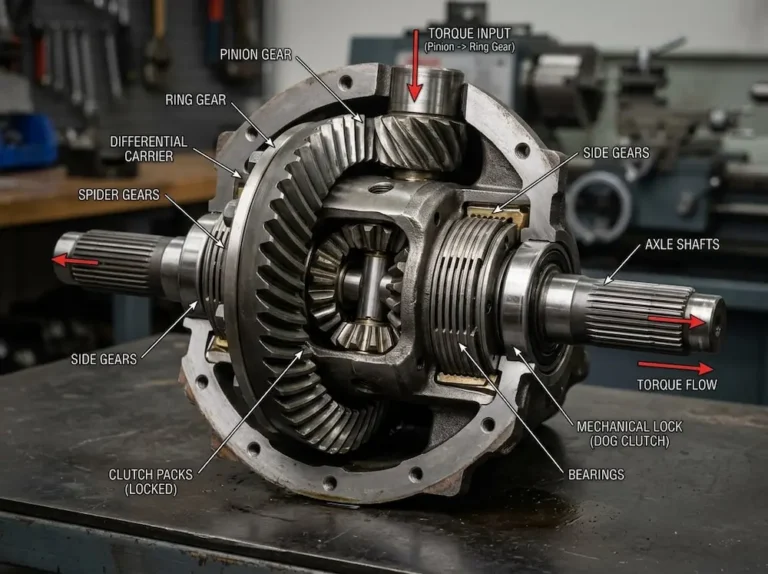
When one wheel loses grip and starts spinning, the speed gap between your two rear wheels grows fast. Once that difference hits 100–120 RPM, the G80’s internal governor fires.
Here’s the mechanical sequence:
- Heavy flyweights on the governor swing outward from centrifugal force
- A flyweight catches a stationary latching bracket inside the housing
- The governor stops rotating while the differential case keeps spinning
- That forces a cam plate to ramp outward
- The cam wedges a side gear into the clutch pack
- The clutch pack compresses and locks both axle shafts together
The cleverness here is that the system is self-energizing. The harder the wheel spins, the harder the cam pushes the clutch pack. More slip equals more lock force — automatically.
Both wheels now spin at the same speed. Power goes where traction is. You move forward.
When you lift off the throttle and torsional stress drops, the cam plate retreats, the clutches release, and you’re back to open differential mode. The whole thing is seamless.
The High-Speed Safety Lockout
The G80 is strictly a low-speed traction device. Locking a rear axle at highway speeds would be catastrophic — instant fishtailing, loss of control, potential rollover.
GM engineered a fix. Above roughly 20–25 mph, centrifugal force swings a weighted lockout bracket out of reach of the governor flyweights. Even if your wheels develop a massive speed difference at 50 mph, the bracket physically can’t latch. The locker stays open. Your truck stays stable.
This isn’t a malfunction. It’s the system doing exactly what it’s supposed to do.
The Sacrificial Fuse Disc: Built to Break on Purpose
In the late 1970s and early 1980s, as GM trucks got more powerful, a problem emerged. When the G80 engaged suddenly under high throttle, the shock load through the axle shafts was enormous. Snapped axles became common.
Eaton’s solution was brilliant and counterintuitive: instead of beefing up the axle shafts, they added a weak component designed to fail first.
Starting in mid-1986, a load-limiting fuse disc was placed inside the left-hand clutch pack. It has fewer exterior drive tangs than the other friction plates. Under normal low-speed traction recovery, those tangs hold fine. Under abusive, high-torque engagement, they shear off clean.
When the fuse disc blows:
- The locking mechanism is permanently disabled
- The differential functions as a standard open unit
- The truck is still completely drivable
- The axle shafts stay intact
It’s an engineered sacrifice — destroy a cheap internal disc, save an expensive axle. Smart engineering.
The “Gov-Bomb”: Why the G80 Gets a Bad Reputation
The G80 has earned some brutal nicknames in enthusiast circles — “Gov-Bomb” and “grenade” being the most popular. Here’s exactly why.
The G80 is explicitly designed as a low-speed traction aid. It is not a performance differential. It wasn’t built for burnouts, drift events, or drag launches.
When someone floors a high-horsepower truck and forces a burnout, one wheel loses grip slightly before the other. RPMs skyrocket. The 100 RPM engagement threshold hits almost instantly. The governor tries to latch at extreme speed.
Inside the differential, there’s approximately a 75:1 gear ratio between the ramp plate and the governor. At wild RPMs, the tiny governor teeth can’t latch cleanly — they skip over the ramp plate teeth instead. That violent, high-speed skipping strips hardened steel teeth off both components. Metal shrapnel goes everywhere. Sometimes the shock load is so severe that it shatters the cast iron differential housing completely.
That’s the “grenade” moment.
The important truth here: the vast majority of catastrophic G80 failures come directly from abuse, not design flaws. Apply gentle, steady throttle until you feel the mechanical clunk, then proceed forward smoothly. Do that, and a G80 will regularly survive 300,000+ miles.
Fluid Maintenance: The Most Misunderstood Topic
This section might be the most important thing you read today. Getting this wrong is expensive.
What Limited-Slip Friction Modifiers Actually Do
Standard limited-slip differentials use pre-loaded clutch packs that need to slip smoothly during cornering. Without a chemical friction modifier in the gear oil, those clutches grab unevenly, causing the loud chatter and shudder you’ve probably heard coming from neglected limited-slip units. The modifier makes the plates slip smoothly and quietly.
Why You Must Never Add Friction Modifiers to a Truck G80
The G80 locker’s clutches are not pre-loaded. They stay loose until the cam plate slams them together during a traction event. Their whole job is to grip hard and completely.
If you add friction modifier to a truck G80, the clutch plates become artificially slippery. When the governor latches and the cam tries to wedge the clutches together, the plates slip instead of grabbing. The differential can’t lock. You lose traction when you need it most. The clutches overheat from continuous partial engagement. A severe chattering and shuddering develops during low-speed turns.
General Motors addressed this so directly that they issued TSB 91-4-109 specifically warning technicians: the truck G80 is a mechanical locker, not a limited-slip. No additives. Period.
What Fluid Does the G80 Actually Need?
| Differential Type | Vehicle Application | Correct Fluid | Friction Modifier? |
|---|---|---|---|
| G80 MLocker (Eaton) | GM Trucks & SUVs (body-on-frame) | GL-5 Synthetic 75W-90 or 80W-90 | ❌ Never |
| G80 Limited-Slip | GM Passenger Cars (Camaro, Corvette) | GL-5 with friction modifier | ✅ Required |
| G86 Mechanical LSD | 2021+ Tahoe, Suburban, Yukon, Escalade | GL-5 with friction modifier | ✅ Required |
GM’s specific fluid for the MLocker (part numbers 88862624 for the US, 88862625 for Canada) has a distinctly sweet, synthetic smell that earned it the assembly-line nickname “grape juice.”
Change the fluid around every 50,000 miles under severe service conditions. The fluid will darken over time from normal clutch wear — that’s fine. It won’t harm seals or bearings.
How the G80 Works With Modern Electronics
You might wonder if a purely mechanical locker conflicts with StabiliTrak or ABS. It doesn’t — in fact, they work together surprisingly well.
When electronic traction control brakes a spinning wheel to control it, that braking action creates an artificial wheel speed difference. The G80 governor reads that difference exactly like a natural traction loss event. It latches, locks, and sends torque to the wheel with grip — adding mechanical force on top of the electronic intervention.
It’s an unplanned but highly effective synergy. You get computer-managed yaw control plus a full mechanical axle lock working simultaneously.
The G80 in Electric Vehicles
Electric motors deliver maximum torque at zero RPM. That punishes differentials hard. Regenerative braking adds reverse torque loads on top. And eAxle packaging space is extremely tight.
The MLocker fits surprisingly well into this world. Because it’s entirely mechanical with no wiring or software integration required, it drops into an eAxle assembly without touching the vehicle’s ECU. Eaton has been supplying MLockers for EV applications since 2016 and has delivered over 500,000 differentials for electric vehicles across the US, Europe, and Asia-Pacific. Heavy electric trucks with extreme tow ratings are natural candidates.
How to Read GM RPO Codes and Find Your G80
Every GM vehicle carries a Service Parts Identification label listing its factory-installed RPO codes. Find it here:
- Glove box interior wall or door (most common)
- Driver’s side door jamb on the B-pillar
- Under the spare tire cover or trunk floor on older sedans
On vehicles from 2018 onward, GM replaced the printed code list with a scannable QR code on the certification label. Scan it with your phone for instant access to all factory RPO data.
Look for the letter “G” codes on the axle section. Here’s what the key codes mean:
| RPO Code | What It Means | Key Note |
|---|---|---|
| G80 (Truck/SUV) | Eaton MLocker mechanical locker | GL-5 only, no additives |
| G80 (Passenger Car) | Traditional limited-slip differential | Requires friction modifier |
| G86 | Mechanical LSD (2021+ independent rear suspension SUVs) | Requires friction modifier |
| G93 | Front driver-selectable electronic locker (ZR2 models) | Driver-actuated |
| G94 | Rear driver-selectable electronic locker (ZR2 models) | Driver-actuated |
| G96 | Electronic limited-slip differential (eLSD) | Corvette, CT4, CT5 |
Frequently Asked Questions About the G80 Locking Differential
How do I know if my truck actually has a G80 differential?
Check the Service Parts Identification label in your glove box or door jamb and look for the code “G80” in the list. If the label is missing or unreadable, you can do a physical test. Put one rear wheel on wet grass or slick pavement, keep the other on dry ground, and apply gentle throttle. If the G80 is present and working, you’ll feel and hear a distinct mechanical clunk within a second, followed by immediate forward movement.
Why does my G80 make a loud clunk when it engages?
That clunk is completely normal. The G80 runs fully open until a 100–120 RPM wheel speed difference is detected. When the governor latches, the cam plate slams the clutch pack together almost instantly. That violent, sudden transition from open to fully locked sends a shock through the driveline — that’s the clunk you hear and feel. It’s not breaking. It’s working.
Should I add a limited-slip friction modifier when I change my truck’s differential fluid?
Absolutely not, if your vehicle is a truck or body-on-frame SUV with a G80. GM TSB 91-4-109 explicitly prohibits it. Friction modifiers make the MLocker’s clutches too slippery to engage properly, disabling the lock function and causing severe chatter. Use straight GL-5 synthetic gear oil in 75W-90 or 80W-90 viscosity, no additives. If your G80 is in a passenger car like a Camaro, the opposite is true — friction modifier is required there.
Why won’t my G80 lock at highway speeds?
Because it’s not supposed to. The G80 has an intentional centrifugal lockout mechanism that physically prevents engagement above roughly 20–25 mph. A locked rear axle at highway speed is extremely dangerous — it can trigger immediate fishtailing and loss of control. If your differential won’t lock at slow speeds either, that’s a separate issue worth investigating.
What is a “Gov-Bomb” and why do people call the G80 that?
The nickname comes from enthusiasts who destroyed their G80s by doing burnouts or aggressive high-RPM launches. At extreme wheel speeds, the governor mechanism can’t latch cleanly. Instead, the teeth skip violently over each other, stripping hardened steel gear teeth and sending debris throughout the housing. In severe cases, the housing itself cracks open. Drive the G80 gently within its intended low-speed parameters and it’ll last over 300,000 miles. Push it like a performance locker and it fails spectacularly.
Can the G80 differential be repaired after it fails?
If the fuse disc blows from a high-torque engagement, the differential permanently loses its locking function but stays drivable as an open unit. Full mechanical failures — stripped governor teeth, shattered housing — typically require a complete differential replacement. Rebuild kits exist for G80 units, but the labor involved often makes replacement more practical. The fuse disc failure is designed as a warning sign; if yours has blown, consider how the vehicle was driven before rebuilding.
Does the G80 work with four-wheel drive?
Yes. The G80 is a rear axle differential and operates independently of the front axle and transfer case. In a 4WD truck, you get front axle engagement from the transfer case and automatic rear axle locking from the G80. They complement each other — the G80 doesn’t interfere with or depend on the 4WD system at all.
How long does a properly maintained G80 last?
When used as designed — gentle throttle application during low-speed traction recovery, no burnouts, correct GL-5 synthetic fluid with no modifiers — G80 differentials routinely exceed 300,000 miles of service. Eaton describes the MLocker as maintenance-free under normal operating conditions. Changing the gear oil around 50,000 miles under severe service keeps things fresh and removes accumulated clutch debris.