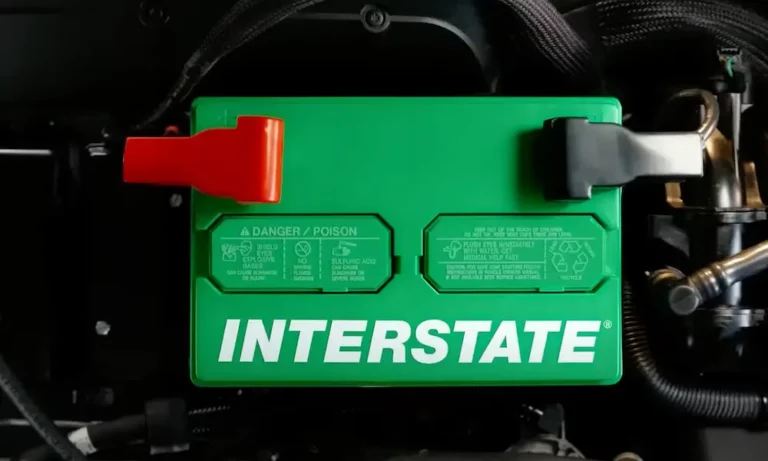
Confused about your Interstate battery warranty? You’re not the only one staring at a date code wondering if you’re still covered. This guide breaks down exactly how the interstate battery warranty works — from free replacement periods to the fine print that could cost you. Read to the end, because a few key details could save you real money.
How the Interstate Battery Warranty Actually Works
The warranty has two main phases: a Free Replacement Period and a Discount Period (on select models).
Free Replacement Period — If your battery fails during this window due to a manufacturing defect, Interstate replaces it at no charge for the hardware. Simple.
But here’s the catch: you still pay sales tax, recycling fees, and any labor costs. The warranty covers the battery itself — not the mechanic’s time to install it.
Discount Period — Some premium models extend coverage past the free replacement window. Instead of a full replacement, you get a percentage off the current Suggested Retail Price (SRP) when you buy a new one.
One important detail: when Interstate replaces your battery under warranty, the replacement doesn’t get a fresh warranty clock. It inherits whatever time was left on the original. If your 36-month battery failed at month 24, the replacement only has 12 months left.
What the Lawsuit Changed
Interstate’s old warranty calculated discounts against an inflated “List Price” — consistently about 20% higher than what anyone actually paid. Customers filing a class-action lawsuit called this out as misleading. After the settlement, Interstate scrapped that model entirely.
Today, the discount applies directly to the current SRP at the time of return. The result is a cleaner, more transparent system using flat discount tiers (like 45%, 25%, and 10% off) instead of confusing monthly depreciation math.
How to Read the Date Code on Your Interstate Battery
No receipt? No problem — as long as you know how to read the date code stamped into your battery’s casing.
Interstate uses an alphanumeric date code system. A letter indicates the month, and a number indicates the last digit of the year. The letter “I” is skipped to avoid confusion with the number 1.
| Month | Code | Month | Code |
|---|---|---|---|
| January | A | July | G |
| February | B | August | H |
| March | C | September | J |
| April | D | October | K |
| May | E | November | L |
| June | F | December | M |
So “C6” means March 2026. “L5” means November 2025. You’ll usually find this code engraved into the plastic cover or heat-stamped on the side — not on a removable label.
If your battery has multiple date codes, Interstate counts from the earliest one. Distributors recharge shelved batteries every three months, and a newer stamp sometimes appears after a maintenance charge. Always go with the oldest date code to establish your warranty baseline.
Automotive Battery Warranty Coverage by Model
The updated warranty effective July 15, 2026 organizes automotive coverage into clear tiers based on battery series.
Standard and Premium Flooded Lines
| Series | Tier | Free Replacement | Discount Period |
|---|---|---|---|
| M | Standard | 18 months | None |
| MT | Silver | 24 months | 25–36 mo: 45% off / 37–48 mo: 25% off / 49–60 mo: 10% off |
| MTP | Gold | 30 months | 31–48 mo: 45% off / 49–60 mo: 25% off / 61–72 mo: 10% off |
The M series covers basic starting needs in moderate climates. The MTP series is built for cold climates where engines are harder to start, and it stretches coverage all the way to 72 months with the discount tiers.
AGM Lines (for Modern Vehicles)
Newer vehicles with start-stop technology, heavy electronics, or luxury features need an AGM battery. Interstate’s AGM lineup handles deep cycling, heavy electrical loads, and extreme vibration far better than standard flooded batteries.
| Series | Tier | Free Replacement | Discount Period |
|---|---|---|---|
| MTX-AUX | Auxiliary | 12 months | None |
| MTX | Platinum | 36 months | None |
| MTZ | Platinum Plus | 48 months | None |
The MTZ Platinum Plus sits at the top of the lineup with a 48-month free replacement period. Notice that neither AGM line includes a discount period — the coverage is front-loaded, and once the free replacement window closes, you’re on your own.
Commercial and Heavy-Duty Warranty Coverage
Diesel engines, heavy hauling, and continuous vibration destroy batteries faster. Interstate’s commercial warranties reflect that reality.
Group 31 and Standard Commercial Models
| Model Classification | Free Replacement | Discount Period |
|---|---|---|
| M-31 prefix | 12 months | None |
| C, 29H, 29NF, or 31 prefix | 18 months | None |
No extended discount periods here. Commercial use is simply too unpredictable.
Commercial AGM Models
| Model | Free Replacement | Discount Period |
|---|---|---|
| 31-AGM5 | 18 months | None |
| 31-AGM7, 31P-AGM7, 31-AGMX, 4D-AGMX, 8D-AGMX | 36 months | None |
The premium commercial AGM units earn their 36-month coverage through superior vibration resistance and durability in extreme conditions.
The “Wrong Application” Penalty
Here’s where a lot of people get blindsided. If you install a standard automotive battery in a commercial vehicle, diesel truck over one ton, or any non-personal-use diesel application, Interstate caps your warranty at 12 months — regardless of the series.
Even the flagship MTZ drops from 48 months to just 24 months under commercial conditions. And if you repurpose commercial AGM units for auxiliary power unit (APU) applications, those 36-month warranties shrink to 24 months instantly.
Use the right battery for the right application. It’s not just about performance — it’s about keeping your warranty valid.
Marine and RV Battery Warranties
Marine environments add wave shock, deep cycling, and long off-season storage to the mix. Interstate segments this coverage clearly.
| Technology & Model | Free Replacement | Discount Period |
|---|---|---|
| Standard Flooded (HD, 24M, 27M, SRM) | 12 months | None |
| Advanced (24M-AGM-A, 31M-AGM-A, 24M-EFB, 27M-EFB) | 24 months | None |
| Premium AGM (27M-AGM, 31M-AGM, 34M-AGM) | 36 months | None |
Cross-application use triggers automatic warranty reductions here too. Deploy a premium marine AGM outside its intended environment, and that 36-month coverage drops to 24 months.
Lithium Battery Warranty: The 10-Year Option
Interstate’s lithium lineup carries the most impressive — and most complex — warranty in the entire portfolio. The lithium warranty, updated October 1, 2025, can stretch a full decade for registered units.
Registration Is Mandatory
Skip the online registration, and your decade of protection collapses to 6 months. That’s not a typo. Interstate requires digital registration on their website to activate the full warranty. For a battery that costs significantly more than a standard lead-acid unit, that’s a registration form worth completing immediately after purchase.
Lithium Coverage by Model Type
Marine/RV Deep Cycle and Golf Cart Models (like the LI24M12V60, LI27M12V100, LIGC48V100):
| Year of Failure | Coverage |
|---|---|
| Years 1–5 | Free Replacement |
| Year 6 | 50% off SRP |
| Year 7 | 40% off SRP |
| Year 8 | 30% off SRP |
| Year 9 | 20% off SRP |
| Year 10 | 10% off SRP |
Marine Dual Purpose (LI24MDP12V100): 3-year free replacement, then 60% off in Year 4, 40% off in Year 5, and 20% off in Year 6.
Powersports Lithium Models: 3-year free replacement, then 50% off in Year 4 and 25% off in Year 5.
Retailer-Specific Warranties: Costco and Amazon
Buying from a big-box retailer or online doesn’t mean you get the same warranty terms as a local Interstate dealer. Both Costco and Amazon operate under entirely different policies.
Costco’s 2023 Policy Shift
Costco used to offer a flat 36-month free replacement — meaning a battery that failed at month 35 got you a brand-new one. Drivers loved it. Interstate didn’t.
In July 2023, Costco changed to a 36-month prorated warranty. There’s no free replacement buffer anymore. If your battery fails at month 30, you’ve used 5/6 of the warranty life, so you only get a refund of 1/6 of the purchase price. This fundamentally changed the value proposition of buying batteries at Costco.
The same cross-application penalties apply — using a Costco automotive battery in a diesel truck or marine vessel triggers an immediate warranty reduction.
Amazon’s IBX Line
Interstate created the IBX brand specifically for their Amazon storefront. The claims process is different — you contact customer service digitally, then physically mail the defective battery back following hazardous materials packaging rules. It’s a higher bar than driving to a local shop.
Coverage specifics for IBX:
- IBX Automotive AGM: 30-month free replacement
- IBX Lithium Powersports: 24-month free replacement, then 50% off through month 36, 25% off through month 48
- Standard IBX Powersports: 6-month free replacement only
What the Warranty Won’t Cover
Interstate’s warranty covers manufacturing defects — not wear, misuse, or neglect. These are the most common reasons claims get denied:
- Dead battery from a charging system failure — If your alternator is faulty and drained a healthy battery, that’s not a defect. The battery just needs a recharge.
- Low water levels in flooded batteries — Letting the fluid drop below the plates causes irreversible damage. The warranty calls this neglect.
- Freezing damage — A deeply discharged battery has more water in its electrolyte. Water expands when it freezes and cracks the plates. Interstate classifies this as a maintenance failure, not a defect.
- Overcharging damage — A bad voltage regulator boiling out your electrolyte isn’t covered.
- Physical damage — Cracked cases from accidents or drops aren’t manufacturing defects.
- Chemical additives or modifications — Pour anything into the battery or modify the terminals, and the warranty is void immediately.
Interstate also won’t reimburse towing, rental cars, diagnostic fees, or any other consequential expenses. The warranty covers the battery — nothing else.
The Claims Process: What Actually Happens at the Dealer
You can’t just walk in and demand a replacement. Here’s what the process looks like at an authorized dealer or All Battery Center.
First, bring the battery in fully charged. Testing a dead battery produces inaccurate resistance readings that can make a healthy battery look defective — and a discharged battery doesn’t qualify for a warranty claim just because it’s dead.
The dealer runs computerized diagnostic load tests to check internal resistance, load-holding capacity, and overall state of health. If the results confirm a genuine material or workmanship defect — and there’s no physical evidence of abuse or excluded damage — they’ll process the replacement according to your model’s specific warranty matrix.
Bring your receipt. A receipt locks in your exact purchase date and gives you the full warranty period. Without it, the dealer estimates your start date from the date code, and a battery that sat on a shelf for months before you bought it could cost you weeks or months of coverage.
Sub-Brands: PowerFast, PowerVolt, and Nationwide
If you’re buying through an All Battery Center location, you may encounter Interstate’s sub-brands. These offer lower price points with more streamlined warranty coverage.
The PowerFast warranty (updated December 1, 2025) uses a label color system — Red Label and Gray Label models carry different coverage periods depending on the series. Standard PowerFast automotive AGM models earn up to 30 months of free replacement coverage, while commercial and marine models stay at 12 months. Using a PowerFast automotive unit in a commercial or diesel application slashes coverage to 6–12 months. Deploying one in a continuous non-starting application like an APU voids it entirely.
The Nationwide and PowerVolt lines (for purchases from mid-2019 onward) follow their own matrices. Nationwide models with a “4-Year Performance” label include a structured discount period — 25% off in months 25–30 and 10% off in months 31–36. Standard PowerVolt automotive and commercial lines offer a straight free replacement period only, typically 12–18 months depending on the model suffix, with zero discount coverage after that.
The Bottom Line on Your Interstate Battery Warranty
The interstate battery warranty rewards customers who stay organized and use the right battery for the right job. Keep your receipt, check your date code, register your lithium battery online, and match your battery to its intended application. Do those four things, and you’re set up to get maximum value out of whatever coverage your model carries.