Picking the wrong battery size wastes money and can damage your car’s electronics. This guide breaks down the real differences between H6 and H7 batteries — dimensions, power output, chemistry, and which vehicles need which. Stick around, because the section on battery management software alone could save you from a very expensive mistake.
What’s the Difference Between H6 and H7 Batteries?
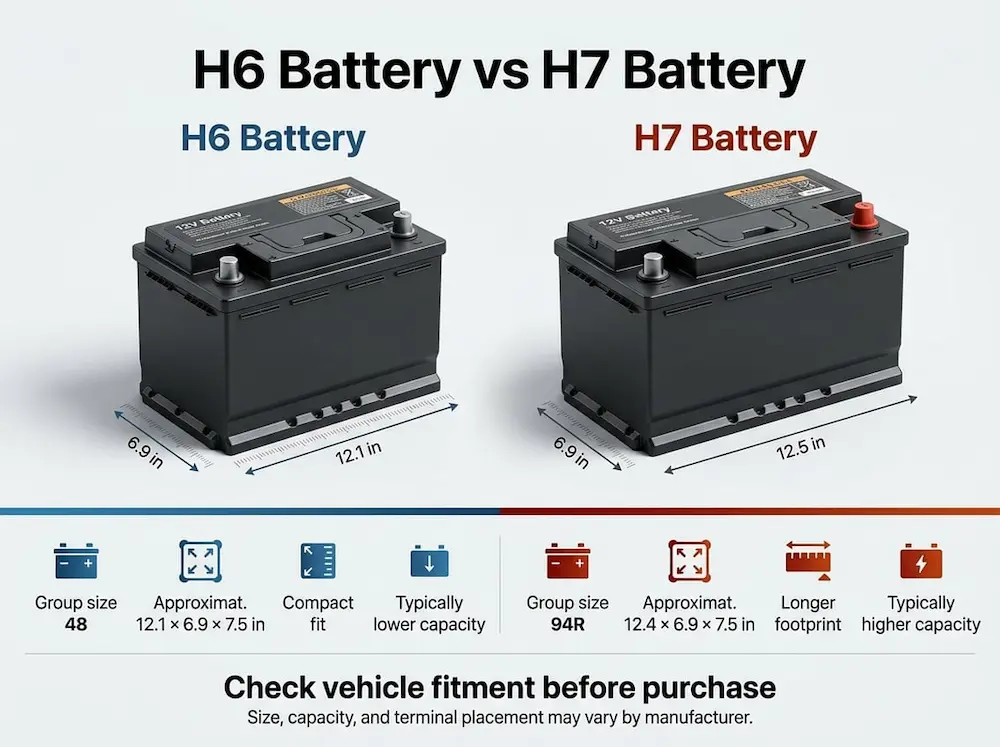
The H6 and H7 are two of the most common automotive battery sizes in the U.S. market. You’ll also see them listed as Group 48 and Group 94R under the Battery Council International (BCI) naming system — they’re the exact same batteries with different labels.
Here’s the short version:
- H6 (Group 48): Slightly smaller, lighter, perfect for standard vehicles
- H7 (Group 94R): Longer, heavier, built for high-demand vehicles and extreme climates
Both sizes share the same width and height. The H7 is about 1.5 inches longer. That one difference changes everything about power output and vehicle fitment.
H6 vs H7 Battery: Size and Weight Compared
Physical fit comes first. No matter how powerful a battery is, it’s useless if it doesn’t fit your tray.
| Physical Feature | H6 / Group 48 | H7 / Group 94R |
|---|---|---|
| Length | 278mm (11.0 in) | 315mm (12.4 in) |
| Width | 175mm (6.89 in) | 175mm (6.89 in) |
| Height | 190mm (7.48 in) | 190mm (7.48 in) |
| Typical Weight | 45–54 lbs | 51–57 lbs |
| Terminal Position | Right Positive | Right Positive |
The identical width and height is intentional. Many manufacturers design battery trays to fit both sizes. You can often upgrade from H6 to H7 by removing a plastic spacer block or shifting a hold-down clamp to a pre-drilled hole.
The extra weight in the H7 isn’t just packaging. More mass means more internal lead plates and more electrolyte — which directly translates to higher energy output and better vibration resistance.
Power Output: Cold Cranking Amps, Reserve Capacity, and Amp-Hours
These three numbers tell you how a battery performs in real conditions.
| Output Metric | H6 / Group 48 | H7 / Group 94R | Why It Matters |
|---|---|---|---|
| Cold Cranking Amps (CCA) | 600–800A | 750–950A | Starting power in freezing temps |
| Reserve Capacity | 95–140 min | 120–160 min | Runtime if your alternator fails |
| Amp-Hour Capacity | 60–72 Ah | 70–85 Ah | Total stored energy for parked electronics |
Cold Cranking Amps (CCA)
CCA measures how much current a battery delivers at 0°F for 30 seconds while staying above minimum voltage. Cold oil thickens, engines resist, and battery chemistry slows down — all at once.
The H7’s extra plate surface area generates current faster. That’s why it’s the go-to choice for northern states, large V8 engines, and diesel trucks that need serious torque to fire up on a January morning.
Reserve Capacity
Reserve capacity tells you how many minutes the battery can run at a 25-amp draw before it dies — critical if your alternator fails mid-drive.
The H7’s extended reserve capacity gives you more time to safely navigate traffic and reach a shop before your electronics shut down. For modern vehicles loaded with radar sensors, electric power steering, and digital dashboards, that buffer matters.
Amp-Hour Capacity
Your parked car isn’t actually off. Security systems, keyless entry receivers, and telematics modules quietly drain power 24/7. The H7’s larger capacity handles that parasitic draw longer before the voltage dips too low to start your engine.
Battery Chemistry: Flooded vs AGM vs Lithium
The size is only half the story. What’s inside the battery changes everything about how it performs and how long it lasts.
Standard Flooded Batteries
Old-school design. Lead plates sit in liquid sulfuric acid. They’re cheap, but they vent gas, require periodic water top-ups, and suffer from acid stratification — where heavier acid sinks and corrodes the bottom of the plates faster than the top.
They also can’t be mounted sideways, and vibrations crack the unsupported plates over time.
Enhanced Flooded Batteries (EFB)
A step up from standard flooded. Better plate supports and poly-fleece materials reduce shedding under heavy use. EFB batteries handle deeper cycling than standard flooded units but still fall short of AGM performance. Good middle-ground option if budget is a real constraint.
Absorbent Glass Mat (AGM) — The Current Standard
AGM is what most modern vehicles need. The electrolyte is absorbed into compressed fiberglass mats between the plates — no free liquid anywhere inside.
Why AGM wins:
- Sealed and spill-proof — can be mounted at various angles
- Up to 15x better vibration resistance than flooded designs
- Recombinant gas technology — oxygen and hydrogen produced during charging recombine into water internally, so you never top it up
- Faster recharge acceptance — the alternator replenishes it quicker
- Essential for start-stop systems — handles the constant engine-off/engine-on cycling without premature failure
Start-stop vehicles are the clearest case for AGM H7s. Every time you stop at a red light, the engine shuts off. Every time you pull away, the battery cranks the engine again. That relentless cycling destroys a standard flooded battery within months.
Lithium Iron Phosphate (LiFePO4)
Top-tier performance, extreme price tag. An H6 or H7 lithium battery weighs 15–20 lbs — roughly 70% lighter than lead-acid. Lifespans reach 7–9 years, with integrated battery management systems built in.
These are for high-end sports cars, racing applications, and builds where shaving weight is worth the premium cost. Not a typical daily driver purchase.
Which Vehicles Use H6 vs H7?
H6 (Group 48) — Standard Applications
The H6 suits millions of mid-sized sedans, compact crossovers, and light-duty trucks. If your vehicle runs standard halogen lights, basic climate controls, and a moderate audio system, the H6 gives you reliable power without overspending.
The lighter weight also helps slightly with fuel efficiency and makes installation easier.
H7 (Group 94R) — High-Demand Applications
The H7 is built for vehicles that push their electrical systems hard:
- Full-size trucks — Ford F-150, Chevrolet Silverado
- Large SUVs with towing packages
- Luxury vehicles with active air suspension, heated/ventilated seats, radar safety suites
- Any vehicle with factory start-stop technology
- High-displacement performance engines in cold climates
Many Jeep Wrangler and Gladiator owners find that base trims ship with H6 batteries in trays designed for H7s — a straightforward upgrade that significantly boosts cold-weather reliability and reserve capacity.
One important warning: Don’t swap an H7 down to an H6 to save money. The smaller battery runs near maximum capacity constantly, causes voltage instability in sensitive electronics, and wears out far faster than it should.
Battery Registration and Software Coding — Don’t Skip This
This is the part most people get wrong. And it’s expensive to get wrong.
Modern vehicles — especially BMWs, Volkswagens, Audis, and increasingly Ford and GM products — use Intelligent Battery Sensors on the negative terminal. These sensors track voltage, current, and temperature in real time.
Over years of use, the battery’s internal resistance rises. The vehicle’s management software responds by slowly increasing alternator output voltage to compensate. When you swap in a fresh H6 or H7, the computer doesn’t know. It keeps commanding high-voltage charging into a brand-new, low-resistance battery — overheating it, warping the plates, and potentially destroying it within months.
Battery Registration
A technician connects a diagnostic scanner to your OBD port and tells the ECU a new battery is installed. The computer resets its degradation algorithm and drops back to a gentle, baseline charging profile. Fresh battery, fresh start.
Battery Coding
If you upgrade the battery’s size or chemistry — say, H6 to H7, or flooded to AGM — coding is also required. The technician inputs the new capacity (e.g., 80Ah instead of 70Ah) and the new chemistry type into the ECU.
AGM batteries have strict maximum voltage limits. If the car still thinks it has a flooded battery installed, it’ll overcharge the AGM unit relentlessly. The result: swelling, gas venting, and total failure. Code it correctly and your new battery gets exactly what it needs.
Heat, Cold, and Battery Lifespan
Cold weather exposes a weak battery. Hot weather kills one.
Inside a hot engine bay, chemical reactions accelerate. Grid structures corrode faster. Water in the electrolyte evaporates. The result is permanent capacity loss — even if the battery looks fine on the outside.
Thermal Insulation Sleeves
Many vehicles ship with thermal insulation sleeves around the battery. These PVC or rubber blankets block radiant engine heat from cooking the battery casing. When you replace your H6 or H7, slide the old sleeve onto the new unit. Don’t throw it away.
Self-Discharge and Sulfation
AGM batteries lose less than 8% of their charge per month during storage — far better than flooded designs. But if any automotive battery sits discharged below its minimum voltage threshold, sulfation begins: hard lead sulfate crystals form on the plates and permanently reduce charging capacity.
If your vehicle sits unused for weeks at a time, connect a microprocessor-controlled maintenance charger. It’s a small investment that prevents a much larger one.
Buying an H6 or H7 Battery: What to Look For
The U.S. market is crowded with options. Premium AGM lines from Duralast Platinum, DieHard Platinum, EverStart Platinum, Odyssey, Optima, and ACDelco consistently score well in longevity and reserve capacity tests.
Key things to check before you buy:
- Chemistry: Prioritize AGM for any vehicle less than 10 years old — it’s mandatory for start-stop systems
- Warranty: Premium AGM H6 and H7 batteries typically offer 36–48 months of full free replacement
- Date code: Check the stamp on the casing. A battery sitting on a shelf for more than 6 months without maintenance charging may already have early sulfation damage
- Fitment confirmation: Double-check your vehicle’s tray length before ordering an H7 upgrade
Frequently Asked Questions
How are old H6 and H7 batteries disposed of in the U.S.?
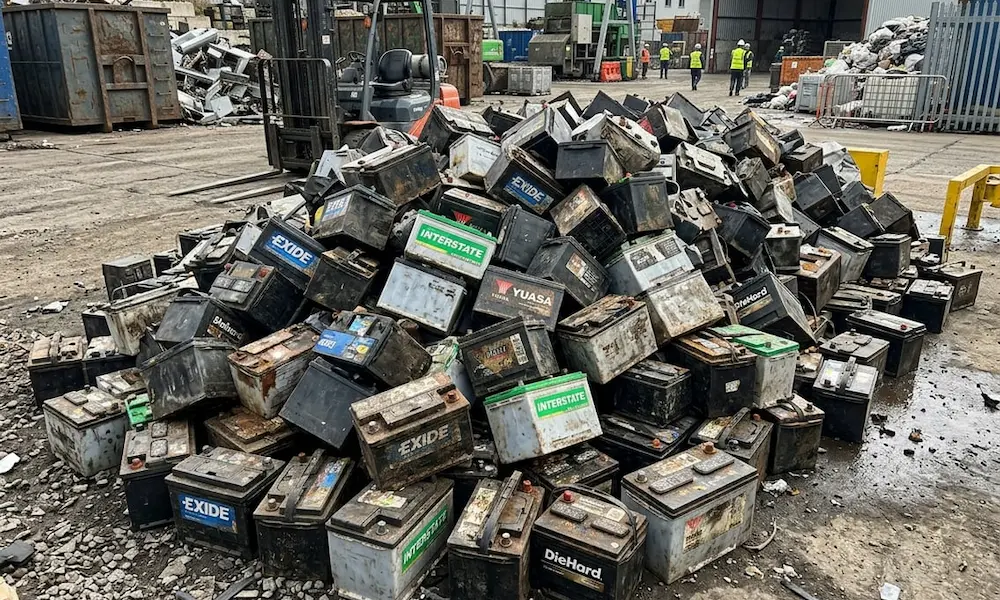
Automotive batteries can’t go in regular trash or landfills — they contain toxic lead and corrosive acid. Retailers use a core charge system: you pay a deposit (usually $15–$25) when buying a new battery, then get it back when you return the old one. The recycling infrastructure is remarkably efficient — automotive batteries have a recycling rate above 95%. The plastic casings, lead plates, and acid are all reprocessed into new materials.
Do parasitic draws damage AGM batteries?
Yes, over time. Modern vehicles draw continuous low-level current from security systems, telematics, and memory modules even when parked. AGM batteries handle deep discharging better than flooded units, but chronic deep discharges still cause cumulative plate damage. If your vehicle sits unused for multiple weeks, connect a smart maintenance charger to prevent the battery from reaching sulfation territory.
Can you order H6 or H7 batteries online?
It depends on chemistry. Standard flooded batteries contain free-flowing acid and face serious shipping restrictions — they’re largely limited to local purchase. AGM batteries are officially classified as non-spillable because the electrolyte is immobilized in fiberglass mats. That exempts them from most hazardous materials shipping rules, so you can order premium H6 and H7 AGM batteries through major online retailers for standard residential delivery.
Can an H6 or H7 battery work in a boat?
For starting a marine engine, yes — an AGM H7 handles that fine. But boats often run trolling motors, sonar, and audio systems for hours with the engine off. That kind of deep cycling demands a true marine deep-cycle battery with thicker internal plates. Using an automotive H7 as your sole house power source on a boat shortens its lifespan considerably compared to a purpose-built marine unit.
Does adding a heavy-duty winch mean you need an H7 — or a dual-battery setup?
Upgrading to an H7 helps, but it’s not enough on its own. A recovery winch under heavy load can pull several hundred amps continuously — well beyond what a single battery handles safely during extended use. For serious off-road or overlanding builds, a dual-battery system is the right answer. A smart isolator relay sends high-draw accessory power to a dedicated secondary battery, keeping your primary H6 or H7 reserved for engine starting and essential electronics.