Got a dead Motorcraft battery and wondering what your warranty actually covers? You’re in the right place. This guide breaks down every coverage tier, explains the fine print that can void your claim, and walks you through exactly how to get a replacement. Stick around — the part about the Battery Monitoring System could save you from a costly mistake.
What Is the Motorcraft Battery Warranty?
The Motorcraft battery warranty is Ford’s official protection plan for replacement batteries sold under the Motorcraft brand. It covers defects in materials and workmanship — not batteries that simply run out of juice due to a bad alternator or a dome light left on overnight.
Ford overhauled its Service Parts Warranty back in October 2013. That update set a universal baseline: 24 months of coverage with unlimited mileage on all Motorcraft parts. No commercial exceptions. Whether you drive a family SUV or a fleet delivery van, you get the same foundational protection.
What makes this warranty stand out? It covers parts, labor, and even towing — if a Ford dealership originally installed your battery. More on that later.
Motorcraft Battery Warranty Coverage by Series
Not all Motorcraft batteries carry the same warranty. Coverage depends entirely on which series you buy. Here’s a full breakdown:
| Battery Series | Free Replacement Period | Total Warranty Duration |
|---|---|---|
| Tested Tough MAX (BXT) | 36 months | 100 months |
| Tested Tough PLUS (BXL) | 18–24 months | 84 months |
| Super Duty (BSD) | 48 months | 48 months |
| Power Series (BXS) | 18 months | 60 months |
| Fleet Tough / Extra | 24 months | 36 months |
| BH-Commercial | 12 months | 24 months |
Tested Tough MAX (BXT Series)
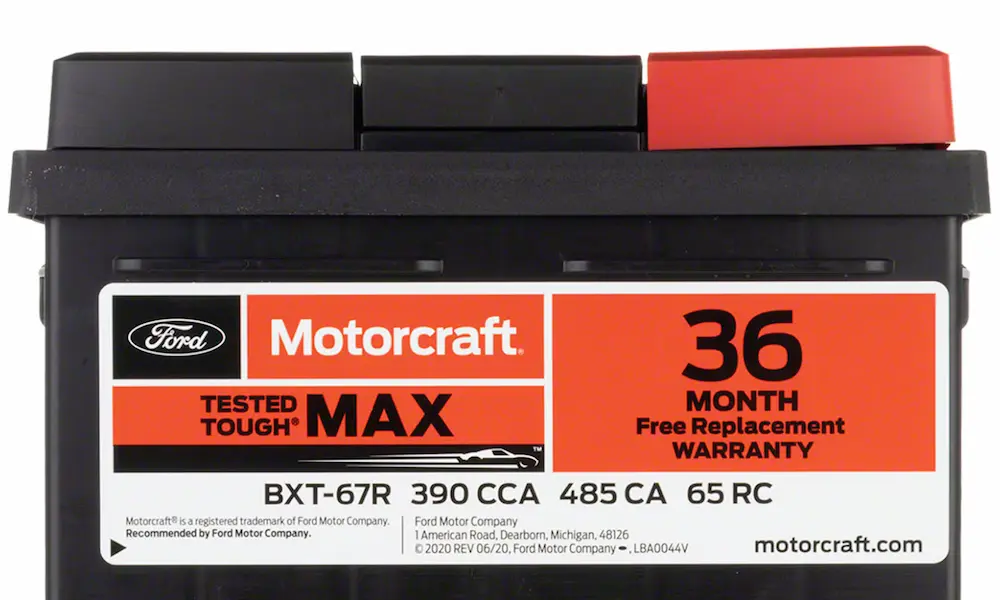
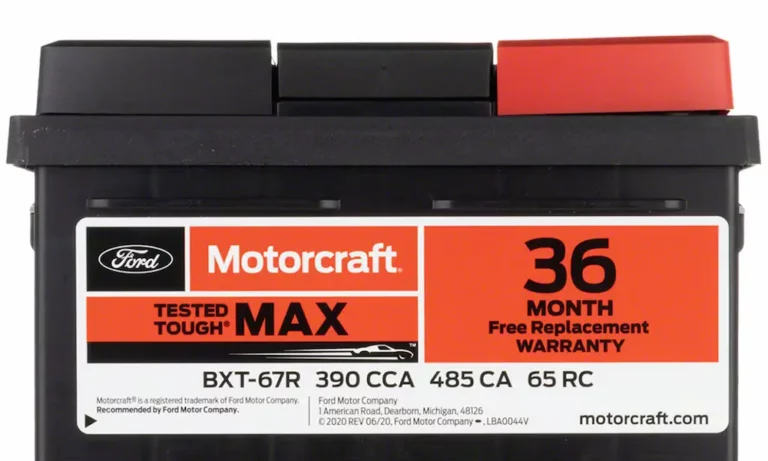
This is Motorcraft’s premium battery line — the factory-approved replacement for all Ford vehicles. It carries a 36-month free replacement period, followed by prorated coverage stretching all the way to 100 months. That’s one of the longest total coverage windows in the industry.
Tested Tough PLUS (BXL Series)
The BXL is a solid mid-tier option. Historically, it came with an 18-month free replacement period. But because Ford’s 2013 Service Parts Warranty update mandates a 24-month minimum on all parts, most dealerships now advertise a 24-month free replacement for this series. Total coverage runs up to 84 months.
Super Duty (BSD Series)
Built for trucks and heavy-duty applications, the BSD series delivers maximum cold cranking amps. Ford backs it with a flat 48-month free replacement warranty — no prorated period, just four years of full coverage.
Fleet, Commercial, and Specialty Lines
- Fleet Tough / Extra: 24 months free, 36 months total
- Power Series (BXS): 18 months free, 60 months total
- BH-Commercial: 12 months free, 24 months total
- Specialty batteries (marine, agricultural, golf carts): Coverage varies — often just a 3-month free replacement period due to the high-abuse nature of these environments
Free Replacement vs. Prorated Coverage: What’s the Difference?
Here’s where most people get confused.
During the free replacement (gratis) period, a defective battery gets swapped out at zero cost. No questions about how long you’ve had it — just a brand-new battery.
Once that period ends, you enter the prorated phase. Think of it as a sliding discount. Ford calculates a monthly depreciation rate by dividing the current retail price of the replacement battery across the total warranty months. You pay for the months you already used; Ford covers the rest.
Quick example: Say your Tested Tough MAX fails at month 37 — right after the 36-month free period ends. You pay for 37 months of use. Ford covers the remaining 63 months. You still save money, but it’s not free.
One heads-up: the industry is moving away from prorated models entirely. Customers hate the math, and retailers like Costco have already dropped prorated coverage altogether. Ford’s own marketing increasingly spotlights only the free replacement window — so expect the prorated structure to fade over time.
Does the Warranty Reset After a Replacement?
This trips people up constantly. The short answer: it depends on whether you paid anything.
- Free replacement (gratis period): The original purchase date stays the anchor. Your new battery inherits the remaining warranty time — it doesn’t restart the clock. If your BXT failed at month 20, the replacement only has 16 free months left.
- Prorated replacement (you paid the depreciation charge): The old warranty is settled and done. Your new battery starts a fresh, full warranty from the date of that transaction.
Make sure the dealership writes your original purchase date on the new receipt. You’ll need it if the replacement ever fails.
The Battery Monitoring System: Don’t Skip This Step
Here’s something most DIYers don’t know — and it can void your warranty fast.
Modern Ford and Lincoln vehicles use a Battery Monitoring System (BMS) that tracks your battery’s age, resistance, temperature, and charge state. As a battery ages, the system tells the alternator to push higher voltages to compensate.
When you install a new battery, the car’s computer doesn’t know the old one is gone. It keeps charging the new battery at the aggressive rate meant for a dying battery. The result? Chronic overcharging that can cut your new battery’s lifespan by 50–70%.
The Reset Mandate
After every battery swap, a technician must perform a BMS reset using an authorized diagnostic scan tool. This clears the old data and tells the system a fresh battery is in place.
Skip this step and your battery degrades fast. If the failure traces back to a missed BMS reset, Ford can — and will — deny the warranty claim. Independent shops and DIY installers often lack the proprietary scan tools required to do this reset properly. That’s one more reason dealer installation protects your warranty.
AGM vs. Standard Flooded Batteries: Get This Right
Vehicles with start-stop technology or regenerative braking require an Absorbent Glass Mat (AGM) battery. These batteries handle deep, repeated discharges that would destroy a standard flooded battery in weeks.
Installing the wrong battery chemistry — even a high-quality standard one — counts as a deliberate misapplication under Motorcraft’s warranty policy. That voids all coverage immediately. Always check your vehicle’s official Motorcraft application catalog before buying.
What the Motorcraft Battery Warranty Doesn’t Cover
The warranty covers manufacturing defects. It doesn’t cover everything else. These situations will get your claim denied:
- Physical damage from impacts, accidents, or rough handling
- Improper installation — overtightened terminals, damaged casing
- Frozen batteries caused by leaving them deeply discharged in cold weather
- Electrical system failures — bad alternators, parasitic drains, leaving lights on
- Wrong application — using a battery outside Motorcraft’s recommended specs
- Consequential damages — lost time, inconvenience, business losses
That last point is worth noting. Ford’s warranty policy explicitly excludes incidental and consequential damages — though some states have laws that limit how far manufacturers can push that exclusion. Know your state’s consumer protection rights.
Labor and Towing: Who Gets Reimbursed?
Your reimbursement depends on how and where you bought the battery.
- Dealer-installed: Full coverage — replacement part, labor, and towing to the nearest authorized facility. This is the best-case scenario.
- DIY / over-the-counter: Parts only. No labor, no towing. Ford can’t verify a DIY installation was done correctly.
- Independent shop / fleet (wholesale purchase): Replacement part plus labor reimbursement up to $150 per repair, calculated using Ford’s standard labor time guidelines. You must provide a repair order with the VIN, diagnostic steps, and labor time.
For repair orders dated February 1, 2023, or later, the approved labor rate for independent fleets is up to $75 per hour.
How to Make a Valid Warranty Claim
Follow these steps to avoid getting your claim rejected:
1. Keep your proof of purchase. Your original invoice or repair order must show the VIN, battery part number, and installation date.
2. Don’t remove the warranty sticker. Every Motorcraft battery has a peel-off warranty sticker on the top label. It stays on the battery until an authorized dealer removes it when processing your claim. Peel it off early and the warranty is void.
3. Get the battery properly tested. A technician must run a computerized diagnostic. If the battery reads below 12.4 volts, it needs a full recharge before testing. A “discharged only” battery that holds a charge after recharging doesn’t qualify for replacement — that’s not a defect.
4. Lost your receipt? If the warranty sticker is still intact, a dealer can process a claim using the battery’s manufacturing date code stamped into the plastic casing. You won’t get cash back — the credit applies to a new Motorcraft battery only.
EV and Hybrid High-Voltage Batteries: A Different Warranty Entirely
Don’t confuse the standard 12V battery warranty with high-voltage traction battery coverage. Ford’s hybrid and EV batteries — in vehicles like the Mustang Mach-E, F-150 Lightning, and E-Transit — fall under the New Vehicle Limited Warranty, not the aftermarket Service Parts Warranty.
Ford covers those high-voltage systems for 8 years or 100,000 miles, whichever comes first. Repairs must happen at a certified EV Ford dealership — not just any service center.
How to Read a Motorcraft Battery Date Code
Lost your receipt? The battery’s age is stamped right into the plastic.
Look for a heat-stamped alphanumeric code along the top edges of the battery cover. This code traces directly back to the manufacturing date. Some batteries also use a two-character sticker — a letter for the month, a number for the year — or a punch-out tab system the selling dealer fills in at purchase.
The heat-stamped code is the most reliable since stickers can fade or fall off under hood temperatures. If there’s no receipt, dealers use this code to determine warranty eligibility — it becomes your fallback start date.
Dealer Inventory and “New Defective” Claims
Even unsold batteries on a shelf can fail. Here’s what dealers need to know:
- Store batteries upright, never more than three layers high
- Check voltage every 90 days — recharge any battery below 12.4 volts
- A “New Defective” claim applies only to batteries that were never installed and are less than 6 months old based on the date code
Batteries damaged by improper storage or neglected recharging schedules don’t qualify for warranty replacement. The warranty starts with how you handle the product.
Can You Transfer the Warranty to a New Owner?
Technically, yes — but only with the right paperwork. A new vehicle owner can claim the remaining warranty on a battery installed by the previous owner, provided they have the original dated repair order showing when the battery was installed.
Without that document, the dealer falls back on the manufacturing date code — which often leaves far less warranty time remaining. If you’re buying or selling a Ford, make sure battery documentation transfers with the car.
The Motorcraft battery warranty is genuinely strong coverage — but only if you follow the rules. Get the right battery for your application, have a dealer install it, make sure the BMS reset happens, and keep your paperwork. Do those four things and you’re fully protected for years.