Lost your Lexus key fob, or just need to add a spare? Before you hand over $500 at the dealership, you’ve got options. Lexus key fob programming ranges from a free 30-second pedal sequence to a 16-minute high-tech reset — and knowing which method fits your car could save you serious cash. Read to the end, because the method you choose matters a lot.
What Type of Lexus Key Do You Have?
Not all Lexus keys work the same way. Before you touch a single pedal or download any software, you need to know your key type. Using the wrong programming method on the wrong key will either do nothing or cause bigger problems.
Here’s a quick breakdown of the three main types:
- Transponder head keys — older models (late 1990s to mid-2000s), physical key with a chip inside
- Smart proximity fobs — mid-2000s onward, keyless entry and push-button start
- Digital Key — 2022 and newer NX, RX, and LX models; your smartphone is the key
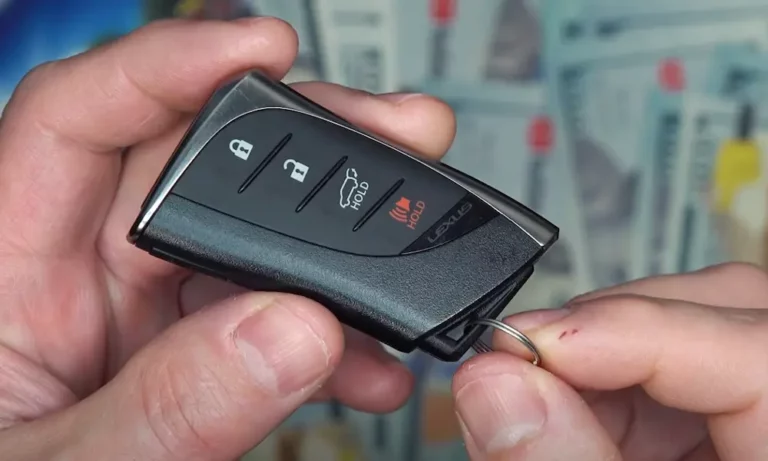
The FCC ID on the back of your fob tells you exactly what you’re working with. Cross-reference it with this table:
| Model | Year Range | Key Type | FCC ID | Chip Type |
|---|---|---|---|---|
| ES 300 / GS 300 | 1998–2005 | Transponder Head | HYQ1512V | 4C Chip |
| ES 350 / LS 460 | 2006–2012 | Smart Proximity | 14AAC | DST-4D |
| GS 350 | 2013–2020 | Smart Proximity | HYQ14FBA | 8A Chip (Board 0020) |
| RX 350 | 2016–2021 | Smart Proximity | HYQ14FBB | 8A Chip (Board 0010) |
| GX 460 | 2021–2023 | Smart Proximity | HYQ14FBZ | 8A Chip (Board 3410) |
| NX / RX / LX | 2022–2024 | Smart + Digital | HYQ14FLC | Encrypted BLE |
Once you know your key type, pick the right programming method below.
Method 1: The “Pedal Dance” (Free, No Tools Required)
This works on older Lexus models with 4C transponder chips — think early RX 300, ES 300, and GS 300. Lexus built a learning mode directly into these vehicles so dealers could add keys fast, and you can use it too.
Important: You must have a black Master key, not a grey Valet key. The Valet key can’t open the programming mode — the car will simply ignore the sequence.
Here’s the exact procedure:
- Insert the existing Master key into the ignition
- Press and release the accelerator pedal 5 times within 15 seconds
- Press and release the brake pedal 6 times within 20 seconds
- Remove the Master key
- Insert the new key — the security light will flash
- Press the accelerator once to begin the 60-second learning phase
If you do any step too slowly, start over. The system resets itself and won’t partially register a key.
For the remote buttons (lock/unlock), the programming is separate from the immobilizer. The door sequence method typically involves inserting and removing the ignition key twice, opening and closing the driver’s door twice, then cycling the ignition from Lock to On. This tells the Body Control Module to listen for a new remote’s signal.
Method 2: Toyota Techstream (Mid-Range DIY)
For smart proximity fobs from the mid-2000s onward, you need software. Toyota Techstream is the official diagnostic platform Lexus dealers use. You can access it yourself with a Mini VCI cable — a J2534-compliant interface that plugs into your OBD-II port.
What you need:
- A laptop (many users run Windows XP in a virtual machine for driver stability)
- A Mini VCI cable ($30–$60)
- Techstream software
- A compatible, unprogrammed key fob
Once connected, navigate to Smart Access > Key Registration. The software walks you through a guided wizard. You’ll touch a registered key to the Power/Start button to authenticate the session, then touch the new key to the same button. According to Lexus technical service documents, the vehicle confirms each successful enrollment with an audible beep.
Two things that kill this process:
- Low battery voltage — a drop during the handshake can corrupt the key ID or freeze the ECU
- Electrical interference — cell phones, aftermarket LED lighting, and power inverters all generate noise that disrupts the transponder signal. Turn everything off.
Method 3: Professional Locksmith Tools (For All Keys Lost Situations)
If you’ve lost your only Master key, Techstream hits a wall. It typically requires a seed code from a Lexus server to authorize a full system reset — and that’s not always quick to get.
Professional tools like the Autel IM608 Pro or XTOOL X100 PAD3 carry built-in bypass calculators that generate these codes locally. That means a mobile locksmith can handle an All Keys Lost situation in your driveway without towing your car anywhere.

- 📢【Please Note Before Purchasing】Compatibility varies by vehicle model and year. 📢We suggest you re.ach us for the compatibility first, any technical or after-sa.les questions, please feel fr-e.e to co.nta.ct us: 📞auteldirect @ outlook. com📞.
Here’s what the All Keys Lost reset actually involves, per NHTSA technical service documentation:
- A mandatory 16-minute wait period built into the vehicle’s firmware as a theft deterrent
- The diagnostic tool must stay connected the entire time
- Battery voltage must stay stable throughout
- After the wait, the system opens a window to register a new Master key
For high-end models like the LS 460 or LX 570, some locksmiths use tools like the Toyota-LexusProg device, which connects directly to the CAN Bus to perform deep resets when the OBD-II port is restricted by an active alarm system.
Method 4: The Lexus Digital Key (2022 and Newer)
If you drive a 2022–2025 NX, RX, or LX, Lexus has replaced the traditional programming process with a smartphone-based system. There’s no pedal dance, no OBD-II cable — just an app.
Here’s what you need to activate it:
| Requirement | What It Does |
|---|---|
| Verified Lexus App Account | Links your identity to the vehicle’s VIN |
| Active Remote Connect Subscription | Provides the cloud-based authentication layer |
| Lexus Interface User Profile | Connects the digital key to your seat/mirror settings |
| Compatible Smartphone | Needs Bluetooth Low Energy and NFC support |
The phone and vehicle communicate via Bluetooth Low Energy (BLE). When you approach the car, they perform a cryptographic handshake and unlock without you touching anything.
The Digital Key also lets you share access with others via phone number or email. You can set speed limits, geographic boundaries, and time restrictions on shared keys. If your phone gets stolen, you revoke the key instantly through the Lexus owner’s portal — no locksmith needed.
What to Do With a Used Key Fob
Buying a used Lexus fob from eBay or a salvage yard sounds like a smart move. It’s usually not. Once a smart key gets programmed to a vehicle, its chip locks to that car. You can’t register it to a different vehicle under normal conditions — that’s an intentional anti-theft measure.
To reuse it, the key needs to be “virginized” — its internal EEPROM reset to factory state. Tools like the Autel KM100 can do this on many chip types. But newer 8A H-chips are highly resistant to this process. For the average owner, buying a fresh, unlocked OEM key from a reputable supplier is far more reliable than gambling on a salvage fob.
Why Key Programming Fails (And How to Fix It)
Most failed programming attempts don’t mean a broken key. They mean a broken communication. Here’s what causes it and how to fix it:
OBD-II port problems:
- Pin 16 must supply 12V to power the scan tool — check your cigarette lighter fuse first since they share the circuit
- Pins 4 and 5 are grounds — corrosion here adds noise to the data stream and causes intermittent failures
- Older Lexus models use ISO 9141-2 protocol; newer ones use CAN Bus — your tool must support the right one
ECU in sleep or hung mode:
- If you don’t properly wake the Body Control Module before starting the sequence, it ignores programming commands
- A “hung” ECU won’t talk to diagnostic tools even though the car drives fine — disconnect the battery, touch the leads together for a few seconds to drain residual charge, then reconnect
Techstream environment issues:
- Running Techstream on Windows 10 or 11 often causes driver conflicts with Mini VCI cables
- Use a virtual machine running Windows XP for stable operation, as many DIYers confirm in the Lexus subreddit
Dealer vs. Locksmith vs. DIY: What’s the Real Cost?
Here’s how the numbers actually break down:
| Programming Path | Fob Cost | Tool Cost | Estimated Total | Risk Level |
|---|---|---|---|---|
| Lexus Dealer | $250–$400 | N/A | $350–$600 | Low |
| Mobile Locksmith | $120–$250 | Included | $180–$400 | Low |
| DIY Techstream | $30–$100 | $30–$60 | $60–$160 | Medium-High |
| DIY Pedal Dance (legacy) | $20–$50 | $0 | $20–$50 | Low |
The dealer experience gives you OEM hardware, a record in the Lexus national database, and zero risk of bricking anything. Some Lexus owners have reported being quoted over $600 for a single smart key replacement — which tracks with Reddit threads where an 08 Lexus ES owner got a $600 quote and went looking for alternatives.
A mobile locksmith typically runs 30–50% cheaper than a dealer and comes to you. That’s the sweet spot for most people.
DIY saves the most money but carries real risk on smart key models. A failed All Keys Lost reset can leave the vehicle completely immobilized and require a dealer recovery — which costs more than just going to the dealer in the first place.
The One Thing That Changes Everything: Keep a Spare Master Key
Every dollar you spend on a spare Master key right now is insurance against a very expensive problem later. On older Lexus models, losing all Master keys sometimes meant replacing the engine control module entirely. On modern models, you’re looking at a 16-minute forced reset procedure, a passcode request from a licensed database, and a tow if you’re stranded.
Get a spare key programmed while you still have your original. It’s the simplest, cheapest thing you can do — and the one step most Lexus owners skip until it’s too late.