Your LML Duramax is a beast — until its CP4 pump destroys itself and takes your wallet with it. A proper LML CP3 conversion fixes this permanently. This guide covers exactly why the factory pump fails, how the CP3 solves it, whether it’s legal, and how the installation actually works. Stick around — there’s a lot here you’ll want to know before spending a dime.
Why the Factory CP4.2 Pump Is a Ticking Time Bomb
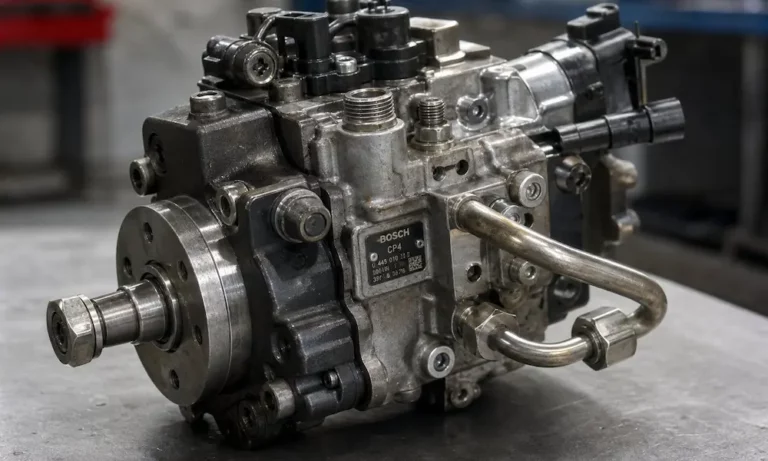
GM equipped the 2011–2016 LML Duramax with the Bosch CP4.2 high-pressure fuel pump. It looked good on paper — smaller, lighter, and more efficient than its predecessor. But in real-world North American conditions, it’s a disaster waiting to happen.
Here’s the core problem: the CP4 uses the fuel itself as its only lubricant. The pump’s internal roller bearings ride directly against hardened cam lobes with nothing but a thin film of diesel keeping them apart. In Europe, where the pump was designed and tested, diesel fuel carries enough natural lubricity to maintain that film.
In the U.S.? Not so much.
American ultra-low sulfur diesel is refined through a hydrotreating process that strips sulfur — and most of the fuel’s natural lubricity along with it. The CP4 can’t tolerate this consistently dry fuel. The roller bearings start to drag instead of roll. Once that fluid film breaks down, metal grinds against metal, and the pump begins machining itself from the inside out.
The Contamination Cascade Nobody Talks About Enough
The real nightmare isn’t the pump failure itself — it’s what happens next.
The LML uses a closed-loop, high-pressure fuel architecture. When the CP4 disintegrates, it sends fine crystalline steel shavings downstream at up to 29,000 PSI — straight into your fuel rails, all eight piezoelectric injectors, the pressure regulator, and eventually back into your fuel tank. Every component in that loop gets contaminated.
Here’s what failure actually looks like from the driver’s seat:
| Symptom | What It Means |
|---|---|
| Sudden loss of throttle response | Pump can’t maintain rail pressure; ECM limits fuel delivery |
| Hard start or no-start | Internal scoring prevents minimum pressure buildup |
| Stalling at idle | Debris-jammed pressure regulator causes erratic fuel pressure |
| Heavy exhaust smoke | Damaged injectors leak raw fuel into cylinders |
| Glittery flakes in fuel filter | Steel shavings confirm full system contamination |
What This Failure Actually Costs You
A full factory-approved repair means replacing the pump, all eight injectors, both fuel rails, high-pressure lines, the pressure regulator, the return line assembly, and deep-cleaning the fuel tank. That repair bill runs between $10,000 and $18,000 — and your truck sits in a shop for weeks.
This failure pattern was widespread enough that it triggered major class-action litigation against GM. A $50 million settlement received final approval in May 2025, providing limited warranty extensions through May 7, 2026 for some owners. But the settlement didn’t redesign the pump. The vulnerability is still there for anyone who hasn’t addressed it.
Stop-Gap Option: The Fuel System Saver
Not ready for a full conversion yet? The Exergy Fuel System Saver buys you time. It replaces the factory 80-micron screen with dual 25-micron filters. When the CP4 starts shedding debris, the fine mesh clogs intentionally, starving the rails of pressure and shutting the engine down before metal reaches your $3,000 injectors. It won’t save the pump, but it can save everything downstream from it.
Why the CP3 Pump Solves This Problem Permanently
The Bosch CP3 pump powered the LBZ and LMM Duramax generations and earned a rock-solid reputation over nearly two decades of heavy-duty use. It’s everything the CP4 isn’t.
The CP3 uses a three-piston radial design instead of the CP4’s two-piston layout. That triangular arrangement distributes mechanical stress far more evenly. Its bearing clearances and cam lobe profiles are built with greater tolerances, making it genuinely compatible with low-lubricity U.S. diesel fuel.
The Graceful Failure Advantage
When a CP3 eventually wears out — typically well over 200,000 miles — it loses sealing tolerances gradually. You’ll notice extended cranking times and harder starts as rail pressure slowly drops. It doesn’t generate metal debris. Your injectors and fuel rails stay clean. You replace the pump, and you move on.
That’s the difference between a $600 pump replacement and an $18,000 fuel system overhaul.
Performance Headroom the CP4 Can’t Touch
The CP4 maxes out around 500 rear-wheel horsepower before it can’t maintain rail pressure. The CP3 blows past that — and it scales far higher with pump modifications:
| Pump Configuration | Max Supported HP | Best For |
|---|---|---|
| Factory CP4.2 | ~500 HP | Stock only |
| Standard CP3 | 600–650 HP | Daily driving, heavy towing |
| 10mm Stroker CP3 | ~750 HP | Upgraded turbos, larger injectors |
| 12mm Stroker CP3 | ~1,000 HP | High-output builds |
| 14mm Stroker CP3 | 1,200+ HP | Dedicated competition use |
Is an LML CP3 Conversion Legal?
This is where a lot of people either get it right or get themselves into expensive trouble. Short answer: it depends entirely on which kit you buy and how you install it.
The Federal Clean Air Act Anti-Tampering Rules
The EPA’s Clean Air Act anti-tampering provisions make it a federal offense to remove, bypass, or disable any emissions control device on a motor vehicle. That includes your diesel particulate filter, your EGR system, your selective catalytic reduction system, and the diesel oxidation catalyst.
Penalties aren’t just a slap on the wrist. Selling or installing defeat devices carries civil penalties over $5,000 per device and up to $45,000 per noncompliant vehicle in serious cases.
Early CP3 conversion kits bypassed the “ninth injector” — the exhaust hydrocarbon doser that feeds the diesel particulate filter regeneration process. These kits were cheap, but they were illegal. Driving one in most states means a failed emissions inspection and a suspended registration.
The CARB Executive Order: Your Legal Green Light
The California Air Resources Board Executive Order system is the gold standard for aftermarket emissions compliance. A manufacturer must prove through laboratory testing that their kit doesn’t alter certified emissions output or affect onboard diagnostics. If it passes, CARB issues an Executive Order number that makes the product legal in all 50 states.
If a conversion kit doesn’t have an Executive Order, don’t install it on a street-driven vehicle.
The Ninth Injector Engineering Challenge
Here’s what makes compliant LML CP3 conversion kits genuinely clever. The LML’s diesel particulate filter relies on active regeneration — a process where the engine control module commands the ninth injector (mounted in the exhaust downpipe) to spray raw diesel fuel into the exhaust stream, creating the extreme heat needed to incinerate trapped soot.
The CP3 pump has no internal port for this ninth injector — it predates diesel particulate filters entirely. Early conversions just plugged the feed line, killed the DPF, and required illegal software tuning to prevent the truck from going into limp mode.
The solution from compliant manufacturers is a cascade distribution block — a precision-machined billet aluminum component that mounts to the top of the CP3 pump in place of the standard overflow valve. It splits the returning low-pressure fuel and routes a calculated portion directly to the ninth injector feed line, maintaining factory flow and pressure specs. The ECM never knows anything changed. No tuning required. DPF regenerations run exactly as GM intended.
Choosing Your LML CP3 Conversion Kit
Two manufacturers lead the market on emissions-compliant LML conversions.
S&S Diesel Motorsport
S&S Diesel holds CARB Executive Order D-756 (with multiple revisions) — the first issued for an LML CP3 retrofit. Their 50-state legal kit includes a factory-calibrated CP3 pump modified to match the LML’s precise fuel delivery curve. The ECM detects no hardware changes, and no aftermarket tune is needed. Retail typically lands between $2,500 and $2,800.
They also offer off-road-only kits with stroker pumps for track and pulling applications where emissions compliance isn’t required.
Fleece Performance Engineering
Fleece holds CARB Executive Order D-834-1 and carries design patents for their hardware configurations. Their kits use pre-formed, custom-molded low-pressure fuel hoses rather than straight universal hoses — a detail that matters for long-term reliability and fitment.
Their lineup covers three key options:
- FPE-LML-CP3-WP (With Pump): Full 50-state legal kit, standard CP3, no tune needed — best for daily drivers and towers
- FPE-LML-CP3-NP (No Pump): All the proprietary hardware without the pump — good if you’re sourcing your own CP3
- FPE-LML-CP3-10 (Heavy Duty): Includes a 10mm stroker CP3 for high-performance builds with upgraded turbos and injectors
Other solid hardware providers include Wehrli Custom Fabrication, Industrial Injection, Dan’s Diesel Performance, and John C Garage, which frequently pair their mounting hardware with pumps calibrated by S&S or Exergy.
Lift Pumps: Don’t Skip This Step
Industry experts universally recommend installing an aftermarket low-pressure lift pump alongside your CP3 conversion. The factory LML has no electric lift pump — the injection pump pulls fuel under vacuum from the tank, which makes it vulnerable to air ingestion and adds unnecessary strain.
Brands like FASS and AirDog mount near the fuel tank and push fuel under steady positive pressure. They also include multi-stage filtration down to 2 microns and vapor separation to eliminate entrained air — both critical for extending CP3 and injector life.
Don’t Overpressure Your CP3
There’s an important pressure ceiling you must respect. The CP3 has a Fuel Control Actuator — an electromagnetic valve that regulates fuel entering the high-pressure chambers. Too much incoming pressure forces it open, floods the pump, and causes violent rail pressure spikes. The result is engine surging, erratic idle, and unpredictable throttle.
- Standard CP3: Lift pump pressure must not exceed 11 PSI
- 10mm Stroker CP3: Must not exceed 2 PSI — the actuator is far more sensitive on modified pumps
If you want to run higher lift pump pressures with a stroker, you’ll need custom ECM tuning or a low-rate pressure spring to compensate.
What the Installation Actually Involves
A professional LML CP3 conversion takes 12–14 hours of labor. It’s not a Saturday afternoon job — the CP3 sits deep in the engine valley, and accessing it means pulling a significant portion of the intake and cooling system.
Here’s the condensed version of what happens:
Teardown: The intake piping, coolant surge tank, charge air cooler pipes, cooling fan, AC compressor, alternators, EGR cooler, and intake Y-bridge all come out to expose the CP4 pump.
Extraction: High-pressure fuel lines, low-pressure feed and return lines, and the ninth injector supply line all disconnect. The CP4 lifts out. The drive gear transfers to the new CP3 at exactly 75 ft-lbs — never over-torque it.
Cascade block assembly: The standard overflow valve removes from the CP3. The cascade distribution block installs with a banjo bolt torqued to exactly 20 ft-lbs. The green fuel temperature sensor transfers to the cascade block. A pre-formed fuel line routes from the cascade block to the ninth injector feed.
Installation and torque specs: The adapter plate O-rings get a heavy coat of clean engine oil. The assembly drops into the block and torques to 18 ft-lbs. The new high-pressure line connects at 28 ft-lbs at the pump and 22 ft-lbs at the fuel rail. The secondary rail port gets a steel block-off plug at 22 ft-lbs.
Reassembly: Everything goes back in reverse order. The cooling system refills — a vacuum-fill tool prevents air pockets in the EGR cooler.
Priming: The manual priming plunger on the fuel filter housing pumps until firm. The bleeder screw releases trapped air. The engine cranks in 10-second intervals until rail pressure builds.
Forced regeneration — don’t skip this: Once the engine runs clean and leak-free, a diagnostic scan tool connects to the OBD port to command a manual DPF regeneration. This purges any air from the new dosing line. Skip this step and you’ll likely trigger a check engine light, disable the aftertreatment system, and eventually land in limp mode — which is exactly the outcome you paid $2,500+ to avoid.
The Bottom Line on LML CP3 Conversions
The factory CP4.2 pump is a genuine liability on every 2011–2016 LML Duramax. It doesn’t wear out gracefully — it self-destructs and takes your entire fuel system with it. A properly executed LML CP3 conversion from a CARB-certified manufacturer like S&S Diesel or Fleece Performance replaces that liability with proven durability, better fuel flow, and a failure mode that gives you warning instead of a catastrophic repair bill.
Buy a kit with an Executive Order number. Install it with a lift pump. Do the forced regeneration. That’s the formula.