Got a check engine light and a code reader showing Nissan P0011? That single code can mean anything from dirty oil to a dying engine — and knowing the difference saves you serious money. This guide breaks down every cause, symptom, and fix so you don’t throw parts at a problem you don’t understand. Read to the end before you touch anything.
What Is the Nissan P0011 Code?
Nissan P0011 means your engine’s intake camshaft on Bank 1 is over-advanced — it’s opening intake valves earlier than the computer commanded. Your engine control module (ECM) spotted the gap between what it ordered and what actually happened, then flagged the fault.
This isn’t a sensor glitch you can ignore. The variable valve timing (VVT) system controls how your engine breathes at every RPM. When it’s wrong, everything from idle quality to fuel economy takes a hit.
Which Nissans Get This Code?
P0011 shows up across a wide range of Nissan and Infiniti models. If your car has a VVT system — and most built after 2002 do — you’re not immune.
Common models include:
- Nissan Altima (2002–present)
- Nissan Maxima
- Nissan Murano
- Nissan Pathfinder
- Nissan 350Z / 370Z
- Infiniti G35 / G37
- Infiniti FX35 / FX45
How the Variable Valve Timing System Works
Your Nissan’s VVT system uses pressurized engine oil as its working fluid. Here’s the simple version of how it operates:
- The ECM reads data from the crankshaft sensor, camshaft sensor, and coolant temp sensor
- It calculates an ideal camshaft angle for your current speed and load
- It sends a signal to the intake valve timing (IVT) solenoid
- The solenoid directs oil pressure into the camshaft phaser
- The phaser rotates the camshaft to hit the target angle
P0011 fires when the camshaft stays advanced even after the ECM tells it to pull back. The system isn’t responding — and that “why” is what your diagnosis needs to find.
| Component | Job | What Goes Wrong |
|---|---|---|
| IVT Solenoid | Controls oil flow to the phaser | Sticks open; clogged filter screen |
| Camshaft Phaser | Physically rotates the camshaft | Sludge buildup; internal wear |
| Engine Oil | The hydraulic fluid for the whole system | Low level, wrong viscosity, or dirty |
| Camshaft Position Sensor | Reports actual cam angle to the ECM | Metal debris causes false readings |
| Timing Chain | Mechanically links crank to cam | Stretches over time, causing sync errors |
The Most Common Causes of Nissan P0011
1. Dirty or Low Engine Oil
This is the number-one cause — and it’s often the cheapest fix. When oil gets old and thick, it clogs the tiny mesh screens on the IVT solenoid. Those screens protect the solenoid’s internal plunger from debris.
Once clogged, oil pressure can still push the camshaft into an advanced position. It just can’t drain back out fast enough. The cam stays advanced. The ECM sees the gap. P0011 sets.
Check your oil first. If it’s dark, gritty, or low, change it before doing anything else. Many P0011 codes disappear after a fresh oil and filter change.
2. Wrong Oil Viscosity
Nissan specifies exact oil weights — usually 0W-20 or 5W-30 depending on the model. Using heavier oil makes the fluid move too slowly through the small passages in the VVT system. The ECM interprets that sluggish response as a performance failure and logs P0011.
Always verify you’re running the manufacturer-specified viscosity — especially after a shop oil change.
3. Faulty IVT Solenoid
The solenoid is the next suspect if fresh oil doesn’t fix the code. A common trap here: the solenoid passes a resistance test (5–15 ohms is normal) but fails mechanically under heat and pressure.
Worse, a solenoid stuck in the open position sends a constant stream of oil to the phaser. The camshaft locks in maximum advance. That’s why rough idle and stalling are so common with this code.
4. Stretched Timing Chain
Timing chains are built to last, but they do stretch — especially with poor lubrication history. Even a few degrees of slack creates a physical misalignment between the crankshaft and camshaft. The ECM reads that misalignment as over-advanced timing.
If you hear a rattle from the front of the engine on cold starts, your timing chain is talking to you. Don’t ignore it.
5. Faulty Camshaft Position Sensor
Metal shavings from normal engine wear can stick to the tip of the camshaft position sensor. That debris distorts the magnetic signal and sends the ECM incorrect angle data. The fix here is often just cleaning or replacing the sensor — a relatively inexpensive repair.
The VQ Engine Oil Gallery Gasket Problem (350Z, 370Z, G35, G37)
This one deserves its own section because it’s a well-documented failure that catches owners completely off guard.
What Fails and Why
VQ35 and VQ37 engines built between 2003 and 2012 have two metal plates behind the front timing cover that house the oil galleries feeding the VVT solenoids. Nissan originally sealed these plates with paper gaskets.
After thousands of heat cycles, those gaskets blow out. And here’s the sneaky part: there’s no external oil leak. The oil pressure just bleeds back into the oil pan internally. Your dashboard oil pressure warning won’t even trigger — it typically activates below 5 PSI. But the VVT system needs at least 14–15 PSI at warm idle to function.
The result? Both phasers can’t move correctly, and both P0011 and P0021 set simultaneously. The engine drops into limp mode.
How to Confirm It
The diagnostic signature is straightforward:
- Both P0011 and P0021 are present at the same time
- A mechanical oil pressure test shows below 14 PSI at warm idle
- Oil level and solenoids check out fine
Nissan eventually released updated metal-reinforced gaskets to fix this design flaw. The repair requires removing the timing cover — it’s a major job, but it’s the only real fix.
Nissan P0011 Symptoms You’ll Actually Notice
| Symptom | What’s Causing It | How Bad Is It? |
|---|---|---|
| Rough idle / stalling | Cam stuck advanced; exhaust gases diluting intake charge | High — affects safety |
| Sluggish acceleration | Valves opening at the wrong time; lost torque | Medium — dangerous when merging |
| Engine knock or ping | Premature ignition from mistimed valves | High — causes internal damage |
| Limp mode (3,000 RPM limit) | ECM protecting engine from catastrophic failure | High — can leave you stranded |
| Poor fuel economy | Inefficient valve timing at all load points | Low — long-term cost |
| Failed emissions test | Excess NOx and unburned hydrocarbons | Medium — legal/registration issue |
The rough idle happens because over-advanced timing at low RPM lets exhaust gases back into the intake manifold. That dilutes the fresh air-fuel mix and causes combustion instability.
How to Diagnose Nissan P0011 Step by Step
Step 1: Pull the Codes and Check the Oil
Use an OBD-II scanner and confirm P0011 is present. Note any companion codes — P0021, P0340, or P0345 all point toward specific subsystems.
Then check the oil. Level low? Top it off. Oil dark and thick? Change it. This step alone resolves a surprising number of P0011 cases. Clear the code after the oil change and drive it before assuming you need parts.
Step 2: Test the Solenoid Electrically and Physically
Remove the IVT solenoid and check its resistance with a multimeter — you’re looking for 5–15 ohms at room temperature.
Then apply 12 volts directly to the solenoid terminals. You should hear a sharp, crisp click as the plunger snaps. A dull, muffled click — or no movement — means the solenoid is bad and needs replacement.
Also inspect the solenoid’s mesh screen for sludge or debris. A partially clogged screen can cause intermittent P0011 faults that don’t show up on basic electrical tests.
Step 3: Use CONSULT-III Plus for Active Testing
Nissan technicians use the CONSULT-III plus diagnostic tool for an active test that confirms whether the VVT system responds to commands.
During the active test, the tech monitors two values:
- INT/V SOL — solenoid duty cycle
- INT/V TIM — actual camshaft timing angle
Commanding 100% duty cycle should cause the engine to run very roughly or stall as timing advances. If the timing angle doesn’t move or responds slowly, the problem sits in the solenoid, oil passages, or phaser itself.
Step 4: Run a Mechanical Oil Pressure Test
If you’re dealing with a VQ engine or both P0011 and P0021 are set, connect a mechanical pressure gauge and measure pressure at warm idle. The VVT system needs at least 14 PSI to operate. Anything below that points toward internal pressure loss — and the gallery gaskets are the likely culprit.
| Diagnostic Step | Tool | What You’re Looking For |
|---|---|---|
| Retrieve DTCs | OBD-II scanner | Confirm P0011; note companion codes |
| Oil inspection | Visual check | Level, color, viscosity |
| Solenoid resistance | Multimeter | 5–15 ohms |
| Solenoid activation | 12V jumper | Sharp, audible click |
| VVT active test | CONSULT-III | Timing angle responds to duty cycle |
| Oil pressure | Mechanical gauge | Min 14 PSI at warm idle |
Repair Costs: What You’re Actually Looking At
Quick Fixes (Under $150)
An oil and filter change runs $80–$150 at a shop or $30–$70 if you do it yourself. Always start here.
Mid-Range Repairs ($150–$450)
Replacing the IVT solenoid is the most common repair. OEM solenoids cost $100–$250 — avoid cheap aftermarket units, they often fail early and communicate poorly with Nissan’s ECM. Add $100–$200 for labor. Camshaft position sensors fall in a similar range.
Major Work ($1,200–$2,500+)
A full timing chain service — chain, tensioners, guides, and water pump — runs $1,500–$2,500 at a professional shop.
Repairing the oil gallery gaskets on a VQ engine takes 7–10 hours of labor. Total bill: $1,200–$2,000. Expensive? Yes. But it’s a fraction of what a destroyed engine costs.
What Happens If You Keep Driving with P0011
Don’t. Here’s what’s at risk:
Engine damage: Nissan engines are interference engines. If the timing chain snaps or skips teeth, the pistons hit the open intake valves. That means bent valves, cracked pistons, and potentially a destroyed engine block.
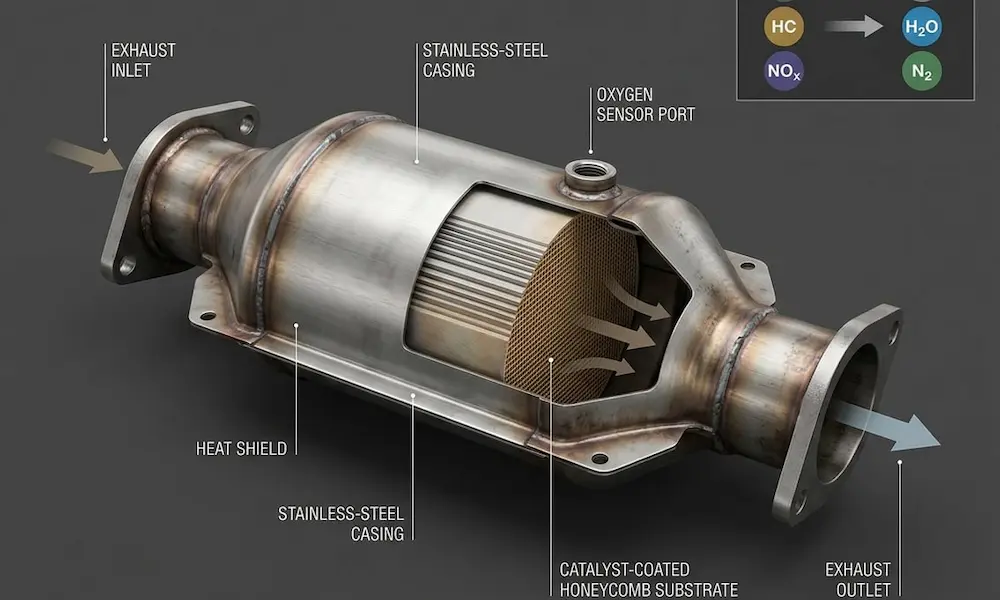
Catalytic converter damage: Unburned fuel entering the exhaust stream degrades the catalytic converter — an expensive component on its own.
Safety risks: A car that stalls at intersections or loses power during highway merges is genuinely dangerous. Limp mode can also leave you unable to maintain highway speeds.
How to Prevent Nissan P0011 from Coming Back
The VVT system runs on oil. Your maintenance habits directly determine whether this code comes back.
Change your oil on time — or early. High-performance VQ engines benefit from shorter oil change intervals, especially in hot climates or heavy stop-and-go traffic. Sludge from old oil clogs solenoid screens — that’s the root cause of most P0011 cases.
Use the right oil. Always match the viscosity your owner’s manual specifies. Don’t let a shop substitute a heavier weight because “it’s what they had.”
Install an oil pressure gauge if you own a VQ. Monitoring your oil pressure at warm idle gives you early warning of gallery gasket failure — before the P0011 code even sets. If pressure trends toward 14 PSI, take it seriously.
Plan a proactive timing chain service at high mileage. Bundling the gallery gaskets, timing chain, tensioners, and water pump into one job saves labor costs and buys you another 100,000 miles of reliable operation.
The Nissan P0011 code is a message, not a death sentence. Catch it early, start with the oil, and work through the diagnostics in order. Most of the time, the fix is simpler — and cheaper — than it looks.