Picking the wrong gear oil can quietly destroy your differential. This guide breaks down the real differences between 75W90 and 75W140, so you can make the right call for your truck, Jeep, or tow rig. Whether you’re crawling trails or hauling a trailer every weekend, stick around — the answer might surprise you.
What Those Numbers Actually Mean
Before you pick a winner in the 75W90 vs 75W140 debate, you need to know what you’re reading.
Both grades fall under the SAE J306 standard, which governs viscosity ratings for gear oils — not engine oils. A lot of people mix these two scales up. Don’t. An SAE 75W-90 gear oil is actually very close in thickness to a 10W-40 engine oil. The numbers look bigger, but they measure differently.
Here’s how to read the label:
- 75W = the “W” stands for winter. It tells you how the oil flows in cold temperatures.
- 90 or 140 = the hot-side number. It tells you how well the oil resists thinning at high operating temperatures.
So the higher the second number, the thicker the oil stays when things heat up. That’s the core of the 75W90 vs 75W140 comparison.
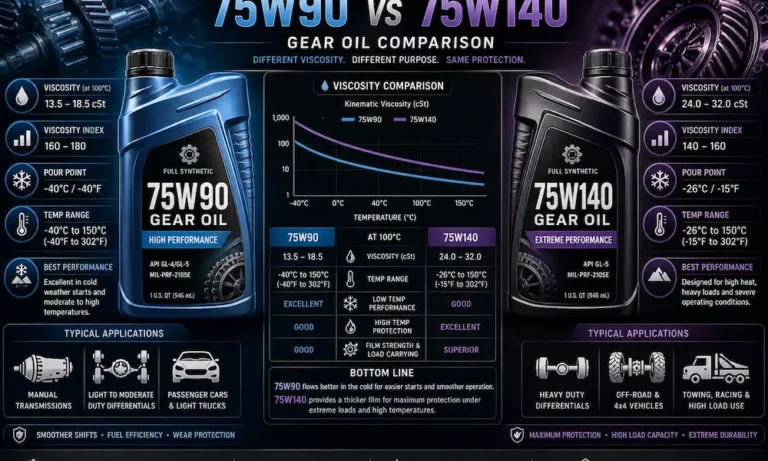
Both grades share the same 75W cold-weather rating — meaning they flow equally well at -40°F. The real difference shows up once your axle gets hot.
| Property | SAE 75W-90 Synthetic | SAE 75W-140 Synthetic |
|---|---|---|
| Kinematic Viscosity @ 40°C | ~100.0 cSt | ~178.0 to 193.2 cSt |
| Kinematic Viscosity @ 100°C | ~15.4 cSt | ~27.0 to 27.6 cSt |
| Viscosity Index | 163 to 166 | 180 to 194 |
| Pour Point | -40°F (-40°C) | -40°F to -51°F |
| Flash Point | 410°F (210°C) | 410°F to 420°F |
The 75W140 is nearly twice as thick at operating temperature. That extra thickness is exactly what protects your ring and pinion under extreme stress — but it also comes with trade-offs.
How These Oils Behave at High Temperatures
Here’s something that trips a lot of people up: gear oil doesn’t thicken as it heats up. It actually gets thinner. Both 75W90 and 75W140 thin out as your axle warms up. The difference is how well each one resists that thinning.
The 75W140 uses a heavier concentration of polymer additives called viscosity index improvers to maintain that thicker film at high temperatures. The problem? Those polymers can break down under mechanical shearing forces inside your differential.
This process is called shear degradation. Over time, a sheared 75W140 can drop in viscosity until it’s behaving close to a 75W90 anyway. That’s why heavy-duty applications with 75W140 often call for shorter change intervals around 12,000 miles to keep protection levels where they need to be.
The 75W90 doesn’t stretch as far across the viscosity range, so it relies less on those polymers. It’s more stable over time, which is one reason manufacturers love it as a factory fill.
The Towing and Heavy-Duty Case for 75W140
If you tow regularly, haul max payloads, or spend weekends rock crawling, 75W140 exists specifically for you.
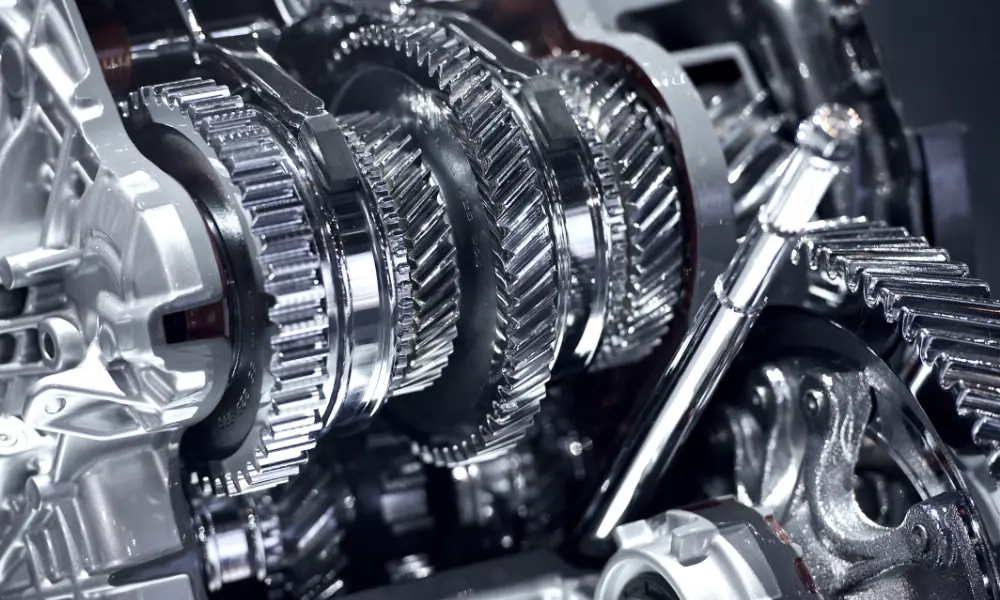
Most modern axles use a hypoid gear design. The pinion sits below the ring gear centerline, which creates a sliding friction action on top of normal rolling contact. That sliding generates intense heat and pressure at the gear mesh. Under light loads, 75W90 handles it fine. Under sustained heavy load — like towing a 15,000-pound trailer up a mountain grade — you need a thicker fluid film standing between your gears and metal-to-metal contact.
AMSOIL’s 75W-140 product data describes this protection layer as a physical barrier against gear scoring, bearing wear, and micro-pitting. Those aren’t minor issues. Ring and pinion replacement typically runs $800 to $2,000 in parts alone before labor.
Heavy-duty scenarios where 75W140 makes sense:
- Consistent towing near or at max capacity
- Off-road rock crawling or trail driving
- Steep mountain passes with loaded trailers
- Sustained extreme heat conditions
- Modified trucks with larger tires or suspension lifts
The extra protection is worth the minor fuel economy hit in every one of these situations.
The Fuel Economy and Churning Loss Reality
There’s a real downside to 75W140 that you should know about. Thicker oil creates more internal drag inside your differential housing.
As your ring gear spins through the oil pool, it has to shear through the fluid. This energy loss is called churning, and it converts mechanical power directly into heat. With 75W140, that churning loss is noticeably higher than with 75W90 during normal highway cruising.
The U.S. Army’s Tank Automotive Research, Development and Engineering Center actually tested this. In controlled evaluations, lighter gear oils in the 75W90 range produced measurable fuel savings compared to heavier grades across large vehicle fleets. That’s why the military cares — when you’re moving thousands of vehicles, those fractions of a mile per gallon add up fast.
This is also why most manufacturers now ship trucks from the factory with 75W90 or even lighter 75W85. Automakers must hit Corporate Average Fuel Economy targets, and lighter gear oil recovers a measurable fraction of fuel efficiency. It’s an engineering compromise — great for the sticker, but thinner on safety margin when you start towing hard.
If you run 75W140, consider a few things to manage heat:
- Install an aluminum finned differential cover to increase oil capacity and dissipation
- Use a full synthetic base oil — it handles thermal stress and oxidation far better than conventional oil
- Stick to shorter fluid change intervals to catch shear-degraded oil before it loses protection
GL-4 vs GL-5: Don’t Get This Wrong
Viscosity grade is only half the equation. The API service classification matters just as much.
GL-5 is what most modern hypoid differentials require. It contains a high concentration of sulfur-phosphorus extreme-pressure additives — typically three to four percent. Under high-load sliding contact, those additives chemically react with the gear steel to form a sacrificial protective layer. Without it, your gears weld together microscopically and then tear apart. That’s scuffing, and it destroys axles fast.
GL-4 uses roughly half that additive concentration. It’s designed for manual transmissions with brass or bronze synchronizers. Here’s the critical part: never run GL-5 in a manual transmission with copper-alloy synchronizers. The sulfur-phosphorus additives in GL-5 chemically attack those soft metals, eating your synchros alive. You’ll notice grinding and rough shifts before the damage becomes obvious.
For differentials, always verify:
- Your axle’s API rating requirement (most differentials need GL-5)
- Whether your differential is a limited-slip (LSD) — these need specific friction modifiers to prevent clutch chatter
- Many modern synthetic 75W90 and 75W140 oils come pre-blended with LSD additives, but confirm before you buy
What Your Truck Actually Calls For
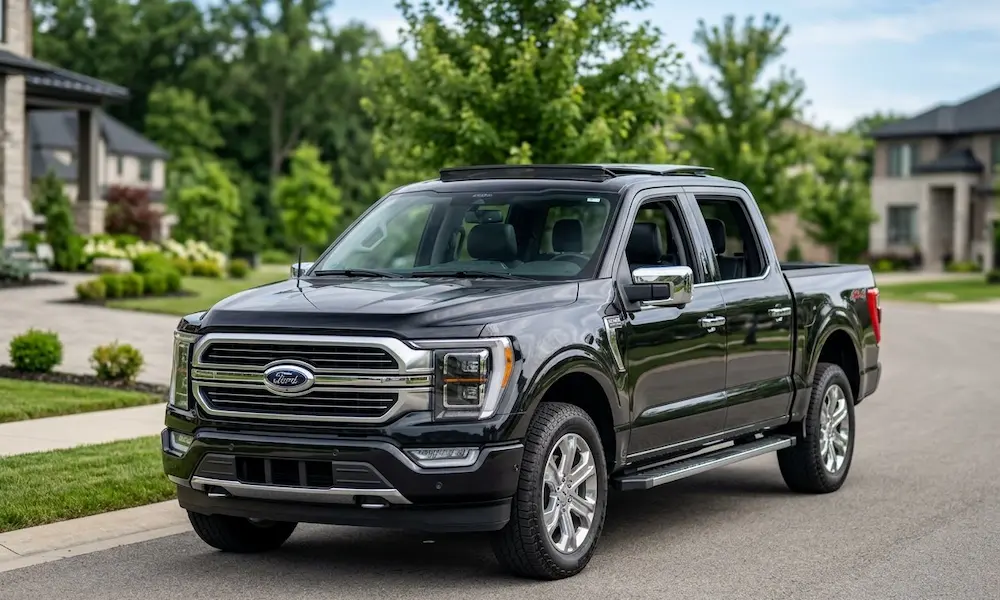
Here’s what several popular trucks specify from the factory. Always verify in your owner’s manual first.
| Vehicle | Axle | OEM Spec | Fluid Grade |
|---|---|---|---|
| Ford F-250/F-350 (10.5-inch rear) | Sterling 10.5 | WSL-M2C192-A | 75W-140 Synthetic |
| Ford F-350 (Dana M80 rear) | Dana M80 | WSS-M2C918-A | 75W-90 Synthetic |
| Ford F-450/F-550 (Dana S110/S130) | Dana S110/S130 | WSL-M2C192-A | 75W-140 Synthetic |
| Chevy Silverado 2500 (2020+) | Rear axle | GM 75W-90 GL-5 | 75W-90 Synthetic |
| Ram 2500 (select models) | Rear axle | MS-8985 | 75W-90 or 75W-85 |
| Nissan Xterra S (C200 axle) | Rear | OEM Manual | 75W-90 Synthetic |
| Nissan Xterra Pro-4X (M226 axle) | Rear | OEM Manual | 75W-140 Synthetic |
| Jeep Wrangler Dana 44 (towing) | Rear | OEM Manual | 75W-140 Synthetic |
Notice the pattern. Heavier-duty axles paired with higher tow ratings get 75W140 from the factory. Lighter axles or vehicles with fuel economy priority get 75W90.
Can You Mix 75W90 and 75W140?
Technically, yes. Since both share the same 75W cold rating and typically use compatible synthetic base stocks, accidentally mixing them won’t immediately damage your axle. The resulting viscosity just lands somewhere between the two grades.
That said, East Coast Gear Supply strongly recommends against mixing different brands, even within the same viscosity grade. Mismatched additive packages can cause foaming, accelerated oxidation, and unpredictable film strength under load. If you mixed brands by accident, it’s not an emergency — but drain and refill with a single product at your next service.
One more thing to keep in mind: never use gear oil in your transfer case. Most modern transfer cases need automatic transmission fluid, not gear oil. Getting that wrong causes clutch engagement failures and internal wear that often goes unnoticed until it’s expensive.
The Simple Answer
Here’s the straightforward breakdown:
Choose 75W90 if you:
- Drive daily with light to moderate loads
- Don’t tow regularly or stay well under your max tow rating
- Care about fuel economy
- Live in a cold climate and want smooth cold-start behavior
Choose 75W140 if you:
- Tow near max capacity on a regular basis
- Off-road seriously — rock crawling, trail running, sand
- Run oversized tires or a lifted suspension that increases drivetrain stress
- Haul maximum payloads through hilly or mountainous terrain
- Want maximum protection and don’t mind a minor efficiency trade-off
The fuel economy difference between these two grades is real but small in everyday driving. The protection difference under severe load is substantial. Pick the fluid that matches what you actually do with your truck — not what the factory defaulted to for fuel economy numbers on a window sticker.