That little tire pressure warning light on your BMW dashboard? It’s trying to tell you something — and ignoring it can cost you way more than a simple sensor swap. This guide walks you through everything: what breaks, why it breaks, how to fix it, and how much you’ll actually pay.
What Kind of TPMS System Does Your BMW Have?
Before you replace anything, you need to know what you’re working with. BMW uses two completely different systems.
Indirect TPMS (RPA/Flat Tire Monitor): This is a software-based system. It doesn’t measure air pressure at all. Instead, it watches wheel spin speeds through the ABS sensors. A soft tire spins faster than a properly inflated one, and the system catches that difference. No sensors inside the wheels means no batteries to die — but it also can’t show you actual PSI numbers, and it won’t catch it if all four tires lose pressure equally.
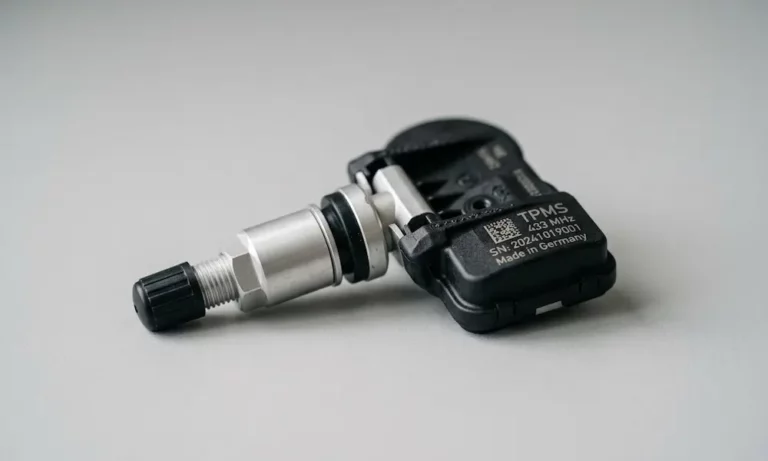
Direct TPMS (RDC): This is what most modern US-market BMWs use. Battery-powered sensors sit inside each wheel on the valve stem. They beam real-time pressure, temperature, and sensor ID data to the car’s receiver. Your iDrive screen shows each wheel color-coded for status. The tradeoff? Batteries die, and sensors can break during tire changes.
| System | How It Works | Shows PSI? | Battery Needed? |
|---|---|---|---|
| Indirect (RPA) | Wheel speed comparison via ABS | No | No |
| Direct (RDC) | Physical sensors transmit data | Yes | Yes |
Picking the Right Replacement Sensor (This Is Where Most People Mess Up)
Getting the wrong sensor is the #1 reason BMW TPMS resets fail. There are two variables that have to match perfectly: radio frequency and communication protocol.
315 MHz vs. 433 MHz
BMW has used both frequencies. The 433 MHz band is the current standard for North American models. Older chassis or certain imports may still use 315 MHz. Putting a 433 MHz sensor in a 315 MHz car is a guaranteed failure.
The September 2010 Protocol Shift
Here’s a tricky one. Around September 2010, BMW changed the data protocol for the 1 Series, 3 Series, and 5 Series — even though the frequency stayed at 433 MHz. A 2011 E90 built in August 2010 needs a different sensor than the same car built in October 2010. Yes, really.
That’s why your 17-digit VIN is non-negotiable when ordering parts. Don’t guess. Don’t go by model year alone.
Which Manufacturer Made Your Sensors?
| BMW Generation | Example Models | Frequency | Sensor Brand |
|---|---|---|---|
| E-Series | E46, E90, E60, E70 | 433 MHz | Beru / Huf |
| F-Series | F30, F10, F25, F15 | 433 MHz | VDO / Huf |
| G-Series | G20, G30, G05, G11 | 433 MHz | PAL / Schrader |
Why BMW TPMS Sensors Fail
Sensors don’t last forever. Here’s what actually kills them.
Dead Batteries
The most common cause by far. Each sensor has a sealed internal lithium battery that typically lasts 7–10 years. You can’t swap the battery without replacing the whole sensor. If your BMW is pushing 8+ years old and a sensor dies, plan on replacing all four — the others are right behind it.
Cold climates accelerate battery drain. Northern US winters are particularly rough on sensor longevity.
Physical Damage During Tire Changes
This one’s avoidable — but only if your tire shop knows what they’re doing. A bead breaker exerts enormous force. If the technician positions the wheel wrong, the bead breaker can crush the sensor body or snap the valve stem entirely. Reputable shops apply the bead breaker 180 degrees opposite the valve stem to protect the sensor. If yours didn’t — that’s probably why you’re reading this article.
Corrosion and Tire Sealants
Aluminum valve stems react badly with road salt and moisture. The stem corrodes, valve caps seize, and removal becomes destructive. Metal valve caps in heavy-salt regions make this worse. Stick with plastic caps unless you’re checking them regularly.
Tire sealants are even worse. Chemical sealants like Fix-a-Flat can block the sensor’s pressure port entirely, blinding the sensor. If someone used sealant in your tire, that sensor is done.
Reading Your BMW’s Warning Signs
Your iDrive screen tells you more than just “there’s a problem.” Here’s how to read it:
- Flashing yellow light that turns solid + “Tire Pressure Monitor Malfunction” — system fault, not just low pressure
- Three green wheels, one gray — that specific sensor is dead or not transmitting
- No data on any wheel — could be a failed central RDC receiver module, not the sensors themselves
That last point is important. A faulty receiver module behind your trunk trim can kill the whole system. Before replacing four sensors, read the fault codes first.
| Diagnostic Code | Meaning | Action |
|---|---|---|
| C1210 | Sensor fault | Replace that wheel’s sensor |
| C1211 | Missing/invalid signal | Check for dead battery or interference |
| C1212 | Low battery warning | Replace proactively |
| C1213 | Communication error | Inspect receiver module and wiring |
A Bartec or Autel TPMS tool can wake up each sensor individually before any tires come off — confirming exactly which sensor is bad. Good shops do this audit first. If yours doesn’t, ask why.
How to Replace a BMW TPMS Sensor
Here’s the step-by-step process. Most BMW owners use a professional shop for this because aluminum alloy wheels are unforgiving of mistakes.
Step 1: Fully deflate the tire. Remove the valve core to speed this up.
Step 2: Break the bead 180 degrees away from the valve stem. This protects the sensor from being crushed.
Step 3: Access the sensor through the valve hole inside the rim.
Step 4: Install the new sensor using the two-stage torque process:
| Component | Tool | Torque Spec |
|---|---|---|
| Sensor-to-stem screw | Torx driver | 2 Newton-meters |
| Valve stem hex nut | 11mm/12mm deep socket | 4 Nm / 35 inch-pounds |
| Lug nuts | 17mm socket + torque wrench | 120–140 Nm (model specific) |
Over-tightening the hex nut strips the aluminum threads or distorts the rubber grommet. Use a torque wrench. It’s not optional.
Step 5: Install a fresh service kit — new grommet, washer, valve core, and cap. These cost almost nothing and prevent future leaks.
Step 6: Re-mount the tire and inflate to the pressure shown on your driver-side door jamb sticker.
Resetting and Relearning the System
A new sensor means nothing until your BMW’s computer recognizes it. The reset process varies by iDrive generation.
iDrive 7 or 8 (2018+): Go to Car → Vehicle Status → Tire Pressure Monitor → Perform Reset. The system enters a “Resetting” state. Drive above 20 mph for 10–15 minutes. The sensors use internal accelerometers to confirm wheel motion and transmit positioning data.
iDrive 4 or 5 (older F-series): Navigate to Vehicle Info → Vehicle Status → Reset TPM. Same driving requirement applies.
No iDrive screen (early E90, E82): Use the dashboard button or turn-signal stalk rocker switch. Hold until the yellow light flashes on the instrument cluster.
The computer isn’t just reading pressure during the relearn. It’s cross-referencing sensor IDs with ABS wheel speed data to figure out which sensor is on which corner. That’s why you have to actually drive the car — parking lot circles won’t cut it.
Why Your TPMS Reset Keeps Stalling
This is one of the most common frustrations with BMW TPMS. The progress bar hangs and never reaches 100%. Here’s what each stall point means:
| Progress % | What’s Happening | Likely Cause |
|---|---|---|
| 0% | System can’t see any sensors | Wrong frequency or unprogrammed sensor |
| 49% | Sensors detected but can’t be positioned | Faulty accelerometer, signal interference |
| 99% | Data received but values are implausible | Uneven tire pressures or temp anomaly |
A stall at 49% is the most common. One sneaky culprit: cheap USB phone chargers plugged into your power outlet can generate enough RF interference to scramble sensor communication. Unplug everything from your outlets before trying again.
A 99% stall usually means one tire is significantly different in pressure from the others. Pull over, check all four with a manual gauge, equalize the pressures, and retry.
What Does BMW TPMS Sensor Replacement Actually Cost?
Here’s the honest breakdown for US drivers:
| Service Level | Sensor Cost | Labor Per Wheel | Total Per Wheel |
|---|---|---|---|
| BMW Dealership | $175–$250 | $100–$150 | Up to $400 |
| Independent Shop | $70–$120 | $50–$100 | ~$220 |
| DIY (parts only) | $40–$70 | $0 | ~$70 |
The smartest money move? Bundle sensor replacements with new tires. The bead-breaking and balancing labor is already baked into the tire price. You pay for parts, not extra labor.
You’ll also see “star-marked” sensors. That star means BMW officially approved the part as factory-equivalent. They’re made by the same manufacturers — Huf, VDO, Schrader — but carry a price premium. The real benefit is guaranteed protocol compatibility, which cheap universal sensors from online marketplaces can’t always promise.
Temperature, Cold Weather, and False Alarms
Every fall, BMW service centers fill up with customers panicking about TPMS warning lights. Most of them don’t have a sensor problem at all. They have a physics problem.
Tire pressure drops about 1 PSI for every 10°F temperature decrease. A tire that was perfectly inflated in September at 70°F can easily trigger a warning by November when temps hit 30°F — that’s a 4 PSI drop. The TPMS warning threshold is a 25% drop from normal pressure.
Check your pressures manually with a quality gauge at least once a month. The system is a safety net for serious leaks — not a replacement for regular pressure checks. Inflating to the door jamb spec solves most cold-weather alerts instantly.
One more thing on maintenance: avoid metal valve caps in salt-heavy winter regions. They corrode and fuse to aluminum valve stems, and removing them becomes a destructive process that ruins the sensor hardware. Plastic caps do the job fine.
Proactive Replacement: The Smarter Long-Term Strategy
If your BMW is past the 7-year mark, don’t wait for sensors to fail one by one. Replace all four at the same time during a tire change. The math works out better, the labor’s already covered, and you won’t be back at the shop in six months with another dead sensor.
Use OEM-equivalent sensors from Huf, VDO, or Schrader. Match everything to your VIN. Torque to spec. Reset the system correctly. That’s the whole formula — no dealership markup required.