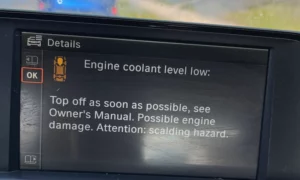
Ever seen that dreaded “Transmission Malfunction Drive Moderately” message light up your BMW’s dashboard? You’re cruising along when suddenly your car decides it’s time to panic. Your smooth-shifting luxury vehicle transforms into a clunky mess, leaving you wondering what went wrong and how to fix it without emptying your wallet.
What Causes BMW Transmission Malfunction Warnings?
BMW’s automatic transmissions are sophisticated systems that learn your driving habits. When the transmission control module gets confused, it triggers that anxiety-inducing warning message.
Common causes include:
- Battery issues: Surprisingly, about 85% of transmission warnings stem from low battery voltage. Even minimal voltage drops can trick sensors.
- Adaptation problems: The transmission’s “memory” of your driving style gets corrupted, causing rough or delayed shifting.
- Fluid issues: Low or degraded transmission fluid affects performance dramatically.
- Component wear: The mechatronic unit, solenoids, or clutch packs may be failing.
- Previous owner’s driving style: If you bought a used BMW, you might be fighting against someone else’s heavy-footed habits stored in the system.
Symptoms That Suggest You Need a Transmission Reset
How do you know if a simple reset might solve your problem? Watch for these telltale signs:
- The “Transmission Malfunction” warning appears intermittently
- Shifting feels rougher than usual
- Delayed engagement when accelerating
- Transmission “hunts” between gears
- Early or late downshifting
- Vehicle enters “limp mode” with limited gears
- Warning appears after battery replacement or service
If your BMW shows these symptoms without grinding noises, burning smells, or leaking fluid, a transmission reset might be your quick fix.
The DIY 30-Second Gas Pedal Reset Method
Before calling your mechanic, try this simple reset procedure that takes less than five minutes:
- Park your BMW on level ground
- Turn off all accessories (radio, AC, lights)
- Insert the key or push the start button once without pressing the brake (to activate electronics only)
- Press the gas pedal to the floor until you feel a click and hold for 30 seconds
- While still holding the pedal down, turn off the ignition
- Release the gas pedal
- Wait 2 full minutes (time it—this allows systems to fully reset)
- Start the vehicle normally
This process essentially reboots your transmission’s memory, clearing adaptation values that might be causing issues. Think of it as turning your computer off and on again when it misbehaves.
Using Diagnostic Tools for a Complete Reset
If the pedal method doesn’t work, more comprehensive options require specialized diagnostic equipment:
INPA Software Method
For tech-savvy BMW owners with access to BMW’s INPA software and a compatible cable:
- Connect a K+DCAN interface to your OBD-II port
- Launch INPA and select your BMW chassis type
- Navigate to the Transmission/Gearbox Control Module
- For E90 models: Press Shift+F8, select Transmission, then GS19
- Look for “reset adaption values” (typically under F3)
- Confirm the reset when prompted
- Exit software and restart your vehicle
This method directly communicates with your transmission module, providing a more thorough reset than the pedal method.
ISTA/ISTA+ Software Method
BMW’s newer diagnostic platform offers similar capabilities:
- Connect to your vehicle’s OBD port with a compatible interface
- Navigate to “Service Functions” → “Powertrain” → “Transmission Control”
- Select “Adjustment” then “Display and Reset Adaption Values”
- Follow the on-screen instructions
This method works best for newer BMW models, while older vehicles might require INPA instead.
The Critical Relearn Process
Attention: Resetting your transmission is only half the battle. The relearning process afterward is crucial for success.
After performing any reset method:
- Drive immediately (don’t let the car sit overnight)
- Include various driving conditions in the next 50-100 miles:
- Gentle starts from complete stops
- Moderate accelerations through multiple gears
- Highway cruising at steady speeds
- Both uphill and downhill driving
During this period, your transmission is creating a new memory profile. You might notice:
| Phase | What You’ll Experience | What’s Happening |
|---|---|---|
| Initial (0-20 miles) | Possibly rougher shifts than before | System gathering baseline data |
| Middle (20-50 miles) | Gradual improvement in shift quality | Fine-tuning adaptation values |
| Final (50+ miles) | Smoother operation, possibly different shift points | Completed adaptation process |
As one transmission specialist warns: “Don’t reset adaptations unless you have time and proper roads to complete the relearn process. Incomplete relearning can damage your transmission.”
When a Reset Won’t Work: Warning Signs
While resetting solves many transmission issues, it’s not a universal fix. Here’s when to skip the reset and call a professional:
- You hear metallic grinding or clunking sounds
- There’s a burning smell near the transmission
- You find red fluid leaks under your vehicle
- The transmission slips between gears even after reset attempts
- You see metal particles in the transmission fluid
- The malfunction warning returns immediately after reset
These symptoms suggest mechanical problems that no amount of electronic resetting will fix.
Preventive Measures to Avoid Future Transmission Warnings
Keep your BMW’s transmission happy with these preventive steps:
- Maintain battery health: Since low voltage is a leading cause of false warnings, have your battery tested regularly.
- Change transmission fluid on schedule: Follow BMW’s service intervals or consider more frequent changes if you drive in extreme conditions.
- Drive gently after cold starts: Allow the transmission fluid to warm up before aggressive driving.
- Address warning lights promptly: Early intervention prevents minor issues from becoming major repairs.
- Use BMW-approved transmission fluid: The wrong fluid can cause serious damage.
BMW-Specific Transmission Issues by Model Series
Different BMW series tend to have specific transmission quirks:
3-Series (E90/F30)
The ZF 6HP transmission in E90 models (2006-2011) frequently shows malfunction warnings due to mechatronic sleeve adaptation issues. The reset procedure works particularly well for these models.
5-Series (F10)
These models often experience transmission warnings related to the valve body. A reset combined with fluid change shows good results in most cases.
X-Series (X3/X5)
SUVs face additional strain due to their weight. The transmission adaptation reset often resolves rough shifting after fluid changes.
Technical Explanation: How Adaptation Systems Work
BMW’s automatic transmissions use an adaptive system that continuously monitors:
- How frequently you press the gas pedal
- How forcefully you accelerate
- When you typically shift (if using manual mode)
- Your braking patterns
This data gets stored in the transmission control module (TCM) to optimize shift timing and pressure for your driving style. When these adaptations become corrupted—often due to battery issues, component replacements, or fluid changes—the transmission behaves erratically.
The reset process clears these learned values, allowing the system to start fresh and rebuild a proper profile based on current conditions and components.
The Battery Connection: Why Voltage Matters
One of the most overlooked aspects of BMW transmission problems is battery health. Here’s why it matters:
- Voltage sensitivity: BMW’s transmission control modules require stable voltage.
- False positives: Even minor voltage drops can trigger sensor errors.
- System protection: The TCM enters “safe mode” when it detects inconsistent power.
- Cascade effect: Low voltage affects multiple systems, creating a chain reaction.
If you’ve recently jumped your BMW or noticed electrical issues, have your battery and charging system checked before assuming transmission problems.
Cost Comparison: Reset vs. Repair
Let’s break down the financial impact of different approaches:
| Solution | Approximate Cost | Time Investment | Success Rate |
|---|---|---|---|
| DIY Gas Pedal Reset | $0 | 5 minutes | 40-60% |
| Diagnostic Reset (Shop) | $100-250 | 1-2 hours | 60-80% |
| Transmission Fluid Change | $300-500 | 1-2 hours | 70-90% when combined with reset |
| Mechatronic Unit Replacement | $1,200-2,500 | 1-2 days | 90%+ |
| Complete Transmission Rebuild | $3,500-7,000 | 3-7 days | 95%+ |
Starting with the free reset method makes financial sense, especially considering the potential savings.
Real Driver Experiences with Transmission Resets
BMW forums are filled with success stories after transmission resets:
“After seeing the warning light for weeks and getting quotes of $2,000+ from the dealer, I tried the pedal reset method. It took 5 minutes and my 335i has been shifting perfectly for 6 months now.” – E90 Owner
“I was convinced my X5’s transmission was toast until I reset the adaptations with INPA. The first 30 miles were rough, but by mile 70, it was shifting better than ever.” – X5 Driver
Of course, not every story ends happily. Those with mechanical issues found the reset provided only temporary relief before the symptoms returned.
Moving Forward with Your Reset BMW Transmission
After successfully resetting your BMW’s transmission:
- Keep track of when the reset was performed
- Note any changes in shifting behavior
- Consider a fluid change if you haven’t done one recently
- Have your battery checked to prevent recurrence
- Be patient through the adaptation period
Remember that while electronic resets can work wonders, they’re not magical fixes for mechanical wear. Treat them as diagnostic tools that can potentially save you thousands in unnecessary repairs—not substitutes for proper maintenance.
By understanding how your BMW’s adaptive transmission works and knowing these reset techniques, you’re now equipped to handle one of the most common (and concerning) BMW driving experiences—hopefully saving time, money, and frustration along the way.