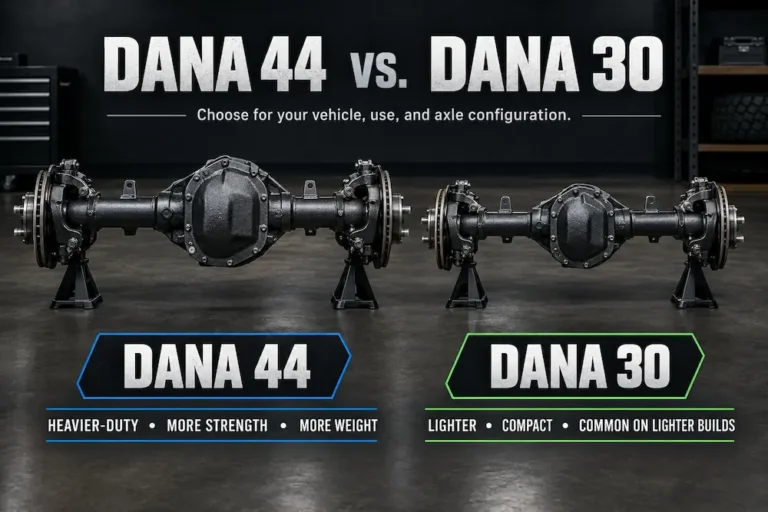
Staring under your Jeep trying to figure out what axle you’ve got? Or maybe you’re planning a lift and bigger tires and keep hearing “you’ll need a Dana 44” but nobody explains why. This guide breaks down the dana 44 vs dana 30 debate in plain English, so you know exactly what’s spinning under your rig and whether it can handle what you’re planning to throw at it.
By the end, you’ll know how to spot each axle, what makes one stronger than the other, and which one actually makes sense for your tires and terrain.
Dana 44 vs Dana 30: Quick Comparison
Before we get into the weeds, here’s the short version.
| Feature | Dana 30 | Dana 44 |
|---|---|---|
| Ring gear size | 7.125 inches | 8.5 inches (up to 8.9″ on Rubicon rear) |
| Max torque rating | ~3,460 ft-lbs | ~6,000 ft-lbs |
| Axle shaft splines | 27 | 30 (up to 35 on JK/JL) |
| Common use | Light-duty front | Front and rear, heavy-duty |
| Best tire size | Up to 33″ | 35″ and up |
| Bare housing weight | ~130 lbs | ~155-180 lbs |
Both axles have been running under Jeeps, old Broncos, and Chevy trucks for decades, according to Wikipedia’s rundown of the Dana 44’s history. The Dana 30 handles light-duty front axle work, while the Dana 44 shows up in both front and rear spots on rigs built for tougher trails.
How to Tell a Dana 30 From a Dana 44
You don’t need to crawl under and Google forever. Look at two things: the cover shape and the tube number.
Check the Differential Cover Shape
The Dana 30 cover is round-ish and symmetrical, about 9 inches across, held on with 10 bolts. The Dana 44’s cover looks lopsided, almost like a hexagon or a muffin shape, and it’s noticeably bigger at 10.375 inches wide. This visual ID guide from ExtremeTerrain has side-by-side photos if you want a visual gut check.
Find the Stamped Number on the Tube
Every factory axle has a code stamped right into the tube. It’s usually six digits, sometimes with a dash and extra number after it. This code tells you the exact gear ratio, build date, and original application, which comes in handy if the cover’s been swapped or painted over.
Don’t Assume Tubes Tell the Whole Story
Here’s a curveball: the standard Dana 30 and the standard Dana 44 (in TJ and early JK Jeeps) both use the same size tubes. Both run 2.5-inch outer diameter tubing with a thin 0.25-inch wall. That means even though the Dana 44 has beefier internals, its stock tubes can bend just as easily as a Dana 30’s under a hard hit.
Ring and Pinion Size: The Real Strength Difference
This is where the dana 44 vs dana 30 comparison really matters. The ring gear size decides how much torque an axle can survive before something snaps.
The Dana 30 runs a 7.125-inch ring gear. That’s fine for stock power and stock-size tires, but the small tooth contact patch gets overwhelmed fast once you add big tires or a locker. Torque capacity tops out around 3,460 ft-lbs.
The Dana 44 steps up to an 8.5-inch ring gear (some rear Rubicon versions go even bigger, up to 8.9 inches). Bigger gear means bigger teeth and way more surface contact. That bumps torque capacity to roughly 6,000 ft-lbs. That’s nearly double the strength, and it’s the main reason people upgrade.
High Pinion vs Low Pinion: Why It Matters Up Front
This part trips a lot of people up, so let’s keep it simple.
Low pinion axles sit the pinion gear below the axle centerline. In the rear, this setup is strong because the pinion pushes on the tough side of the ring gear teeth. But up front, low pinion axles push on the weaker side of the teeth during acceleration, cutting strength by 10-15%.
High pinion axles flip that. The pinion sits above centerline and uses reverse-cut gears, so the strong side of the teeth takes the load up front instead. It also lifts the driveshaft yoke higher off the ground, keeping it away from rocks.
That’s why a high pinion Dana 30 (like the one in the Jeep Cherokee XJ) actually holds up better off-road than a low pinion Dana 30 (found in the TJ Wrangler), even though they’re technically the same axle family. Check NAXJA’s high vs low pinion thread if you want the deep-dive version.
Axle Shafts: Splines and Metal Matter
Torque gets from the differential to your wheels through the axle shafts. Two things decide how much abuse they can take: the spline count and the steel type.
- Dana 30: 27-spline shafts, about 1.13-1.16 inches thick.
- Dana 44: 30-spline shafts, about 1.31 inches thick (older versions bump to 32 or 35 splines on JK/JL models, up to 1.41 inches).
That extra fraction of an inch matters a lot more than it sounds, because a shaft’s twisting strength grows fast with diameter.
Want to toughen up a Dana 30 without a full swap? Swapping factory shafts for chromoly steel ones is common. Chromoly flexes under load and springs back instead of snapping, and it can actually outlast a stock carbon-steel Dana 44 shaft in some cases. Just know this trick moves the weak point somewhere else, usually to the ring and pinion.
The U-Joint Myth You Need to Know
Here’s something a lot of people get wrong. Front axles need u-joints so power can transfer through a joint that pivots when you steer.
Old Dana 30 and Dana 44 axles both used the small Spicer 5-260x joint. As trucks got heavier, that joint became a weak spot, so manufacturers switched to the beefier 5-297x joint with bigger 1.188-inch caps.
Then Jeep needed something tougher for the Rubicon’s 4:1 low range and locking diffs, so Spicer built the 5-760x. It’s cold-forged (denser and stronger) and skips the grease channels that weaken older joints. That design bump gives it up to 10 times the fatigue life of the old joint, according to PartsMike’s u-joint specs.
Here’s the kicker: modern Dana 30 and Dana 44 front axles both use this exact same 5-760x joint. So if you keep snapping u-joints on a Dana 30, swapping to a Dana 44 won’t fix it. The joint strength is identical either way.
The TJ Rubicon Trap: A Hybrid Axle in Disguise
If you’ve got a 2003-2006 TJ Wrangler Rubicon, you technically have a Dana 44 up front. But it’s not the upgrade it sounds like.
The center section (housing the 8.5-inch ring gear and 30-spline shafts) is real Dana 44. But everything outboard of that — the tubes, the inner knuckle gussets, the outer knuckles, and the 27-spline outer stub shafts — is straight-up Dana 30 hardware.
That means this axle bends and breaks in the exact same spots a Dana 30 does. A Reddit thread on r/Jeep covers this frustration well: people expect a huge upgrade and get disappointed when they still bend axle tubes. The ring gear is stronger, sure. But the rest of the assembly isn’t.
Modern Axles: JK Super 44 and the AdvanTEK Era
Jeep kept improving the design after the TJ years, and the upgrades are worth knowing about if you’re shopping for a used Jeep or planning a swap.
JK “Super 44”
The 2007-2018 JK Wrangler brought a wider, stronger Dana 44 nicknamed the “Super 44.” It got a thicker pinion shaft, bigger carrier bearings, and beefed-up ring gear bolts (up from 3/8-inch to 7/16 or 1/2-inch). Rear shafts jumped to 1.41 inches with 32 splines. The catch? The front axle still kept those thin 2.5-inch tubes, so tube sleeves and trusses became a popular aftermarket fix.
AdvanTEK (JL and JT Models)
Newer JL Wranglers and Gladiators ditched old naming and switched to metric gear sizes:
- M186 — replaces the Dana 30, 186mm (7.3″) ring gear
- M210 — new front Dana 44 for Rubicons, 210mm (8.2″) ring gear
- M220 — new rear Dana 44, 220mm (8.6″) ring gear
These use nodular iron and bigger pinion gears that hold their strength even at steep gear ratios like 5.13 or 5.38. That solves an old problem where steep gears made the pinion head too small and weak.
Gear Ratios and Carrier Breaks
If you’re upgrading gears for bigger tires, you need to know about carrier breaks. Basically, as gear ratios get numerically higher, the pinion gear shrinks and the ring gear has to sit closer to the pinion. Different carriers exist to handle different ratio ranges.
| Axle | Low Ratio Carrier | High Ratio Carrier | Break Point |
|---|---|---|---|
| Dana 30 | 3.54 & down | 3.73 & up | 3.54/3.73 |
| Dana 35 | 3.31 & down | 3.55 & up | 3.31/3.55 |
| Dana 44 | 3.73 & down | 3.92 & up | 3.73/3.92 |
| Dana 60 | 4.10 & down | 4.56 & up | 4.10/4.56 |
This matters because you can’t just bolt any gear ratio onto any carrier. Going from 3.21 gears to 4.56 gears on a Dana 30, for example, might mean swapping the whole carrier — unless you use “thick cut” gears designed to skip that step. Drivetrain America’s guide on carrier breaks explains this in more detail if you’re regearing soon.
Lockers and Limited Slips: What Works Where
Both axles accept traction aids, but your choice affects performance differently depending on which axle you’re running.
- Selectable lockers (ARB Air Locker, Eaton ELocker) let you flip a switch to lock the axle 100%. Great for both Dana 30 and Dana 44 setups, though they need extra plumbing or wiring.
- Helical limited slips (like the Detroit Truetrac) work automatically without any switches. They’re smoother on snow and dirt but aren’t a true locker.
If you’re running a Dana 30 up front with a locker, remember: the ring gear is still your weak link. A locker adds shock load that a small ring gear may not love long-term.
Fluid and Maintenance Differences
The Dana 44’s bigger housing holds more gear oil, which helps it run cooler under load. Here’s a quick capacity guide.
| Axle | Fluid Capacity | Standard Oil | Heavy-Duty Oil |
|---|---|---|---|
| Dana 30 (Front TJ/JK) | ~1.05 to 1.7 qts | 80W-90 | 75W-140 synthetic |
| Dana 44 (Front JK Rubicon) | ~1.35 qts | 80W-90 | 75W-140 synthetic |
| Dana 44 (Rear TJ/JK) | ~4 to 4.75 pints | 80W-90 | 75W-140 synthetic |
| AdvanTEK M220 (Rear JL/JT) | ~3.06 pints | 80W-90 | 75W-140 synthetic |
Because the Dana 30 holds less oil, it runs hotter under stress. Switching to full synthetic gear oil helps a lot if you’re towing or running lockers regularly.
Upgrading Instead of Swapping: Crate Axles and Covers
If you don’t want to source a full used axle, there are ways to boost strength without starting from scratch.
Heavy-duty differential covers made from nodular iron do more than protect against rock strikes. They actually stiffen the whole housing, cutting down on flex that misaligns your gears under load. Some covers add nearly 960 ft-lbs of extra torsional rigidity.
Crate axles are a bigger investment but solve everything at once. The Spicer Ultimate Dana 44 uses 5/16-inch tubes (way thicker than stock) plus chromoly shafts and upgraded u-joints. Premium builders like Dynatrac’s ProRock 44 go even further with 3-inch, half-inch-wall tubes that basically won’t bend from normal trail abuse.
Which One Actually Fits Your Build?
Here’s the practical takeaway.
Stick with a Dana 30 if you’re:
- Running stock to mild tires (up to 33 inches)
- Daily driving or light trail use
- Not running a front locker
Go Dana 44 (or upgrade to one) if you’re:
- Running 35-inch tires or bigger
- Adding a locker up front
- Rock crawling or hitting technical trails regularly
Trying to make a Dana 30 survive 35-inch tires with chromoly shafts and a truss is possible, but you’re fighting a losing battle against a tiny 7.125-inch ring gear that can’t get bigger no matter what you bolt onto it.
Final Thoughts
The dana 44 vs dana 30 choice really comes down to what you’re driving on and how hard you’re pushing it. The Dana 30 is light, efficient, and totally fine for mild use. The Dana 44 costs a little more in weight and price but gives you the strength to run bigger tires and lockers without constantly worrying about snapped parts.
If your build is creeping toward bigger tires or gnarlier trails, save yourself the headache and go straight to a Dana 44 (or a proper crate axle) instead of nursing a Dana 30 past its limits. Your wallet and your trail buddies will thank you.