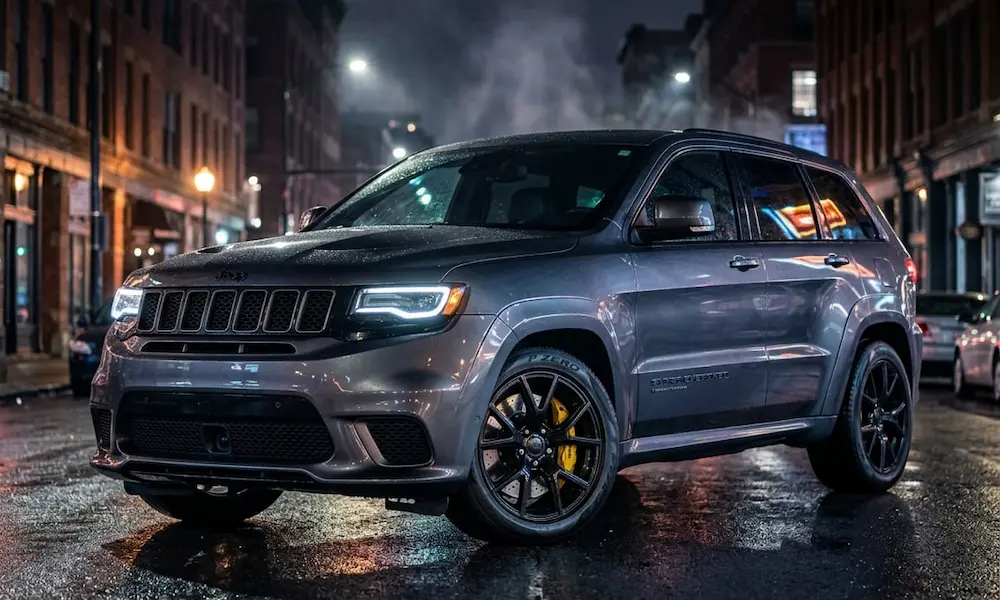

You want one number, and you want it fast. The Jeep Grand Cherokee Trackhawk makes 707 horsepower, and that’s only the start of the story. This guide covers where the power comes from, how the SUV puts it down, and what it costs to feed. You’ll also see how it stacks up against Hellcats and what tuners can squeeze out of it. Stick around to the end, because the ownership costs might surprise you.
How Much Horsepower Does a Trackhawk Have? The Short Answer
The Trackhawk makes 707 horsepower at 6,000 RPM and 645 lb-ft of torque at 4,800 RPM. Those numbers come straight from the factory. Stellantis called it the most powerful and quickest SUV ever when it launched.
Jeep built the Trackhawk for the 2018 through 2021 model years. It’s a full-size family hauler with supercar muscle. Here’s the quick spec sheet.
| Spec | Number |
|---|---|
| Engine | 6.2-liter supercharged V8 |
| Horsepower | 707 hp @ 6,000 RPM |
| Torque | 645 lb-ft @ 4,800 RPM |
| 0–60 mph | 3.5 seconds |
| Quarter mile | 11.6 seconds @ 116 mph |
| Top speed | 180 mph |
| Curb weight | 5,363 lbs |
| Max towing | 7,200 lbs |
Is It 707 HP or 717 HP?
You’ll see both numbers online. They describe the same engine. The 717 figure is metric horsepower (PS), which European and other markets use. In the US, it’s 707 hp. Don’t let a spec-sheet argument ruin your day.
Is That Crank or Wheel Horsepower?
Crank horsepower. The 707 number measures power at the engine. Some power disappears on the way to the tires, because the transmission, transfer case, and axles all take a cut. That’s why tuners talk about wheel horsepower separately. We’ll get to that.
Where the 707 HP Comes From
The Trackhawk uses a 6.2-liter supercharged V8. It shares its basic design with the Dodge Challenger and Charger Hellcat. Jeep didn’t just drop a Hellcat engine in an SUV and call it done, though. The all-wheel-drive setup and heavy body demanded extra work.
The Supercharger Does the Heavy Lifting
A supercharger runs off the engine’s crankshaft with a belt. A turbo waits on exhaust gas. That means a supercharger delivers power right away, with no lag.
The Trackhawk’s twin-screw unit is huge. Here are the numbers:
- It moves 2,380 cc of air per revolution.
- It makes 11.6 psi of boost.
- Its rotors can spin up to 14,600 RPM.
- The rotors wear a special coating that tightens clearances and cuts air leakage.
Compressing air makes it hot, and hot air means less power. So the Trackhawk runs a separate liquid cooling loop for the intake air. Jeep also swapped the fog lights for cold-air scoops that feed the supercharger. Yes, the fog lights lost their jobs for more horsepower. Fair trade.
A Tough Engine Built to Take It
Making 707 hp means the engine has to survive 707 hp. The core parts are built for abuse:
- Cast-iron block with extra cooling channels between cylinders
- Forged-steel crankshaft with hardened bearing surfaces
- Forged-alloy pistons cooled by oil jets
- Sodium-cooled exhaust valves that pull heat away from the valve head
That overbuilt design matters later, when we talk about tuning. Engineers left a lot of headroom in there.
How the Trackhawk Puts 707 HP on the Pavement
Power means nothing if the tires just smoke. The Trackhawk solves that with all-wheel drive and some clever software.
Transmission and Gearing
An eight-speed automatic handles the shifting. It’s the ZF 8HP95 variant, and it’s the strongest version of that gearbox family, rated for up to 1,100 Newton-meters of torque.
First gear is a punchy 4.71:1, which helps the 5,363-pound SUV leave the line hard. Eighth gear is 0.67:1, so the engine relaxes on the highway. The final drive ratio is 3.70:1.
Beefed-Up All-Wheel Drive
The Quadra-Trac system sends power to all four wheels. Jeep reinforced the transfer case with forged-steel sprockets and a wider chain. The rear axle gets an electronic limited-slip differential and a four-point mounting system. Even the driveshafts and half-shafts got thicker, stronger steel.
All that hardware lets the Trackhawk do something its rear-drive Hellcat cousins can’t. It uses nearly every pony right from a stop.
Launch Control Helps Too
Launch Control uses a “torque reserve” trick. Here’s how it works:
- You hold the brake and floor the gas.
- The computer cuts fuel to some cylinders and delays spark timing.
- The engine revs without making full torque, and the supercharger builds boost.
- You release the brake, and full fueling and spark return instantly.
The SUV leaps forward with boost already waiting. Torque News has a good breakdown of how this works.
What 707 Horsepower Feels Like: Real Performance
Numbers on paper are fun. Numbers on a timeslip are better. Official figures put the 0–60 time at 3.5 seconds. Car and Driver’s test showed how quick this thing really is for something so heavy.
| Performance Metric | Result |
|---|---|
| 0–60 mph | 3.5 seconds (some tests hit 3.3–3.4) |
| Quarter mile | 11.6 seconds @ 116 mph |
| Top speed | 180 mph |
| 60–0 braking | 114 feet |
| Drag coefficient | 0.377 |
Trackhawk vs. Hellcat in a Drag Race
The Challenger Hellcat has the same engine. But it’s rear-wheel drive, so it fights for traction. The Trackhawk just goes. In Digital Trends’ Hellcat vs. Trackhawk race, you can see how the SUV’s traction advantage plays out.
The lighter muscle cars can catch up above 120 mph. But the Trackhawk’s launch usually wins the race first. Not bad for something that hauls groceries.
How Does 707 HP Compare to Other Jeeps and Rivals?
The Trackhawk sits near the top of the performance food chain. Here’s where it lands.
| Vehicle | Horsepower |
|---|---|
| Grand Cherokee SRT (naturally aspirated) | 475 hp |
| Grand Cherokee Trackhawk | 707 hp |
| Dodge Durango SRT Hellcat | 707 hp |
| Dodge Challenger Hellcat Redeye | 797 hp |
The SRT model has a 6.4-liter V8 with no supercharger. The Trackhawk beats it by 232 horsepower. The Durango SRT Hellcat shares the same output and similar all-wheel-drive hardware. It’s longer and has three rows of seats, and the slightly lighter Trackhawk tends to edge it out.
European rivals like the Porsche Cayenne Turbo S, Bentley Bentayga, and Lamborghini Urus corner better and feel fancier. But they cost much more. The Trackhawk’s pitch is simple: huge power for the price.
Drive Modes Change How That Power Feels
The Trackhawk doesn’t always deliver all 707 horsepower in the same way. The Selec-Track system has five drive modes, and each one changes how the SUV behaves.
- Auto: The default setting. It’s comfortable, with a rear-biased power split.
- Sport: Stiffer suspension, held gears, and faster shifts.
- Track: Maximum stiffness, 160-millisecond shifts, and up to 70 percent of torque to the rear wheels.
- Tow: Smoother launches and a steady 60/40 front-to-rear split.
- Snow: Reduced power, second-gear starts, and a 50/50 split.
Stellantis’ press release lists the full details on each mode.
Valet Mode Cuts the Power
Handing 707 horsepower to a stranger is a bad idea. So Jeep built in Valet Mode. You set a four-digit PIN on the touchscreen. Then the SUV limits engine speed to 4,000 RPM, blocks first gear, disables launch control and paddle shifters, and softens the suspension. Your valet gets a very expensive minivan experience.
The Cost of Feeding 707 HP
Big power comes with a big bill. Here’s where the money goes.
Fuel Economy Hurts
The EPA rates the Trackhawk at 11 mpg city, 17 mpg highway, and 13 mpg combined. The tank holds 24.6 gallons, which gives a highway range around 418 miles. Drive it hard and you’ll see single digits. TFLcar averaged about 10 mpg during spirited testing.
The engine needs premium fuel. Edmunds lists 91 octane as the minimum, but 93 is the better choice because it lets the engine run full ignition timing.
Brakes Cost Real Money
The Trackhawk stops with big Brembo brakes. The front rotors measure 400 mm (15.75 inches) and use six-piston yellow calipers. The rear rotors are 350 mm with four-piston calipers. They’ll stop the SUV from 60 mph in just 114 feet.
But replacing them stings. Dealer quotes for pads and rotors all around can run $3,000 to $4,500. A pair of front rotors alone can cost $1,100 to $1,500. Some owners report needing new ones by 24,000 to 30,000 miles.
Tires Wear Fast
The SUV rides on Pirelli P Zero summer tires in 295/45R20 at all four corners. They grip great. But the tread compound is soft, and the treadwear rating is just 220. Hard drivers often replace them every 12,000 to 15,000 miles.
Maintenance Schedule
This table shows what to expect for routine service.
| Maintenance Item | Interval | Estimated Cost |
|---|---|---|
| Engine oil and filter | 10,000 miles / 12 months (sooner for severe duty) | $45–$75 |
| Brake fluid flush | Every 24 months | $100–$180 |
| Differential / transfer case fluid | 50,000 miles | $100–$180 |
| Transmission fluid (ZF 8-speed) | 60,000 miles | $150–$250 |
| Spark plugs | 100,000 miles | $150–$250 |
| Engine coolant flush | 100,000 miles / 10 years | $120–$200 |
If you tow or hit the track, change the oil closer to every 3,000 to 5,000 miles.
It’s Still a Practical Family SUV
Here’s what makes the Trackhawk special. It doesn’t give up daily usability for speed.
- Seats five adults comfortably
- 36.3 cubic feet of cargo space behind the rear seats
- Over 68 cubic feet with the seats folded
- 7,200 pounds of towing capacity
- 8.1 inches of ground clearance
It also carries more than seventy safety features. These include Full-Speed Forward Collision Warning with Crash Mitigation Braking, Adaptive Cruise Control, Lane Departure Warning-Plus, and blind-spot monitoring. You can haul the kids to school, then go humiliate a sports car at the next light. Responsibly, of course.
Can You Get More Than 707 HP?
Yes, and a lot of owners do. The Trackhawk’s strong engine internals leave plenty of room for extra power. Shops found the 6.2-liter was under-stressed from the factory and could handle well over 1,000 horsepower with the right parts.
Stage One: Pulleys, Intake, and a Tune
The simplest upgrade spins the supercharger faster. Tuners do it with a smaller upper pulley or a larger crank pulley. Boost climbs from 11.6 psi to 15 or 18 psi. Add a cold-air intake, bigger injectors (often 1000 to 1300 cc/min), and a custom tune. Gains can reach 150 to 200 horsepower.
Ethanol Blends
Pump gas limits power because it knocks under high pressure. E85 ethanol fights that problem. It soaks up heat as it evaporates, so it cools the combustion chamber. But E85 needs bigger fuel pumps and flex-fuel sensors, so the engine can adjust to the blend. DTX Performance covers how tuners make 1,000 hp reliable.
Big-Power Builds
To pass 1,000 wheel horsepower, which equals about 1,200 at the crank, builders swap the supercharger for a larger one or add twin turbos. The stock transmission needs help too. Shops like Sipple build upgraded HP95 transmissions with billet parts.
The results are wild:
- Hennessey’s HPE1200 package makes over 1,000 wheel horsepower. It runs the quarter mile in about 9.66 seconds at 145 mph.
- One 1,200-whp Trackhawk ran an 8.72-second pass.
- Another heavily modified build recorded an 8.18-second quarter mile at 177 mph.
Builds at that level need drag parachutes. Your grocery-getter has officially become a rocket.
What a Trackhawk Costs Today
At launch in 2018, the Trackhawk started around $85,900. Options pushed some window stickers past $105,000. By 2021, the base price topped $90,000.
Used values hold up well. Kelley Blue Book data for a 2021 model shows these ranges:
| Condition | Trade-In Value | Private Party Value |
|---|---|---|
| Excellent | $62,250 | $68,930 |
| Very Good | $60,550 | $67,030 |
| Good | $58,650 | $65,030 |
| Fair | $53,950 | $59,730 |
Low-mileage cars can sell near their original price. Jeep dropped the supercharged V8 after 2021, and the newer Grand Cherokee uses the WL platform with plug-in hybrid and inline-six options. The Trackhawk is now a modern classic, and prices reflect that.
Quick Answers About Trackhawk Horsepower
Does every Trackhawk year make the same horsepower?
Yes. The 2018 through 2021 models all make 707 hp and 645 lb-ft of torque.
Is the Trackhawk faster than a Hellcat?
Off the line, yes. The all-wheel-drive Trackhawk launches harder than a rear-drive Hellcat. At higher speeds, the lighter Hellcat can close the gap.
How much horsepower does a Trackhawk make at the wheels?
Less than 707, since the drivetrain absorbs some power. Exact numbers vary by dyno and conditions, so check dyno results for the specific car you’re eyeing.
Can you tow with a Trackhawk?
Yes. It tows up to 7,200 pounds when properly equipped. Tongue weight maxes out at 720 pounds with a weight-distributing hitch.
Final Thoughts
So, how much horsepower does a Trackhawk have? 707 hp and 645 lb-ft of torque, from a 6.2-liter supercharged V8. That’s enough for a 3.5-second sprint to 60 and a 180-mph top speed, in a five-seat SUV that tows 7,200 pounds.
Owning one isn’t cheap. Expect thirsty fuel bills, expensive brakes, and tires that vanish quickly. But the Trackhawk also delivers something rare. It’s a family SUV that can embarrass sports cars, and Jeep will probably never build another one. If you can afford the upkeep, that’s a pretty good trade.