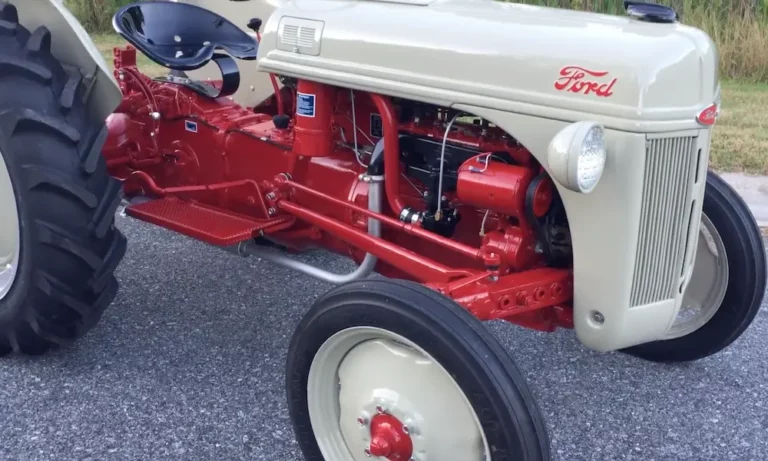
Looking at a Ford 8N and wondering what it can actually do? You’re in the right place. This iconic tractor dominated American farms from 1947 to 1952, and understanding its specs helps you decide if it’s right for your needs—or if that barn find is worth restoring.
What Made the Ford 8N Special?
The Ford 8N tractor wasn’t just another farm machine. With 524,000 units built at Ford’s Highland Park facility, it became North America’s most popular farm tractor of its time. The original $1,404 price tag (in 1952) made it affordable for smaller operations, while Harry Ferguson’s three-point hitch system gave it capabilities that reshaped agriculture forever.
That three-point hitch? It’s virtually unchanged today. That’s how good the design was.
Engine: The Flathead Four That Could
At the heart of every 8N sits a 2.0-liter, four-cylinder L-head engine. Here’s what powers this workhorse:
- Displacement: 119.7 cubic inches
- Bore x Stroke: 3.188″ x 3.75″
- Compression Ratio: 6.50:1
- Operating Range: 400 RPM idle to 2,000 RPM max
- Firing Order: 1-2-4-3
The flathead design was simple and bulletproof. Valves sit beside the cylinders rather than overhead, making adjustments easier than Sunday morning. You could run it on gasoline or distillate fuel (the 8NAN variant), which mattered when distillate was cheaper and readily available.
Cooling comes from a pressure system with either four or six-blade fans, depending on your specific model. It’s not fancy, but it works.
How Much Power Does It Actually Make?
Here’s where the numbers get interesting. Ford claimed 23.16 hp at the drawbar and 27.32 hp at the PTO. The University of Nebraska tested it and found slightly different results:
| Power Type | Tested Output |
|---|---|
| Drawbar | 21.95 hp |
| PTO | 23.24 hp |
| Belt | 25.77 hp |
That’s honest power for small to medium farms. You can pull plows, run cultivators, and handle mowers without breaking a sweat. But let’s be real—if you’re trying to run a big brush hog or multiple-bottom plow, you’ll feel the limitations.
Some folks installed Funk conversion kits with Ford V-8 engines to push past 100 hp. That’s overkill for most jobs, but it’s an option if you need serious grunt.
Transmission: Four Speeds Forward, One Back
The 8N’s four-speed manual transmission was a step up from the three-speed units in earlier 9N and 2N models. It’s constant mesh, meaning you stop completely and clutch in before shifting. The transmission holds 20 quarts of oil and does its job without fuss.
First gear gets you about 4.19 mph at full RPM—perfect for heavy pulling. Fourth gear handles transport duties, though you shouldn’t push it hard for extended highway runs.
Want more versatility? The Sherman Combination Transmission bolted on and gave you 12 forward speeds and 3 reverse. The step-down gearing (reduced by 1.513:1) added torque for tough jobs, while step-up gearing (increased by 1:1.495) let you move faster between fields.
Size and Dimensions That Work
The 8N’s compact footprint makes it surprisingly maneuverable:
- Wheelbase: 70 inches
- Length: 115 inches
- Width: 64.75 inches
- Height: 54.5 inches
- Ground Clearance: 13 inches
- Front Axle Clearance: 21 inches
Both front and rear tread widths adjust from 48 to 76 inches in 4-inch increments. This matters when you’re switching between row crops or need specific spacing for different applications.
These dimensions strike a sweet spot between stability and agility. You can navigate tight spaces without tiptoeing around, and the 13-inch ground clearance handles typical field conditions just fine.
Weight: Light Enough to Move, Heavy Enough to Work
Understanding weight helps you plan for traction and transport:
- Shipping Weight: 2,410 lbs
- Operating Weight: 2,717 lbs (with fluids)
- Ballasted Weight: 4,043 lbs (maximum)
That ballasted weight comes from liquid ballast in rear tires, wheel weights, or front-mounted weights. Proper ballasting transforms traction, especially with heavy implements or in challenging soil. Without it, you’ll spin tires and waste time.
Tires: The Rubber That Meets the Dirt
The 8N uses different tire sizes front and rear:
Front Options: 4.00-19 or 6.00-16
Rear Options: 10-28 or 11.2-28
Most operators prefer the wider 11.2-28 rear tires. They look better, distribute weight across more surface area, and reduce ground pressure in soft conditions. Less compaction means better soil health and fewer stuck tractor moments.
The staggered setup is classic utility tractor design—small fronts for steering, big rears for power and traction.
Hydraulics: Capable But Not Modern
The hydraulic system works, but it shows its age:
- Reservoir Capacity: 5 gallons
- Operating Pressure: 1,700 psi
- Pump Flow: 2.85 GPM
- Rear Lift Capacity: 800 lbs
- Hitch Type: Category I three-point
Here’s the catch: hydraulics only work when the PTO is engaged and the clutch is engaged. It’s not “live,” so you can’t operate hydraulics independently. That limits flexibility compared to modern tractors.
Need live hydraulics? Aftermarket solutions like Hokie Hydraulics mount belt-driven systems to the engine, providing 3-10+ GPM independent flow. It’s a popular upgrade that opens up modern implement options.
The 800-lb lift capacity handles most Category I implements without complaint. The three-point hitch remains compatible with modern equipment, which is remarkable for 70-year-old technology.
PTO System: Powering Your Implements
The transmission-driven PTO spins at 545 RPM with a 1.125:1 ratio. That’s close to the modern 540 RPM standard but not quite the same.
Since the PTO drives the hydraulic pump, engaging it activates your hydraulics. You can’t have one without the other. The PTO engages only when you’re stopped with the transmission in neutral—something to remember when planning implement hookups.
Aftermarket PTO overrunning clutches became popular for implements with momentum. They prevent implement overrun from driving the tractor’s PTO system during shutdown, which protects components and improves safety.
Electrical System: Six Volts of Vintage Power
The 8N runs a 6-volt electrical system with positive ground:
- Generator Output: 20 amps at 140 watts
- Battery Capacity: 80 amp-hours
- Configuration: Positive ground, two-brush shunt-wound generator
It works fine in warm weather. Cold weather starting? That’s where 6-volt systems struggle.
Many owners convert to 12-volt systems with alternators, 12-volt batteries, and negative ground. Starting performance improves dramatically, especially below freezing. Modern electronic accessories become plug-and-play options. It’s one of the most common upgrades for daily-use tractors.
Steering and Brakes: Manual But Manageable
The mechanical steering has no power assist. It’s fine for implement work and provides good feedback, but it gets heavy when you add front ballast. The straightforward linkage design is easy to service and rarely causes problems.
Manual drum brakes feature independent left and right pedals. Differential braking helps with tight turns and maneuvering in barns or sheds. Lock both pedals down for parking, though it’s not as secure as modern parking brakes.
Brake effectiveness depends entirely on proper adjustment. Keep them dialed in or you’ll be disappointed.
Operator Station: Open Air and Basic
There’s no cab, no weather protection, and no creature comforts. The single seat puts you in the elements with basic controls:
- Main gear shift lever
- Throttle control
- Choke control
- PTO engagement lever
Some 8Ns came with minimal gauges—maybe an ammeter, possibly oil pressure and temperature. Others had nothing. Modern restorations often add upgraded gauge packages for better monitoring.
It’s utilitarian farming at its finest. You’ll know what the weather’s doing because you’re in it.
Fuel Capacity: A Day’s Work in the Tank
The 10-gallon fuel tank handles a full day’s work under normal conditions. A manual shutoff valve controls fuel flow—open it before starting, close it when parked. It’s both flow control and safety device, preventing leaks when the tractor sits.
Original 8Ns could run gasoline or distillate fuel. The 8NAN variant handled distillate’s different combustion characteristics. Today, you’ll run regular gasoline since distillate disappeared from the market decades ago.
Maintenance: Built to Be Fixed
The L-head engine makes service straightforward. Flathead design means valve adjustments without pulling the head. Oil changes, cooling system service, and routine checks are simple with basic tools.
Hydraulic fluid and filters need periodic attention. The transmission and differential share oil in many areas, simplifying intervals but requiring attention to levels and condition.
The electrical system’s simplicity aids troubleshooting. Most problems trace to loose connections, worn brushes, or tired generators—all fixable in an afternoon.
Parts availability is excellent. Strong enthusiast communities mean knowledge, advice, and used parts are everywhere.
What Can the 8N Actually Do?
The 8N excels at tasks requiring precision over brute force:
- Cultivation and row-crop work
- Mowing and brush cutting (within limits)
- Light plowing (2-3 bottom plows max)
- Implement work needing precise control
- Orchard and vineyard applications
- Small field operations
Its compact size shines in confined spaces where bigger tractors can’t operate. The three-point hitch handles modern Category I implements without fuss.
Travel speeds vary by transmission setup. Standard four-speeds work fine for field-to-field moves. Sherman transmissions with overdrive ratios reach highway speeds when properly configured, though extended high-speed running isn’t recommended.