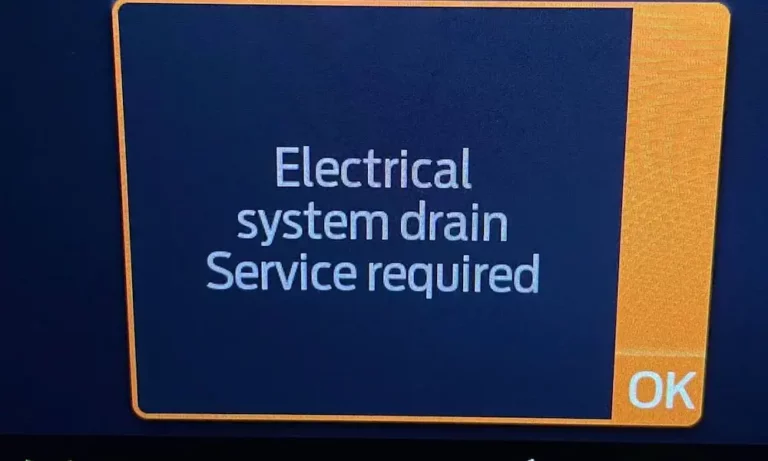
That dreaded warning light just popped up on your dashboard: “electrical system drain service required.” Your car’s telling you something’s quietly sucking power from your battery even when the engine’s off. Don’t panic—this guide breaks down what’s happening and how mechanics track down these sneaky power thieves.
What Does “Electrical System Drain Service Required” Actually Mean?
Your car’s throwing up a red flag about excessive parasitic draw. Here’s the deal: modern vehicles need some electrical power even when parked to keep memory settings, security systems, and control modules alive. That’s normal.
What’s not normal? When components keep guzzling power when they should’ve gone to sleep. Think of it like leaving your porch light on overnight—except you didn’t know it was on, and it’s draining your battery fast.
Your vehicle monitors its 12V battery health constantly. When it detects unusual discharge patterns during sleep mode, that warning message appears. It’s basically your car saying, “Hey, something’s not right here.”
How Modern Car Electrical Systems Work
Today’s vehicles aren’t simple anymore. They’re rolling computers with 50-100+ electronic control units (ECUs) talking to each other constantly. Each one needs a tiny bit of power to remember your seat position, radio presets, and thousands of other settings.
These ECUs follow specific sleep protocols. After you shut off the ignition, it takes 10-30 minutes for everything to power down properly. They don’t all sleep at once—they gradually reduce power consumption in stages.
Different manufacturers handle this differently. BMW vehicles have a “functional test” that forces instant sleep mode. Other brands just wait for natural timeout periods.
What’s Normal vs. What’s a Problem
Here’s what you need to know about acceptable power draw:
Normal Parasitic Draw by Vehicle Type
| Vehicle Category | Acceptable Draw Range | Typical Components Drawing Power |
|---|---|---|
| Economy Cars | 5-15 mA | Clock, security system, radio memory |
| Luxury Vehicles | 25-30 mA | Multiple ECUs, telematics, comfort systems |
| Electric Vehicles | 10-200 mA | Battery management, charging systems, connectivity |
| Hybrid Vehicles | 15-50 mA | High-voltage battery monitoring, ECU networks |
Anything above these ranges? You’ve got a problem. A faulty alternator diode alone can drain 100-500mA, killing your battery overnight.
Common Causes of Electrical System Drain
Let’s talk about the usual suspects mechanics find when diagnosing these issues.
Alternator Problems
Bad diodes in your alternator create a backwards power path. Instead of charging your battery, they let current flow back through the alternator when the engine’s off. This creates significant drain that’ll leave you stranded.
Stuck Relays
Relays are electrical switches. When they stick in the “on” position, they keep circuits powered indefinitely. Common culprits include fuel pump relays, cooling fan relays, and HVAC system relays. The contacts weld together from electrical surges, and boom—constant power drain.
Modules That Won’t Sleep
Sometimes control modules throw a tantrum and refuse to enter sleep mode. Software glitches or hardware failures keep them awake, consuming power like it’s their job. Ford addressed this specifically with their HVAC modules in the Mach-E.
Aftermarket Add-Ons
That dashcam you installed? The GPS tracker? Remote start system? If they’re wired to constant power instead of switched power, they’re draining your battery 24/7. Many aftermarket accessories cause drain issues because they’re improperly installed.
Door Switches and Trunk Latches
A faulty door switch that thinks your door’s always open keeps interior lights, courtesy lights, and various modules awake. Same goes for trunk and hood switches.
Ford Electric Vehicle Specific Issues
Ford EV owners see this message more than they’d like. Here’s what’s unique about Ford’s electrical system drain warnings.
The 12V Battery Confusion
Your Mach-E or Lightning has two battery systems: the big high-voltage traction battery and a regular 12V auxiliary battery. That warning message? It’s about the 12V system, not your driving range battery.
The 12V battery powers all the computers and accessories. When it drains, your car can’t “wake up” properly, even if your main battery is fully charged.
Common Ford EV Drain Culprits
Welcome lighting is sneaky. If your key fob’s too close to the car (within 25 feet), it keeps activating proximity sensors and waking up systems.
Dashcams improperly connected to always-on power outlets drain batteries fast. Many Lightning owners discovered this the hard way.
HVAC module issues plagued early Mach-E models. Ford released Customer Satisfaction Program 24P16 addressing modules that wouldn’t sleep properly.
Telematics systems sometimes get stuck trying to connect to cellular networks, staying awake indefinitely while searching for signal.
Ford’s released multiple Technical Service Bulletins for these issues. TSB 25-2058 specifically addresses 12V battery drain with software updates for 2021-2023 Mach-E models.
Subaru’s Telematics Module Problems
Subaru owners aren’t immune to drain issues. Their Data Communication Modules (DCM) cause headaches when cellular signal strength is poor.
The NHTSA documented these problems extensively in TSB 15-308-23. When the DCM can’t establish a network connection, it stays awake searching for signal—for up to 14 days straight.
That’s right. Two weeks of constant searching, constantly draining your battery. Areas with poor cellular coverage see this problem more frequently. When signal strength drops below 23%, diagnostic procedures kick in to identify the issue.
How Mechanics Diagnose Electrical System Drain
Professional diagnosis isn’t guesswork. It’s a systematic process using specialized equipment.
Step 1: Battery and Charging System Check
Before hunting for drains, mechanics verify your battery’s actually healthy. A fully charged battery should read 12.6-12.8 volts. With the engine running, the alternator should produce 13.8-14.4 volts.
Bad batteries mimic parasitic draw symptoms through self-discharge. Testing eliminates this possibility first.
Step 2: Vehicle Preparation
Mechanics remove all aftermarket accessories, unplug devices from power outlets, and disconnect any diagnostic equipment from the OBD port. Keys go far away—at least 25 feet—to prevent proximity sensor activation.
Then comes the waiting game. The vehicle needs 10-30 minutes to enter sleep mode naturally. Opening doors or accessing fuse panels during this time resets the process.
Step 3: Current Draw Measurement
The gold standard involves connecting a digital multimeter in series with the negative battery cable. Professional meters need 10-amp capability with 1-milliamp resolution for accurate readings.
Advanced technicians use low-current clamp meters for non-invasive testing. These require 1mA minimum resolution but don’t disrupt sleep modes.
Step 4: Fuse-Pull Testing
When excessive draw is confirmed, mechanics systematically pull fuses while monitoring current. They start with underhood fuse boxes before accessing interior panels.
Each fuse removal gets monitored. Significant current drop points to the affected circuit. Advanced techs measure voltage-drop across individual fuses to identify current flow without disrupting sleep protocols.
Diagnostic Equipment Needed
| Tool | Purpose | Key Specifications |
|---|---|---|
| Digital Multimeter | Series current measurement | 10A capability, 1mA resolution |
| Low-Current Clamp Meter | Non-invasive testing | 1mA minimum resolution |
| Battery Analyzer | Health verification | Conductance testing capability |
| Professional Scan Tool | ECU fault codes | Network communication diagnostics |
| Memory Saver | Preserve settings | Prevents programming loss |
Understanding ECU Power Management
Modern ECU power management follows AUTOSAR protocols governing wake-up events and sleep modes. Different modules consume different amounts of power in sleep mode.
Body Control Modules typically draw 100-1000 microamps. Infotainment systems might consume 1000-10000 microamps while sleeping. Those numbers seem tiny, but they add up across dozens of modules.
Network Management and CAN Bus
ECUs communicate over CAN bus networks to coordinate sleep and wake cycles. When network management protocols get disrupted, entire network segments can’t sleep properly.
Corrosion in connectors, damaged wiring, or faulty modules throw off these carefully choreographed power-down sequences. One misbehaving module can keep an entire network awake.
Telematics and Connectivity Challenges
Connected car features bring new complications. Telematics modules need periodic network communication to update vehicle data and receive commands. Poor cellular signal prevents proper sleep mode entry, causing modules to stay active while searching for connections.
GM’s Load Shedding Systems
General Motors vehicles take a different approach with sophisticated electrical load shedding. When battery voltage drops below critical thresholds, the Body Control Module automatically disconnects non-essential circuits.
Your heated seats suddenly stop working? HVAC system reduces power? That’s load shedding kicking in. It’s not necessarily a parasitic drain issue—it might indicate charging system problems.
Understanding these protocols prevents misdiagnosis. Temporary feature disconnection points to alternator or battery problems, not parasitic draw.
The Cost Factor
Electrical diagnosis isn’t cheap. Shops charge 1-3 hours diagnostic time for thorough parasitic draw testing. That’s $150-450 depending on labor rates.
Repairs vary wildly. A stuck relay costs $30-80 parts and labor. Alternator replacement runs $400-800. Module replacement can hit $500-2000 depending on which module and vehicle complexity.
Don’t skip professional diagnosis trying to save money. Shotgun parts replacement gets expensive fast and rarely fixes electrical issues on the first try.
Why This Problem’s Getting More Common
Vehicles grow more complex every year. More electronics mean more potential failure points. Connected car features, advanced driver assistance systems, and infotainment complexity all increase parasitic draw risks.
Your car’s electrical architecture rivals a small data center now. That sophistication brings convenience but also vulnerability to electrical gremlins.
Understanding your specific vehicle’s sleep protocols and normal draw specifications helps you recognize problems early. Don’t ignore that warning message—it’s telling you something legitimately needs attention.