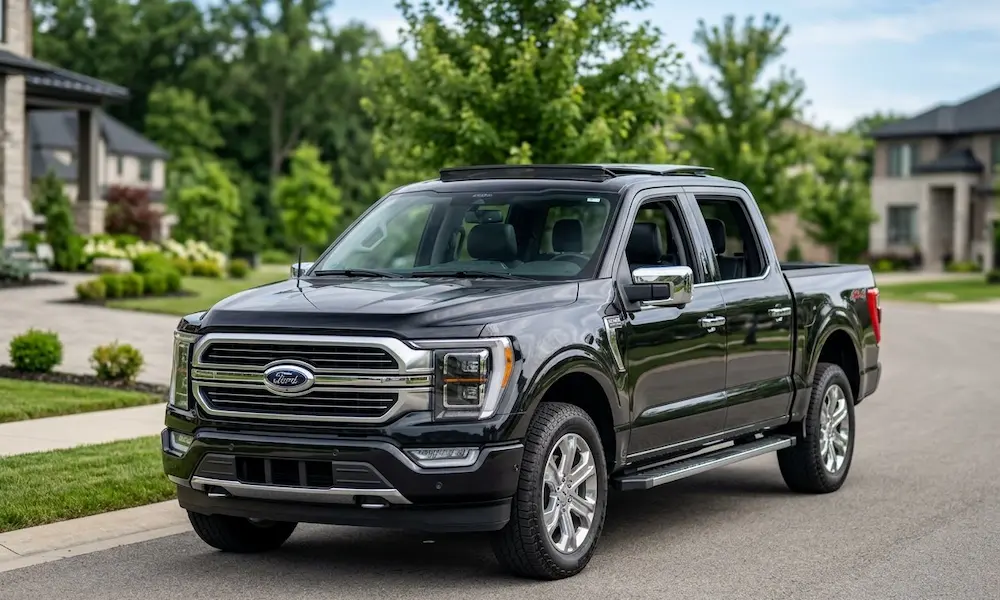
Getting the oil capacity wrong on your F-150’s 5.0L Coyote V8 is an easy mistake — and an expensive one. Whether you’re doing your first DIY oil change or just double-checking the dealership’s work, this guide gives you every spec, every year, with zero guesswork. Stick around — there’s one generation that’ll surprise you.
Why Ford F-150 5.0 Oil Capacity Isn’t One-Size-Fits-All
Here’s the thing most people miss: the Ford F-150 5.0 oil capacity has actually changed three times across four engine generations. Pour the wrong amount and you’re either running low on protection or overfilling — both of which can damage an engine that’s capable of hitting 300,000 miles with proper care.
The 5.0L Coyote V8 isn’t just a big engine — it’s a precision system. Its Twin Independent Variable Camshaft Timing (Ti-VCT) uses engine oil as a hydraulic fluid to control cam phasing. Oil is also used for piston cooling via squirters in early models. Under-fill and those systems starve. Overfill and you foam the oil. Neither is good.
Let’s break it down by generation.
Ford F-150 5.0 Oil Capacity by Year: Full Breakdown
| Model Year | Generation | Oil Capacity (w/ Filter) | Viscosity | Filter |
|---|---|---|---|---|
| 2011–2014 | Gen 1 | 7.7 quarts (7.3L) | SAE 5W-20 | FL-500-S |
| 2015–2017 | Gen 2 | 7.7 quarts (7.3L) | SAE 5W-20 | FL-500-S |
| 2018–2020 | Gen 3 | 8.8 quarts (8.3L) | SAE 5W-20 | FL-500-S |
| 2021–2025 | Gen 4 | 7.75 quarts (7.33L) | SAE 5W-30 | FL-500-S |
That 2018–2020 jump to 8.8 quarts isn’t a typo. We’ll explain exactly why that happened — and why it caused major headaches for thousands of owners.
2011–2017: Gen 1 and Gen 2 Coyote (7.7 Quarts, 5W-20)
The first two generations of the F-150 5.0L share the same oil capacity: 7.7 quarts including the filter. Both use SAE 5W-20, and both use the Motorcraft FL-500-S filter.
Ford settled on 5W-20 during this era primarily to satisfy Corporate Average Fuel Economy (CAFE) standards. Thinner oil creates less cold-start drag, which nudges fuel economy numbers slightly upward.
The Gen 2 engine bumped output to 385 horsepower in 2015, but the lubrication system stayed identical. Ford’s engineers considered the 7.7-quart capacity well-matched to the engine’s thermal and mechanical demands at that power level.
Quick specs for 2011–2017:
- Capacity: 7.7 quarts with filter
- Viscosity: SAE 5W-20 full synthetic or synthetic blend
- Ford Spec: WSS-M2C945-A
- Filter: FL-500-S (Part No. AA5Z-6714-A)
- Drain plug torque: 19 ft-lbs
2018–2020: Gen 3 Coyote (8.8 Quarts — Here’s Why)
This is where things get interesting. The 2018 redesign introduced Plasma Transferred Wire Arc (PTWA) cylinder liner technology. Instead of traditional cast iron sleeves, Ford sprayed a thin, ultra-hard steel coating directly onto the aluminum cylinder bores.
This change bumped displacement slightly (from 4,951cc to 5,035cc), pushed horsepower to 395, and required a bigger oil sump to manage the extra heat. Ford’s answer: jump from 7.7 to 8.8 quarts — a nearly 15% increase.
But this generation also became infamous for something else entirely.
The 2018–2020 Oil Consumption Problem
Thousands of Gen 3 owners noticed their trucks eating through oil at alarming rates — sometimes more than a quart every 1,500–2,000 miles. Ford’s investigation traced the problem to a specific driving behavior: deceleration.
When you lift off the throttle at highway speed, the throttle plate snaps shut while the engine keeps spinning. That creates a vacuum spike strong enough to pull oil past the piston rings and through the PCV system directly into the intake manifold.
Ford’s fix came through Technical Service Bulletin 19-2365, which addressed the issue with three changes:
- PCM reprogramming — keeps the throttle plate slightly open on deceleration to reduce vacuum spike
- New dipstick (Part No. JL3Z-6750-E) — expanded the “normal” operating range to 2 quarts instead of 1 quart
- Oil service reset — technicians filled the engine to the MAX line as a baseline for future consumption testing
The PCM update resolved the issue for around 90% of affected vehicles. If you own a 2018–2020 F-150 5.0 and haven’t had this TSB applied, visit your Ford dealer.
Quick specs for 2018–2020:
- Capacity: 8.8 quarts with filter
- Viscosity: SAE 5W-20
- Ford Spec: WSS-M2C945-B
- Filter: FL-500-S
- Drain plug torque: 19 ft-lbs
- Check oil level frequently — this generation needs it
2021–2025: Gen 4 Coyote (7.75 Quarts, 5W-30)
The Gen 4 engine brought two notable changes: a return to near-Gen 1 capacity at 7.75 quarts, and a shift to SAE 5W-30 viscosity.
The capacity drop from 8.8 quarts makes sense. Ford refined the oil pan baffling and windage control enough that a smaller sump volume provides the same level of protection — without the weight penalty of nearly nine quarts of fluid on board.
The viscosity change is more significant. Ford’s OEM recommendations moved away from 5W-20’s slight fuel economy advantage toward the stronger film protection of 5W-30. At operating temperature, a 30-weight oil delivers a kinematic viscosity of roughly 9.3–12.5 cSt versus 5.6–9.3 cSt for a 20-weight. That extra thickness matters when you’re towing a trailer in 95°F heat.
Quick specs for 2021–2025:
- Capacity: 7.75 quarts with filter
- Viscosity: SAE 5W-30
- Cold climate alternative: SAE 0W-30 (WSS-M2C963-A1) for temps below -20°F
- Ford Spec: WSS-M2C961-A1
- API Rating: SP / ILSAC GF-6A
- Filter: FL-500-S
- Drain plug torque: 19 ft-lbs
The One Filter That Works for Every Year
Regardless of the generation, one filter covers all 5.0L F-150 applications from 2011 to 2025: the Motorcraft FL-500-S (Part No. AA5Z-6714-A).
Don’t swap it for the older FL-820-S used on Triton V8s. That’s a common mistake. The FL-820-S lacks the silicone anti-drain back valve that the Coyote’s design specifically needs.
Here’s why it matters: the dual overhead cams sit at the top of the engine. When you shut off the engine, gravity pulls oil back down to the pan. Without an anti-drain back valve, those cam journals sit dry until the oil pump builds pressure — a process that takes several seconds. Repeated dry starts cause that characteristic metallic ticking on cold startup and accelerate cam wear.
The FL-500-S uses a cellulose and polyester blend media rated at 80% efficiency on particles 20 microns and larger, plus that critical silicone valve that maintains an oil column in the galleries between starts.
Oil Type and API Standards: Don’t Get This Wrong
Modern Coyote engines require oil meeting API SP and ILSAC GF-6A standards. These specs were developed specifically to combat Low-Speed Pre-Ignition (LSPI), which can cause catastrophic internal damage.
The high compression ratio of the 5.0L Coyote puts it in a similar risk category to turbocharged engines regarding combustion stability. Full synthetic oil is strongly encouraged — especially for severe duty use.
Viscosity quick reference:
| Scenario | Recommended Oil |
|---|---|
| 2011–2020 standard use | SAE 5W-20 Full Synthetic |
| 2021–2025 standard use | SAE 5W-30 Full Synthetic |
| Cold climates (below -20°F) | SAE 0W-30 (Gen 4) / 0W-20 (Gen 1–3) |
| E85 flex-fuel use | Full synthetic + shortened intervals |
| Heavy towing / severe duty | Full synthetic, 3,000–5,000 mile intervals |
When to Change the Oil (And When to Change It Sooner)
Ford’s Intelligent Oil-Life Monitor (IOLM) calculates remaining oil life using engine data — temperature, RPM, idle time. For most normal driving, that works out to around 10,000-mile intervals.
But if your truck lives a harder life, don’t trust the monitor alone. Severe operating conditions include:
- Frequent towing or hauling
- Off-road use
- Extended idling (think construction sites or cold-climate warm-ups)
- Extreme heat environments
- Regular E85 use
Under these conditions, 3,000–5,000 miles is the safer target. Ethanol absorbs moisture, which can work its way into the crankcase and dilute your oil. If you run E85 regularly, used oil analysis is worth considering to check for fuel dilution and water content.
Parts Reference: What You Actually Need
| Component | Ford Part Number |
|---|---|
| Oil Filter | FL-500-S / AA5Z-6714-A |
| 5W-20 Motorcraft Oil (5 qt) | XO-5W20-5Q3SP |
| 5W-30 Motorcraft Oil (5 qt) | XO-5W30-5Q3SP |
| TSB Dipstick (2018–2020) | JL3Z-6750-E |
| Drain Plug (Standard) | 097-826.1 |
Source: NHTSA TSB 19-2365
The Bottom Line on Ford F-150 5.0 Oil Capacity
The Ford F-150 5.0 oil capacity isn’t a single number — it’s a spec that evolved alongside engine technology:
- 2011–2017: 7.7 quarts, 5W-20
- 2018–2020: 8.8 quarts, 5W-20 (watch for oil consumption — get TSB 19-2365 applied)
- 2021–2025: 7.75 quarts, 5W-30
Always use the Motorcraft FL-500-S filter, torque your drain plug to 19 ft-lbs, and match your oil viscosity and API rating to your year. Get those details right and you’re giving one of Ford’s best V8 engines exactly what it needs to last.