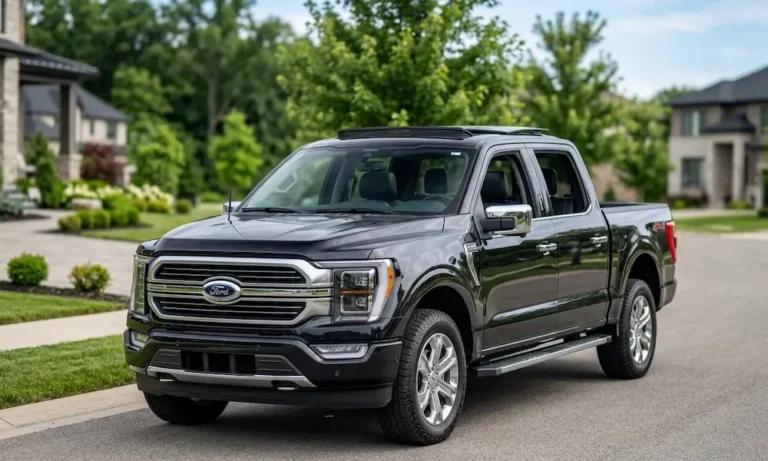
Picking the right Ford F-150 tow package can feel like decoding a menu written in a foreign language. Get it wrong and you leave serious capacity on the table — or worse, you tow beyond your truck’s limits. This guide breaks down every package, engine, and tech feature so you can build the right truck for your actual needs. Read to the end — the axle ratio section alone could save you a costly build mistake.
What Comes Standard on Every F-150
Before you spend a dollar on upgrades, know what you already have. Every 2024 and 2025 F-150 leaves the factory with a solid towing foundation — no extra options required.
Here’s what’s included on every trim:
- Class IV 2-inch hitch receiver — rated for up to 14,000 lbs
- 7-wire/4-pin/7-pin wiring harness
- Trailer Sway Control — electronic stability integration
- Tow/Haul Mode — software-adjusted shift points for towing
- Smart Trailer Tow Connector (XLT and above) — monitors trailer lights and battery status
That Smart Trailer Tow Connector is worth calling out. It doesn’t just connect power — it actively monitors your trailer’s brake lights and turn signals, then alerts you on the productivity screen if something fails. That’s a feature that used to cost extra. Now it’s just there.
| Component | Spec | Included |
|---|---|---|
| Hitch Receiver | Class IV, 2-inch | All trims |
| Wiring Harness | 7-wire / 4-pin / 7-pin | All trims |
| Smart Trailer Connector | Diagnostic + battery monitor | XLT and above |
| Trailer Sway Control | Electronic stability | All trims |
| Tow/Haul Mode | Software shift optimization | All trims |
The standard setup handles light utility trailers, small boats, and weekend campers without any issue. But if you’re chasing serious numbers, you’ll need the package below.
The Tow/Haul Package (Option Code 53T): The Main Upgrade
The Ford F-150 Tow/Haul Package is the primary path to maximum towing capability on 2024 and 2025 models. It replaced the old Max Trailer Tow Package and absorbed its functions — one cleaner option instead of several overlapping ones.
This package isn’t just a badge and a hitch. It adds:
- Integrated trailer brake controller — essential for trailers with electric brakes
- Upgraded radiator and transmission oil cooler — critical for sustained heavy towing
- Pro Trailer Backup Assist — steer your trailer with a dial, not guesswork
- Pro Trailer Hitch Assist — the truck aligns itself to your coupler automatically
- Heavy-duty reinforced rear bumper — distributes tongue weight across more frame
For the 2025 model year, you’ll also need to add the Max Tow Axle upgrade alongside 53T to unlock the maximum advertised capacity of 13,500 lbs. That axle swap upgrades the rear differential to a reinforced locking unit, typically at a 3.55 or 3.73 ratio.
Think of the Tow/Haul Package as the foundation, and the Max Tow Axle as the multiplier.
Engine Options and What They Actually Tow
Your engine choice shapes everything — capacity, torque delivery, and how the truck feels under load. The 2025 F-150 offers four main powertrains, each with a different towing sweet spot.
3.5-Liter EcoBoost V6 — The Towing King
This twin-turbo V6 is the engine to choose if max towing is your priority. It hits peak torque at just 3,100 RPM, which means it pulls hard the moment you need it — on ramp merges, steep grades, slow trailer starts.
| Spec | Value |
|---|---|
| Horsepower | 400 HP at 6,000 RPM |
| Torque | 500 lb-ft at 3,100 RPM |
| Max Towing | 13,500 lbs |
| Max Payload | 2,445 lbs |
Pair it with the SuperCrew 4×4 (157.2-inch wheelbase), the Tow/Haul Package, and the Max Tow Axle, and you’ve got the full 13,500-lb setup. That’s the configuration to build if you’re hauling large travel trailers or heavy equipment.
5.0-Liter Ti-VCT V8 — Payload and Versatility
The 5.0-liter V8 maxes out at 12,900 lbs of towing — slightly lower than the EcoBoost — but it earns its place for drivers who carry heavy loads in the bed. Slide-in truck campers, construction materials, and tool setups all play to the V8’s strengths. Its peak torque comes at 4,250 RPM, so it needs the 3.73 axle ratio to deliver adequate mechanical advantage during heavy pulls.
3.5-Liter PowerBoost Full Hybrid V6 — Instant Torque, Added Utility
The PowerBoost hybrid combines the twin-turbo EcoBoost with a 33-kilowatt electric motor inside the transmission. The result is 570 lb-ft of torque delivered instantly — before the turbos even spool. Starts with a heavy trailer feel buttery smooth.
The trade-off? The hybrid hardware adds weight, which reduces available payload compared to gas-only models. Max tow rating sits at 11,200 lbs. You also get the Pro Power Onboard system with up to 7.2 kW of exportable power — handy for job sites or remote campsites.
How the F-150’s Tow Tech Makes You a Better Tower
The 2024 and 2025 F-150 packs digital tools that genuinely reduce the stress of towing. These aren’t gimmicks — they solve real problems that cause accidents and damage.
Onboard Scales and Smart Hitch
Overloading your truck is one of the most common — and dangerous — towing mistakes. These two systems help you avoid it.
Onboard Scales use suspension sensors to give you a real-time payload estimate through the SYNC 4 screen or the FordPass app. The F-150 even builds the display into the LED taillamps: load the bed and the LED bars fill up as you approach the payload limit. You’ll see it without opening an app.
Smart Hitch solves tongue weight guessing. As you lower your trailer onto the ball, the system measures the downward force and tells you whether to move weight forward or backward in the trailer. Tongue weight should sit between 10-15% of total loaded trailer weight — too little causes sway, too much kills your steering.
Pro Trailer Backup Assist and Hitch Assist
Backing a trailer in reverse takes most people years to master. Pro Trailer Backup Assist skips the learning curve entirely. You turn a dial on the center console to indicate the direction you want the trailer to go — the truck handles the counter-steering automatically.
Pro Trailer Hitch Assist goes one step further. Using the rear camera and radar, the truck steers itself, brakes, and controls acceleration to line up the hitch ball with the coupler. If you’ve ever tried to do this alone in a tight campground, you understand why this feature matters.
Axle Ratios: The Build Decision Most People Miss
The axle ratio you choose during the build process has a bigger impact on towing performance than most buyers realize. A lower numerical ratio like 3.31 keeps RPMs down at highway speeds and saves fuel on empty drives. A higher ratio like 3.73 gives you the mechanical leverage to move heavy loads efficiently.
| Axle Ratio | Best Use | Availability |
|---|---|---|
| 3.15 / 3.31 | Fuel-focused highway driving | Standard on many 4×2 and hybrid configs |
| 3.55 | Balanced performance and towing | Standard on 4×4; required for Max Tow |
| 3.73 | Maximum towing and payload | Required for 5.0L V8 and 3.5L Hybrid Max Tow |
| 4.10 | Off-road performance | Raptor models only |
You can’t change your axle ratio after purchase without significant cost. Pick the right one at the order stage.
Wheelbase, Drivetrain, and Why Configuration Matters
Not every F-150 can hit the same numbers. The SuperCrew 4×4 with a 157.2-inch wheelbase is the specific configuration required to achieve the maximum 13,500-lb rating with the 3.5-liter EcoBoost. Longer wheelbases create a more stable towing platform and reduce trailer push during sudden maneuvers.
4×2 models often carry slightly higher tow and payload ratings than 4×4 versions. The 4×4 hardware — transfer case, front differential, drive shafts — adds weight that gets subtracted from the Gross Vehicle Weight Rating. If you never take the truck off-road, a 4×2 build can give you a small but meaningful capacity advantage.
All capacity numbers follow the SAE J2807 standard — a real-world set of tests that includes highway acceleration, grade climbing, and braking. Ford’s numbers aren’t marketing estimates.
F-150 Lightning Towing: Electric Capability with One Big Caveat
The all-electric Lightning delivers massive instant torque and a surprisingly capable tow rating when properly equipped.
| Lightning Config | Standard Battery | Extended Range Battery |
|---|---|---|
| Max Towing (Base) | 5,000 lbs | 7,700 lbs |
| Max Towing (w/ Max Tow Pkg) | 7,700 lbs | 10,000 lbs |
| Max Payload | 2,235 lbs | 1,952 lbs |
The catch is range. Pulling a large, boxy trailer can cut the Lightning’s range by 50% or more. Ford built range-estimation software that accounts for your specific trailer’s drag and weight — but you’ll still need to plan charging stops more carefully than with a gas model.
F-150 Raptor: Off-Road Star, Average Tower
The Raptor’s long-travel suspension and soft spring rates that make it incredible off-road actively hurt its towing numbers. You can’t have both — the same compliance that absorbs big hits can’t support heavy tongue weight.
- Raptor: 8,200 lbs max towing
- Raptor R (720-HP supercharged V8): 8,700 lbs max towing
These trucks work well for towing a couple of personal watercraft or an off-road toy trailer to the trailhead. They’re not built for a 40-foot travel trailer.
Weight Distribution and Safe Towing Practices
For any trailer over 5,000 lbs, Ford’s official towing guide strongly recommends a weight-distributing hitch. A standard hitch puts all the tongue weight on the rear bumper — that lifts the front axle and kills your steering control and braking effectiveness. Weight-distributing hitches use spring bars to share that load across all axles, keeping the truck level.
A few other things to keep in check:
- Check tire pressure on both truck and trailer before every heavy tow — cold inflation numbers change with load
- Monitor your GCWR (Gross Combined Weight Rating) — this is the combined limit of truck plus trailer, fully loaded
- Inspect brake fluid and cooling system fluid more frequently if you tow regularly — the 10-speed transmission generates serious heat under sustained loads
The truck’s adaptive transmission software compensates for some wear, but heat is the enemy of any towing setup. Stay ahead of it with regular fluid checks.
Why Ford Dropped the Heavy-Duty Payload Package
Starting in 2024, Ford discontinued the Heavy-Duty Payload Package (HDPP). This package previously pushed payload over 3,000 lbs but required a very specific combination — 5.0-liter V8, regular cab, 4×2, 8-foot bed — that almost nobody ordered.
Ford cut the complexity to streamline production. The current best-in-class payload of 2,445 lbs covers the vast majority of real-world half-ton needs. If your work genuinely requires payload over 3,000 lbs on a consistent basis, Ford’s position is clear: step up to the Super Duty F-250 or F-350. That’s the right tool for that job.