Your Ford’s check engine light is on, you’ve pulled the code, and it says P0304. That’s a cylinder 4 misfire — and it can mean anything from a bad spark plug to a cracked engine block. This guide breaks down every real cause, how to diagnose it correctly, and why driving through it is a genuinely bad idea.
What Is the Ford P0304 Code?
Ford P0304 means the powertrain control module (PCM) detected a misfire specifically in cylinder 4. A misfire happens when the air-fuel mixture in that cylinder doesn’t burn properly — or doesn’t burn at all.
The PCM catches this by watching the crankshaft position sensor. Every healthy combustion event gives the crankshaft a small speed boost. If cylinder 4 misfires, that boost doesn’t happen. The PCM counts those missed events, and once they hit a set threshold, it stores the P0304 code.
See a flashing check engine light? That’s more urgent. It means the misfire is happening fast enough to dump raw fuel into the catalytic converter, which can destroy it. Don’t keep driving.
Where Is Cylinder 4 on a Ford Engine?
Before you touch anything, you need to find the right cylinder. Cylinder 4’s location changes depending on your engine.
| Engine | Cylinder 4 Location | Bank |
|---|---|---|
| Inline 4-Cylinder (1.5L / 2.0L EcoBoost) | Furthest from the front, closest to the transmission | Single bank |
| V6 Longitudinal (F-150 3.5L / 2.7L) | Front-most cylinder, driver’s side | Bank 2 |
| V6 Transverse (Edge / Fusion 3.5L) | Front-most cylinder, radiator side | Bank 2 |
| V8 (Coyote 5.0L / Triton 5.4L) | Rear-most cylinder, passenger side | Bank 1 |
| V10 Triton (6.8L) | Fourth cylinder from front, passenger side | Bank 1 |
On a V8 like the Coyote 5.0L, cylinder 4 sits near the firewall on the passenger side — one of the hardest spots to reach. That location matters because moisture and heat concentrate back there.
The Three Root Causes of Ford P0304
Every misfire traces back to one of three systems: ignition, fuel delivery, or mechanical compression. Start with ignition — it’s the most common culprit by far.
Ignition System Failures
Coil-on-Plug Problems
Ford’s coil-on-plug (COP) system puts an individual ignition coil directly on top of each spark plug. It’s efficient, but it also puts the coil in a brutal heat environment. Over time, the rubber boot that connects the coil to the plug develops microscopic cracks. High-voltage energy takes the path of least resistance — right through those cracks into the cylinder head instead of to the plug.
This is called carbon tracking, and it causes a misfire that gets worse under load. You’ll notice it most when merging onto a highway or climbing a hill.
On the 5.4L Triton, cylinder 4 has a specific problem: it sits directly below the heater core and cowl drain area. Leaking heater hoses or rainwater can drip right onto that coil. Water shorts it out, and the misfire stays until you fix the leak — not just the coil. Owners on the F-150 forum have documented this exact failure pattern repeatedly.
Spark Plug Degradation
Spark plugs wear out. The electrode erodes, the gap widens, and eventually the coil can’t produce enough voltage to jump the gap — especially under the pressure of a turbocharged engine. The result is a misfire that starts soft and gets progressively worse.
Fouled plugs are just as common:
- Oil fouling — Oily film on the plug tip, usually from a leaking valve cover gasket or worn piston rings
- Wet fouling — Raw fuel soaking the plug, pointing to a leaking injector
- Carbon fouling — Hard carbon deposits on the insulator in EcoBoost direct-injection engines
- Cracked insulator — The spark leaks out the side instead of firing at the gap
If a plug is fouled, find out why before you replace it. A fresh plug in a broken engine just buys you a few weeks before the Ford P0304 comes back.
Fuel Delivery Problems
Clogged or Faulty Fuel Injectors
A bad injector can cause a lean misfire (too little fuel) or a rich misfire (too much fuel). In Ford’s EcoBoost direct-injection engines, the injector tips live inside the combustion chamber. Carbon deposits build up on those tips, wrecking the spray pattern. The cylinder doesn’t get the right mixture, and it misfires.
A stuck-open or leaking injector is the opposite problem. A technician using a borescope on a 2018 F-150 5.0L actually watched fuel dripping from the cylinder 4 injector and pooling on the piston after a hot restart. That soaked mixture is too rich to ignite. You’ll smell raw fuel in the exhaust.
High-Pressure Fuel System Issues
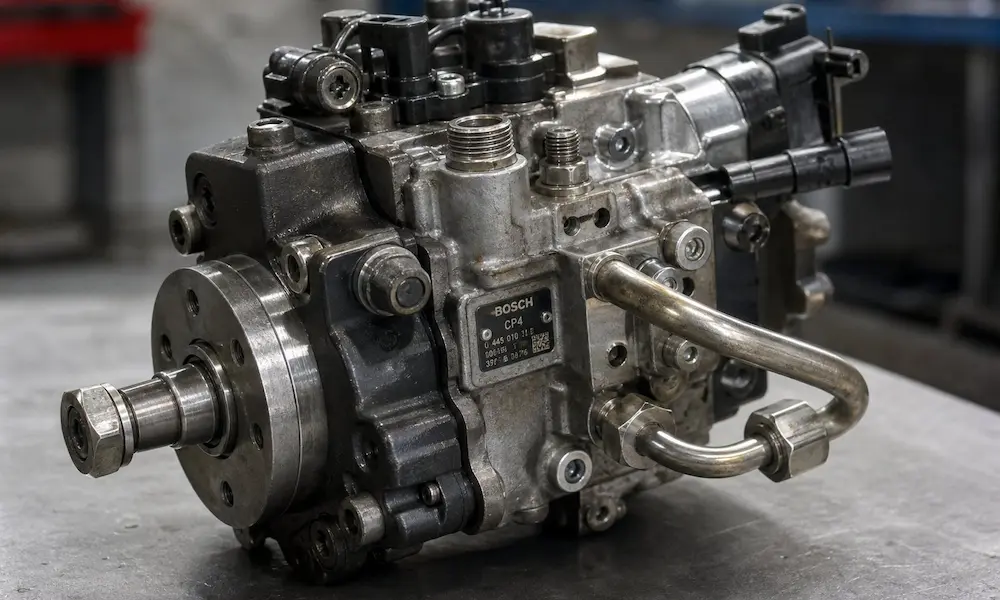
The high-pressure fuel pump in direct-injection engines runs off the camshaft. A failing pump typically triggers misfires across multiple cylinders (P0300), but a localized restriction in the fuel rail can sometimes hit cylinder 4 alone — particularly if it’s the furthest cylinder from the pump.
Mechanical Compression Failures
If the ignition and fuel systems check out, you’re looking inside the engine.
Carbon on Intake Valves (EcoBoost-Specific)
Port-injection engines spray fuel into the intake manifold, so the fuel naturally cleans the valves. Direct-injection engines don’t. Oil vapors from the positive crankcase ventilation system coat the hot intake valves and bake into rock-hard carbon deposits. Eventually, those deposits are thick enough to prevent the valve from closing fully. Compression drops, and you get a P0304 — usually worst at idle.
The fix is walnut blasting. Technicians remove the intake manifold and blast crushed walnut shells through the intake ports with the valves closed. It strips the carbon without damaging the metal. Chemical cleaners usually don’t cut it for heavy buildup.
Piston Rings and Head Gaskets
Worn or broken piston rings let compressed gases blow past the piston into the crankcase. A failed head gasket allows pressure to escape into the cooling system or a neighboring cylinder. On high-mileage Coyote 5.0L engines, valve seat recession — where the metal seat wears away — can also cause a mechanical misfire that requires cylinder head replacement.
The EcoBoost Coolant Intrusion Problem
This one deserves its own section because it’s not just a common cause of Ford P0304 — it’s a documented design flaw.
The 1.5L and 2.0L EcoBoost engines used in the Fusion, Escape, and Edge have a cooling groove between the cylinder bores that was meant to regulate heat. Under turbocharged combustion pressure, the metal around that groove fatigues. Coolant seeps past the head gasket and pools in cylinder 4 (and sometimes others) while the engine sits overnight.
When you start the car cold, the engine tries to compress liquid coolant. It can’t. The result is an extremely rough start, white smoke from the tailpipe, a sweet smell from the exhaust, and a P0304 code. Low coolant level is usually the first sign something’s wrong.
Ford issued multiple technical service bulletins and a full customer satisfaction program in response:
| TSB / Program | Affected Engine | What Ford Does |
|---|---|---|
| TSB 19-2346 | 2.0L EcoBoost (2015–2018 Edge, 2017–2019 Fusion/Escape) | Replace long block assembly |
| TSB 19-2139 | 1.5L EcoBoost (2014–2019 Fusion, 2017–2019 Escape) | Replace short block and head gasket |
| Customer Satisfaction Program 21N12 | 1.5L EcoBoost (2017–2019 Fusion/Escape) | One-time no-cost short block replacement |
If your car falls in those model years and you have a cold-start misfire with low coolant and white smoke, check if your VIN qualifies for 21N12 before spending money on anything else.
The 3.5L EcoBoost Intercooler Condensation Issue
The F-150’s 3.5L EcoBoost has a different environmental quirk. The intercooler cools compressed air before it enters the engine. In humid weather, that cooling process can cause moisture to condense inside the intercooler’s bottom tank. Hit the throttle hard — like merging onto a highway — and the sudden airflow can suck that pooled water straight into the engine.
The water momentarily kills combustion in cylinders 4, 5, and 6. You get a hard stumble, a flashing check engine light, and P0304. Ford addressed this with TSB 13-8-1, which installs plastic deflectors to reduce over-cooling and updates the PCM’s software to handle the air-fuel ratio better during hard acceleration.
Air Leaks and Vacuum System Failures
Unmetered air sneaking into the intake system causes a lean misfire. The PCM doesn’t know to add more fuel, so cylinder 4 starves.
Common leak points:
- Intake manifold gasket — Cracked or warped gaskets near cylinder 4’s intake port, especially on plastic intake manifolds
- Brake booster hose — Cylinder 4 sits near the rear of many engines, close to the vacuum lines. A cracked hose floods the rear cylinders with air
- Intake Manifold Runner Control (IMRC) — On the Coyote 5.0L, a disconnected or stuck butterfly valve for cylinder 4 disrupts airflow and sets the P0304
Technicians use a smoke machine here — pressurize the intake, then look for where the smoke escapes.
How to Diagnose Ford P0304 Step by Step
Don’t throw parts at it. Work through this in order.
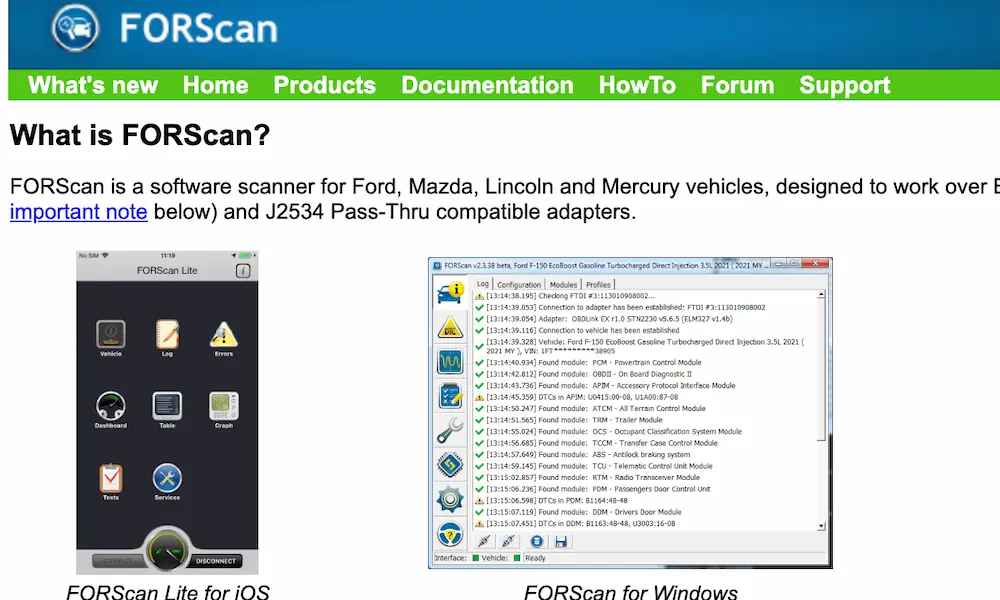
Step 1 — Read the freeze frame data. Pull the P0304 and note what the engine was doing when the code set. Cold start? Under load? At idle? That context narrows it down fast.
Step 2 — Visual inspection. Look for chewed wires (rodent damage is more common than you’d think), loose connectors, and moisture near cylinder 4’s coil pack. Check the coolant level.
Step 3 — The swap test. Move the cylinder 4 coil to cylinder 3. If the misfire moves to P0303, the coil is bad. If it stays at P0304, swap the spark plug. If it still stays, the coil and plug are fine — dig deeper into fuel and mechanical causes.
Step 4 — Check fuel trims. A scan tool showing positive fuel trims means the engine is running lean — look for vacuum leaks or a clogged injector. Negative fuel trims mean it’s running rich — check for a leaking injector.
Step 5 — Compression and leakdown test. If the ignition and fuel systems look fine, do a compression test. A cylinder reading more than 15% lower than the others has a mechanical problem. Follow it with a leakdown test — inject compressed air into the cylinder and listen for where it escapes.
- Air from the throttle body → bad intake valve
- Air from the tailpipe → bad exhaust valve
- Air from the oil fill cap → worn piston rings
Step 6 — Advanced diagnostic tools. Ford’s IDS Power Balance test maps each cylinder’s contribution to total power output in real time. A dipping line on cylinder 4 confirms the misfire. An oscilloscope attached to the coil’s control wire lets you see the actual spark signature — useful for catching coils that fail under load but test fine at rest.
What Happens If You Ignore Ford P0304
Driving with an active P0304 damages things fast — and expensively.
Catalytic converter destruction. Raw, unburned fuel dumps into the exhaust with every misfire cycle. The catalytic converter tries to burn it off, its internal temperature skyrockets, and the ceramic substrate melts. Replacing a catalytic converter costs significantly more than fixing a spark plug.
Cylinder wall damage. Unburned fuel washes the oil film off the cylinder walls. Metal rings scrape against a dry metal bore. You’re scoring the cylinder walls, which turns a $30 plug replacement into an engine rebuild.
Oil dilution. In direct-injection engines, fuel seeping past the piston rings mixes with the engine oil. Diluted oil can’t protect the crankshaft bearings or the turbochargers. Both failures are catastrophic and expensive.
Repair Tips That Actually Matter
Use OEM parts. Ford engines — especially EcoBoost models — are sensitive to the electrical resistance of spark plugs and coils. Cheap aftermarket parts often have slightly different specs that the PCM reads as a soft misfire. You’ll clear the code, drive two weeks, and the light comes back. Motorcraft plugs and coils are worth the extra cost.
Address the root cause first. If you pull a plug and it’s soaked in oil, replace the valve cover gasket before you install the new plug. If it’s white and crusty, check for coolant intrusion before anything else. A fresh component in a broken system is a short-term fix at best.
Check for TSBs and open programs. If your Ford is a 2014–2019 Fusion or 2017–2019 Escape with a 1.5L EcoBoost, check your VIN against Customer Satisfaction Program 21N12 before paying out of pocket for an engine repair that Ford may cover for free.
Consider a PCM reflash. If every hardware component tests perfectly, Ford may have released a software update that changes how the PCM handles certain conditions — cold starts, high humidity, or load transitions. A reflash costs almost nothing and occasionally eliminates a ghost P0304 entirely.
The Ford P0304 isn’t always a catastrophe, but it’s never something to park and forget about. Follow the diagnostic steps, use the right tools, and you’ll track down the real cause without wasting money on parts you don’t need.