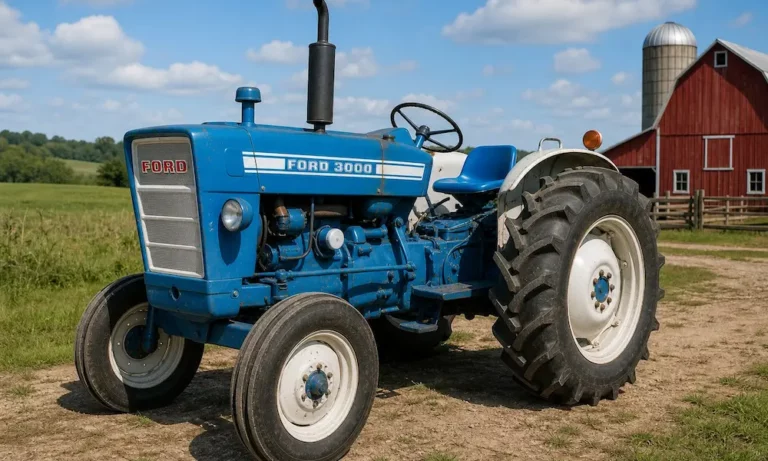
Got an old Ford tractor sitting in your barn and no idea what year it is or how it’s configured? You’re in the right place. This guide walks you through every era of Ford tractor serial numbers — from the original 9N right up to the compact Shibaura imports. Read to the end, because the details in the later sections could save you from ordering the wrong parts entirely.
Why the Ford Tractor Serial Number Decoder Matters More Than You Think
Here’s the thing most people miss: a Ford tractor’s serial number isn’t just a birth certificate. It tells you the exact engine, transmission, PTO setup, and even which factory built it.
Get this wrong, and you’ll order clutch kits that don’t fit, hydraulic seals that leak from day one, and water pumps that bolt up to nothing. According to the Ford Fordson Collectors Association, because parts vary significantly even within a single model year, the stamped numbers are the only reliable way to confirm which replacement parts actually fit.
There’s another problem worth knowing upfront: component swapping is very common in the used tractor market. An engine from a 1949 tractor sitting inside a 1951 frame isn’t unusual. If the stamps don’t line up across components, a previous owner almost certainly rebuilt the machine using salvage parts. You’ll want to spot that before you buy or restore anything.
Where to Find the Serial Number on a Ford Tractor
The location changed multiple times across the decades. Don’t go hunting in the wrong spot.
Here’s exactly where to look:
- 9N, 2N, and 8N (1939–1952): Left side of the engine block, just below the cylinder head and behind the oil filter. These stamps are shallow and often caked with grease. Use a wire brush and try different light angles.
- NAA Jubilee (1952–1954): First 22,238 units use the engine block location. Later NAAs move to the left side of the transmission housing, just below the flat surface above the starter motor.
- Hundred Series and 01 Series (1954–1962): Machined horizontal surface on the transmission bell housing, directly above and behind the starter motor on the left side.
- Three-Cylinder Thousand Series (1965–1975): Right side of the tractor, on the flywheel housing clutch flange, directly behind the starter motor.
If you find stamps in two different locations that don’t agree with each other, an engine swap happened at some point. That’s not always a dealbreaker, but you need to know it going in.
Ford’s Sneaky Stamping Quirks That Trip Everyone Up
Ford deliberately used non-standard character dies to prevent serial falsification. This trips up even experienced restorers.
Watch for these:
- The letter “I” was used instead of the number “1”
- A lowercase “b” was used for the number “6”
- That same “b” die, flipped upside down, was used for “9”
Also, every genuine serial number on pre-1965 models is flanked by stamped symbols. Stars appear on 8N tractors before serial 433578. Diamonds appear on later 8N models and all subsequent series through 1964. If those flanking symbols are missing, that’s a red flag worth investigating.
Decoding N-Series and NAA Jubilee Serial Numbers (1939–1954)
The N-Series uses strictly sequential numbering with a model prefix. One thing catches almost everyone: Ford never used a “2N” prefix. Every 2N tractor uses the “9N” prefix on its engine block stamp.
Here’s the full production serial range for this era:
| Model | Year | Start Serial | End Serial |
|---|---|---|---|
| Ford 9N | 1939 | 9N1 | 9N10275 |
| Ford 9N | 1940 | 9N10276 | 9N46017 |
| Ford 9N | 1941 | 9N46018 | 9N88933 |
| Ford 9N | 1942 | 9N88934 | 9N99046 |
| Ford 2N | 1942 | 9N99047 | 9N105411 |
| Ford 2N | 1947 | 9N258540 | 9N306221 |
| Ford 8N | 1947 | 8N1 | 8N37907 |
| Ford 8N | 1950 | 8N245637 | 8N343592 |
| Ford 8N | 1952 | 8N442035 | 8N524076 |
| Ford NAA | 1952 | NAA00001 | NAA04929 |
| Ford NAA | 1954 | NAA77475 | NAA128965 |
Key 8N Design Changes Mid-Production
Two design changes happened mid-stream on the 8N, and the serial number tells you which version you have:
- At serial 263843 (1950): Ford switched from a front-mounted distributor to a side-mounted distributor. The block casting changed to “8N-B.”
- After serial 433577: Thicker cylinder sleeves were introduced. Blocks carry the “8N-C” casting identifier.
These details matter a lot when sourcing ignition parts and engine seals.
Rare Variant Prefixes
Some specialized variants carry unique prefix codes worth knowing:
- 9NAN / 8NAN — Distillate or kerosene-burning tractor with a dual fuel tank
- 9NBN — Industrial variant with heavy steel frame, no hydraulic lift
- BNO25 / BNO40 — Military and commercial heavy towing tractors
Reading the Hundred Series and 01 Series Model Codes (1954–1962)
From 1954 onward, Ford switched to a two-line system stamped on the transmission bell housing. The top line is the model configuration code. The bottom line is the sequential serial number.
First digit — Chassis and engine size:
- 5 = One-row offset, 134ci gas/LP or 144ci diesel
- 6 = Four-wheel utility, adjustable front axle, 134ci or 144ci
- 7 = High-clearance row-crop, 134ci or 144ci
- 8 = Four-wheel utility, 172ci gas/LP or diesel
- 9 = High-clearance row-crop, 172ci engines
Second digit — Drivetrain and PTO:
- 2 = 4-speed, no PTO, no hydraulic lift
- 4 = 4-speed, transmission PTO, hydraulic lift
- 6 = 5-speed, live PTO with two-stage clutch, hydraulic lift
- 8 = Select-O-Speed, dual-speed PTO, hydraulic lift
Third digit — Generation:
- 0 = Hundred Series (1954–1957)
- 1 = “01” Series (1957–1962)
Letter suffixes flag factory options:
- -L = LP Gas engine
- -D = Diesel engine
- -1 = Tricycle single front wheel
- -4 = High-clearance wide front axle
Here’s the serial number range for this era:
| Model Group | Year | Start Serial | End Serial |
|---|---|---|---|
| Hundred Series | 1954 | 1 | 10614 |
| Hundred Series | 1955 | 10615 | 77270 |
| Hundred Series | 1956 | 77271 | 116367 |
| “01” Series | 1957 | 1001 | 11996 |
| “01” Series | 1959 | 58312 | 105942 |
| “01” Series | 1962 | 155531 | End of Series |
| Early 4-Cyl Thousand Series | 1962 | 1001 | 11947 |
| Early 4-Cyl Thousand Series | 1964 | 38931 | End of Series |
Decoding the Three-Cylinder Thousand Series (1965–1975)
This is where Ford’s ford tractor serial number decoder system gets sophisticated. Three separate lines of data are stamped on the right-side flywheel housing flange. Here’s what each line means:
Line 1: Model Configuration Code (6 characters)
- Character 1 — Model series: 2/B = 2000, 3/C = 3000, 4/D = 4000, 5/E = 5000, F = 6000. Numeric prefixes were used before April 1968; letter prefixes replaced them after.
- Characters 2–3 — Chassis type: 10 = Agricultural all-purpose, 11 = Low center of gravity industrial, 20 = Row-crop, 50 = Heavy industrial
- Character 4 — Fuel type: 1 = Diesel, 2 = Gasoline, 3 = LP Gas
- Character 5 — PTO configuration: 0 = No PTO, 3 = Live dual-clutch 540rpm, 5 = Independent dual-speed 540/1000rpm
- Character 6 — Transmission: A = 4-speed manual, C = 8-speed dual-range, E = 10-speed Select-O-Speed, G = 4-speed forward/reverse manual-reversing
Line 2: Unit Date Code
The date code breaks down like this:
- First digit = last digit of the year (7 = 1967 or 1977)
- Second character = month (A = January through M = December, skipping “I”)
- Next two digits = day of month
- Final letter = shift (A = midnight, B = day, C = afternoon)
So a code reading 2J29B means assembled September 29, 1972, during the day shift.
Line 3: Serial Number with Factory Prefix
The letter prefix identifies which factory built the tractor:
- A = Antwerp, Belgium
- B = Basildon, England
- C = Highland Park, Michigan, USA
| Year | US (C prefix) | UK (B prefix) | Belgium (A prefix) |
|---|---|---|---|
| 1965 | C100000 | B100000 | A100000 |
| 1968 | C190200 | B190200 | A190200 |
| 1971 | C292100 | B292100 | A292100 |
| 1974 | C405200 | B405200 | A405200 |
| 1975 | C450700 | B450700 | A450700 |
A Real-World Decode Example
Take a tractor stamped 45021G, serial C166016, date 7I3I4.
Breaking it down:
- 4 = 4000 Series platform
- 50 = Industrial chassis
- 2 = Gasoline engine
- 1 = No PTO
- G = 4-speed forward/reverse manual-reversing transmission
- C serial prefix = Highland Park, Michigan
- 166016 = Production year 1967
- Date code 7 = 1967, final 4 = afternoon shift
The doubled “I” in the date stamp is a classic mis-stamp — a known anomaly documented on Yesterday’s Tractors Forums. Once you know Ford used “I” in place of “1”, those confusing date stamps start making sense.
Post-1975 Models: The 600 and 10 Series
After 1975, Ford moved to a unified sequential serial system covering the 2600, 3600, 4600, 5600, 6600, and later the 2610, 3910, 4610, and 5610 series. The A, B, and C factory prefixes stayed in place.
| Year | Starting Serial (C prefix) |
|---|---|
| 1976 | C490300 |
| 1979 | C595800 |
| 1982 | C682000 |
| 1985 | C732600 |
| 1987 | C763228 |
Shibaura Compact Imports: The “U” Prefix Models
Starting in the mid-1970s, Ford partnered with Shibaura in Japan to produce compact tractors — the 1000, 1100, 1200, 1300, 1500, 1700, and 1900 models — for North America.
These don’t use the A/B/C factory prefixes. They use a “U” prefix (Universal Import), and the serial is stamped on the left side of the engine block or on an aluminum ID tag inside the hood.
| Model | Year | Starting Serial |
|---|---|---|
| Ford 1000 | 1973 | U100001 |
| Ford 1000 | 1975 | U102021 |
| Ford 1200 | 1980 | U200001 |
| Ford 1300 | 1979 | U300001 |
| Ford 1500 | 1979 | U500001 |
| Ford 1700 | 1980 | U704803 |
| Ford 1900 | 1979 | U900001 |
Anglo Agriparts’ Ford serial number tables carry the extended ranges for these compact models.
Owners of British Fordson imports — the Dexta or Major Series — need a separate set of serial ranges from the Dagenham facility.
One Last Tip Before You Start Decoding
Take photos of every stamp before you touch anything. Wire brushes and cleaning solvents can lift shallow stamps permanently. If numbers are too worn to read clearly, the Yesterday’s Tractors Forums identification threads have helped owners identify tractors from partial stamps and casting codes for years. Post your photos there if you get stuck — the community knows these machines inside out.