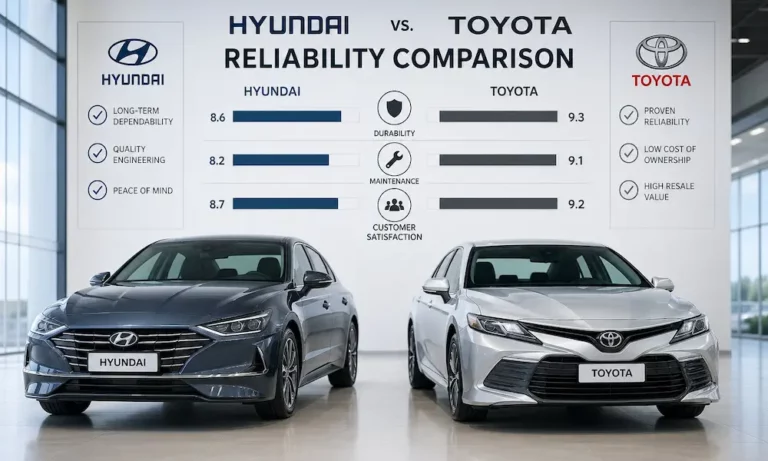
Picking between these two giants isn’t easy — especially when your wallet’s on the line. This post breaks down real data on Hyundai vs Toyota reliability, from repair costs to recalls to what happens after 200,000 miles. Stick around, because the answer might surprise you.
The Reliability Scorecard: Where Each Brand Stands Right Now
Let’s cut straight to it. Toyota took the #1 spot in Consumer Reports’ 2026 predicted reliability rankings with a score of 66 out of 100. Hyundai sits at 12th place with a score of 48.
That sounds like a blowout — but it isn’t.
Hyundai still beats most American and European brands. It’s 12th out of the entire industry, not the bottom of the barrel. The gap between Toyota and Hyundai is real, but the story behind the numbers matters more than the numbers themselves.
| Brand | 2026 Reliability Score | Industry Rank |
|---|---|---|
| Toyota | 66 | 1st |
| Subaru | 63 | 2nd |
| Lexus | 60 | 3rd |
| Honda | 59 | 4th |
| Hyundai | 48 | 12th |
Toyota’s top ranking comes from one core strategy: keep what works, improve slowly. Hyundai’s strategy is the opposite — pack in more tech, move faster, and back it all with a monster warranty.
Both strategies have real consequences for your ownership experience.
Why Toyota Keeps Winning the Long Game
Toyota engineers don’t love change for the sake of it. Their “slow and steady” approach means core components — engines, transmissions, suspension — stay consistent for years. They tweak, they refine, they don’t reinvent.
The result? The Toyota 4Runner scored a near-perfect 95 out of 100 in the 2026 Consumer Reports rankings. That score comes from running an older, proven platform that Toyota has spent years dialing in.
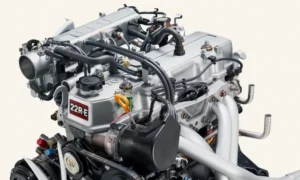
This philosophy matters most to the 200,000-mile crowd. Toyota’s naturally aspirated engines — like the 2.5-liter four-cylinder in the Camry and RAV4 — are built with generous tolerances and survive a wide range of conditions with minimal wear.
What this means for you:
- Fewer “cascading failures” from untested new systems
- Engines that just keep running past 200k miles
- Higher resale value because buyers trust the name
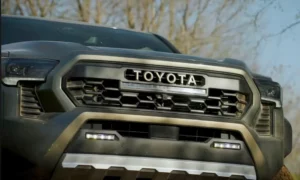
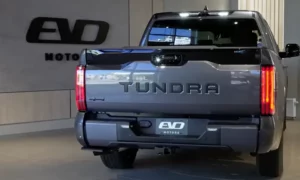
The downside? Toyota’s interiors can feel dated. And newer models like the 2026 Tundra — which jumped to a twin-turbo powertrain — have early teething issues with a reliability score of just 41 out of 100. Toyota isn’t immune to its own complexity tax when it strays from simplicity.
Why Hyundai Is Closing the Gap Fast
Hyundai isn’t the budget brand it used to be. It’s now a genuine tech competitor — bigger screens, smarter driver-assistance systems, more features per dollar than almost anyone.
The trade-off is what analysts call a complexity tax. More technology means more chances for something to glitch. The 2026 J.D. Power Vehicle Dependability Study confirmed that high-tech vehicles fail more often than simpler ones — mostly due to infotainment and software issues.
Hyundai’s biggest recent headache? A recall of over 41,000 vehicles — including the Tucson, Ioniq 5, Santa Fe, and Sonata — because a software bug caused digital instrument displays to go blank at startup. That’s not a mechanical failure. It’s a software deployment problem.
Still, Hyundai’s mechanical core has genuinely improved. The Palisade, for example, shows strong powertrain durability in owner surveys. The Elantra Hybrid earns solid marks for efficiency and features.
The honest summary: Hyundai’s engines are better than they’ve ever been. The electronics need more time to mature.
The Real Cost Difference: 10 Years of Ownership
Here’s where Hyundai vs Toyota reliability gets very personal — your bank account.
Over 10 years, Toyota owners spend an average of $5,470 on maintenance and repairs. Hyundai owners spend $7,024. That’s a $1,554 difference — roughly the cost of three or four repair visits.
But the bigger number is the major repair probability:
| Brand | Average 10-Year Cost | Major Repair Probability |
|---|---|---|
| Toyota | $5,470 | 14.97% |
| Hyundai | $7,024 | 23.46% |
A “major repair” means any single bill over $500. Toyota’s probability is nearly 10 percentage points lower than Hyundai’s. For a budget-conscious buyer, that gap represents real financial risk.
Both brands get cheaper to maintain in their electric and hybrid models. Toyota’s bZ4X projects just $3,479 over 10 years, while Hyundai’s Ioniq 6 comes in at $3,893. As both brands go electric, the cost gap shrinks — because EVs simply have fewer things to break.
Hybrid Reliability: Toyota’s Secret Weapon
If you drive a lot of miles, hybrid reliability is everything. And this is where Toyota has the clearest edge.
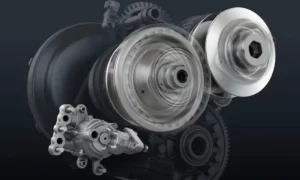
Toyota’s Hybrid Synergy Drive uses a planetary gearset instead of a traditional transmission. It has fewer moving parts and has proven it can last well over 300,000 miles on original hardware. Toyota also backs new hybrid batteries with a 10-year/150,000-mile warranty.
Hyundai’s hybrid systems use a conventional six-speed automatic transmission. That gives drivers a more familiar shifting feel — but it also means clutch packs, valve bodies, and fluid changes over time. Hyundai covers hybrid components for 10 years or 100,000 miles — solid coverage, but 50,000 miles shorter than Toyota’s.
There’s also a secondary market issue. Toyota has sold hybrids since 1997. That means replacement batteries are widely available — including refurbished packs for $1,500 to $3,500. Hyundai’s smaller hybrid market share means fewer affordable aftermarket options when you’re out of warranty.
The Warranty Question: Does Hyundai’s Coverage Change the Math?
This is Hyundai’s strongest argument, and it’s a real one.
Hyundai’s “America’s Best Warranty” covers powertrains for 10 years or 100,000 miles. Toyota’s powertrain warranty is 5 years or 60,000 miles — half the duration.
| Coverage | Toyota | Hyundai |
|---|---|---|
| Bumper-to-Bumper | 3 Years / 36,000 Miles | 5 Years / 60,000 Miles |
| Powertrain | 5 Years / 60,000 Miles | 10 Years / 100,000 Miles |
| Complimentary Maintenance | 2 Years / 25,000 Miles | 3 Years / 36,000 Miles |
| Roadside Assistance | 2 Years / Unlimited | 5 Years / Unlimited |
| Anti-Perforation (Rust) | 5 Years / Unlimited | 7 Years / Unlimited |
For buyers who keep cars 7–10 years, a 10-year-old Hyundai with 90,000 miles is still under powertrain warranty. A Toyota of the same age has been on its own for five years.
One catch: Hyundai’s powertrain warranty doesn’t fully transfer to a second owner. A private sale drops coverage to 5 years/60,000 miles — matching Toyota’s original terms. So the warranty advantage mainly benefits original buyers.
For anyone on a fixed budget who plans to keep the car for a decade, Hyundai’s warranty is genuinely valuable protection.
Recalls: Both Brands Have Work to Do
Neither brand gets a clean slate on recalls. Both Toyota and Hyundai had significant recall events in 2025–2026.
Toyota’s recalls tend to be mechanical and hardware-driven. Over 55,000 Camry and Corolla Hybrids were recalled for a loose inverter bolt that could cause power loss or fire risk. Some 2023–2024 models faced recalls for incorrectly welded steering column cables.
Hyundai’s recalls are increasingly software and electronics related — but not always. The Palisade faced a recall of over 568,000 units for seat belt buckles that could fail to latch — a critical safety issue requiring dealer inspection.
| Metric | Toyota | Hyundai |
|---|---|---|
| Sample Week Units Affected | 591,377 | 568,580 |
| Primary Issue Type | Electrical / Mechanical | Safety / Software |
| Fix Method | Dealer Visit | Dealer Visit or OTA Update |
One area where Hyundai holds an edge: over-the-air updates. Many software-related issues get fixed remotely without a dealer visit. Toyota’s mechanical recalls almost always require a physical service appointment.
Model-by-Model: Which Wins in Each Segment?
Sedans
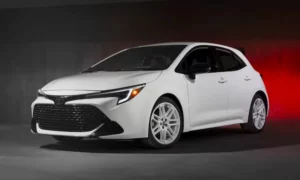
The Toyota Camry and Corolla remain the benchmarks for long-term durability. High-mileage owners consistently report that engines and transmissions outlast the interior. The Hyundai Elantra Hybrid earns strong marks on features and fuel economy — but reports more “nuisance” issues like flickering dashboards and unresponsive screens.
For resale value, the Camry wins clearly.
SUVs
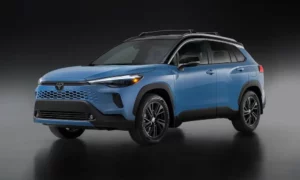
The RAV4 and Highlander are legendary family haulers. The 2026 Hyundai Tucson competes on price, warranty, and interior quality — but early Palisade models had minor electrical comfort glitches. The Palisade’s mechanical core is solid, though.
Trucks
The 2026 Tundra has faced multiple recalls including manufacturing debris in the twin-turbo engine — a serious issue that temporarily tarnished Toyota’s truck reputation. The Tacoma and 4Runner remain segment benchmarks. Hyundai’s Santa Cruz is a capable compact unibody pickup but isn’t designed for heavy work cycles.
The 200,000-Mile Reality Check
This is the ultimate test — and it still favors Toyota.
Toyota vehicles regularly hit 200,000 miles with routine maintenance. Some Prius and Highlander hybrids reach 300,000 miles on original battery packs. The primary threat to a high-mileage Toyota is rust — not mechanical failure.
Hyundai has genuinely improved. Recent Palisade and Kona models compete closely with Toyota in five-year durability tests. But as Hyundai vehicles age, their electronics and accessory systems — infotainment, heated seats, adaptive cruise — become more expensive to maintain.
| Factor | Toyota @ High Mileage | Hyundai @ High Mileage |
|---|---|---|
| Engine/Transmission | 200k+ miles common | Improved; some oil consumption past 150k |
| Interior/Electronics | Functional but dated | Feature-rich but prone to glitches |
| Resale Value at 150k Miles | Strong used market demand | Steeper depreciation |
| Repair Mindset | Fix it once, it stays fixed | Warranty covers it while it’s young |
Which Brand Should You Actually Buy?
Here’s the honest framework:
Buy Toyota if you:
- Keep cars for 10–15 years
- Want the lowest possible repair surprises
- Drive high mileage (especially in a hybrid)
- Care about resale value
Buy Hyundai if you:
- Trade in every 5–7 years
- Want more features for less money upfront
- Value warranty protection over statistical reliability
- Lease or operate on a tighter monthly budget
| Buyer Type | Best Pick | Key Reason |
|---|---|---|
| Long-Term Owner (10+ years) | Toyota | Lowest 10-year cost; 200k-mile reputation |
| Tech-Savvy / Budget Buyer | Hyundai | Best features per dollar; industry-best warranty |
| Hybrid / High-Mileage Commuter | Toyota | Proven Hybrid Synergy Drive; 150k battery warranty |
| Family Safety Focus | Both | Both brands earn top IIHS safety ratings |
| Truck / Work Use | Toyota | Tacoma and 4Runner still lead despite Tundra setbacks |
The Hyundai vs Toyota reliability debate isn’t about one brand being broken and the other being perfect. Toyota avoids problems better. Hyundai protects you from the cost of problems better. Know which one matches your situation, and you’ll make the right call.