Think your 4×4 automatically powers all four wheels equally? It doesn’t — and that gap in understanding leaves a lot of trucks spinning their tires in the mud. This post breaks down exactly how locking differentials and 4×4 systems work, when each one saves you, and when the wrong choice gets you stuck deeper. Read to the end — the side-slope warning alone is worth it.
The Open Differential: Great on Roads, Terrible in Mud
Before you understand locking differentials vs 4×4, you need to know what an open differential actually does — and why it fails you off-road.
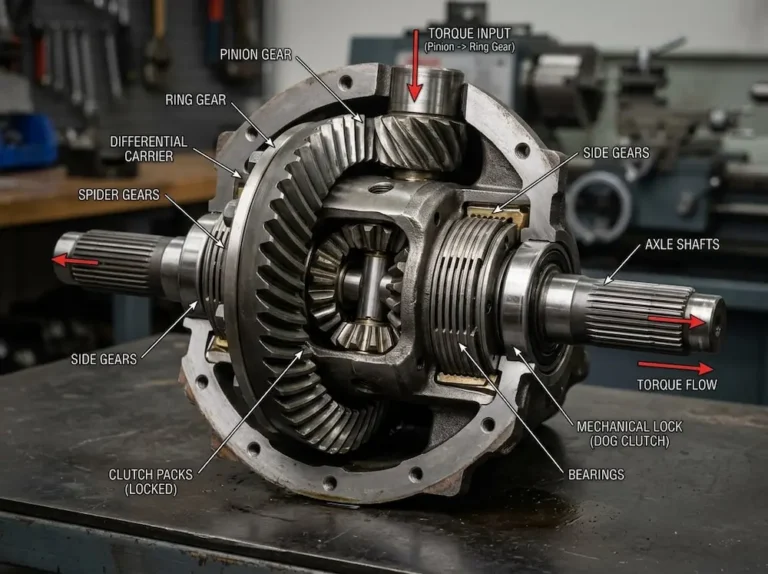
When you turn a corner, your outside wheels travel a longer arc than your inside wheels. The differential solves this by letting each wheel spin at a different speed. Without it, your tires would scrub, skip, and your axle shafts would snap under stress.
Here’s the problem: the open differential always follows the path of least resistance.
Picture one wheel hanging in the air over a boulder. That airborne wheel needs almost zero force to spin. So the open differential sends all available torque to that wheel — the one doing nothing useful. The wheel on solid ground gets nothing. You go nowhere.
This isn’t a budget-truck problem. It happens on expensive rigs too.
So What Does 4×4 Actually Do?
This is the big misconception. Engaging 4×4 does not mean all four wheels get equal, continuous power. Here’s what it actually does:
A part-time 4×4 system uses a transfer case that physically locks the front and rear driveshafts together. That guarantees a 50/50 split between the front axle assembly and the rear axle assembly.
But once power reaches those axles? The open differentials take over — and they still route torque to whichever wheel spins easiest.
The real-world result: If your front-left and rear-right wheels are both in the air or on ice (called cross-axle slip), your 4×4 becomes a zero-wheel-drive vehicle. Both open differentials send power to the two useless spinning tires while the grounded wheels sit still.
4×4 vs AWD: Not the Same Thing
| Feature | Part-Time 4×4 | All-Wheel Drive (AWD) |
|---|---|---|
| Center connection | Locked transfer case | Center differential or clutch packs |
| Dry pavement use | Causes drivetrain binding | Safe at all times |
| Extreme off-road capability | High (locked front/rear split) | Lower (open center diff can slip) |
| Best for | Mud, sand, snow, rock | Rain, patchy ice, light trails |
| Risk of windup | Yes, on pavement | No |
AWD vehicles with an open center differential can theoretically lose all traction through a single spinning wheel. Premium systems like the Toyota Land Cruiser include a locking center differential that manually converts the AWD setup into a true 4×4 — useful for deep mud and sand while still unlocking for highway driving.
Note: The National Park Service explicitly bans standard AWD crossovers from certain trails that require a low-range transfer case. Your AWD Subaru won’t cut it there.
Drivetrain Windup: Why You Can’t Use 4×4 on Pavement
Here’s something that destroys transmissions: running part-time 4×4 on dry pavement.
When you turn on pavement, all four wheels need to rotate at slightly different speeds. The locked transfer case refuses to allow any speed difference between the front and rear driveshafts. Torsional stress — called windup — builds fast in the driveshafts, U-joints, and transmission gears.
Eventually the tires break traction violently to release the tension. The steering goes heavy. The tires chirp and skip. And if you do this repeatedly, you’ll stretch transfer case chains, shatter U-joints, and strip ring and pinion gears.
The rule is simple: Part-time 4×4, center diff locks, and axle lockers are for dirt, mud, sand, snow, and ice only — where loose surfaces let the tires slip and dissipate tension naturally.
What a Locking Differential Actually Does
A locking differential bypasses the spider gears entirely and physically clamps both axle shafts together. Both wheels on that axle spin at the same speed — no matter what.
If one wheel is dangling in the air, the locker doesn’t care. It forces the grounded wheel to take 100% of the available torque. That’s the difference between crawling over a boulder and spinning helplessly next to it.
Here’s a quick breakdown of every differential type you’ll encounter:
| Differential Type | How It Works | Best For | Key Weakness |
|---|---|---|---|
| Open Differential | Splits torque equally, allows independent wheel spin | Daily driving, paved roads | Sends power to the slipping wheel off-road |
| Limited-Slip (LSD) | Clutch packs or helical gears transfer torque toward grip | Snow, mild trails, wet roads | Never fully locks; clutch packs wear out |
| Automatic Locker | Defaults to locked; unlocks momentarily when turning | Budget off-road builds, mud | Loud clicking; lurching in corners; dangerous on ice |
| Selectable Locker | Air or electric actuator locks on demand | Rock crawling, premium overlanding | Higher cost; requires maintenance of air lines or wiring |
| Spool | Permanently welded axles, zero differential action | Race-only builds | Destroys tires on pavement; terrible turning radius |
Rear Locker First — Always
The rear locker delivers the highest return on investment for any off-road build. Weight transfers rearward on climbs, so the rear tires generate most of your forward thrust. Rear suspension also flexes more, keeping those tires on the ground longer. Lock the rear, and both tires push together. For stock-differential vehicles, a rear locker upgrade changes everything.
Front Lockers: Powerful but Risky
A front locker gives you true four-corner traction — but it severely restricts steering. Both front tires spin identically, so the vehicle resists turning input and wants to go straight. Forcing a tight corner under throttle with a locked front diff risks snapping CV joints, axle shafts, and tie rods. Use front lockers only for straight-line, low-speed technical climbs — then disengage immediately.
Electronic Traction Control vs Mechanical Lockers
Modern trucks use brake-based traction systems to simulate a locker. Jeep calls theirs Brake Lock Differential (BLD). Toyota uses A-TRAC. Land Rover has its own version.
Here’s how BLD works: ABS sensors detect one wheel spinning fast while the opposite stays still. Instead of cutting power, the system clamps the brake on the spinning wheel. Because the open differential always balances torque equally, this forced resistance redirects torque toward the grounded wheel.
It’s clever. It genuinely works for most trail scenarios.
But it’s not identical to a mechanical locker:
- BLD is reactive. It waits for wheel spin to start before engaging. A mechanical locker prevents the spin entirely.
- BLD costs engine torque. Your engine fights both the obstacle and your own brakes. You need smooth, sustained throttle — not the idle-speed crawl a locked diff allows.
- Heat builds up. Prolonged use in deep mud can overheat the brakes. Modern systems include thermal cutoffs, though engineers note this rarely triggers in real-world trail use.
For most overlanders, a well-tuned BLD plus a rear limited-slip differential covers the vast majority of terrain. For serious rock crawling, a mechanical locker is the right call.
Air Lockers vs E-Lockers: Which Should You Buy?
Both achieve the same result — 100% lock. The difference is how they get there.
| Feature | Air Locker (Pneumatic) | E-Locker (Electromagnetic) |
|---|---|---|
| Power source | Onboard air compressor | 12V vehicle battery |
| Engagement speed | Fast, but subject to pressure lag | Near-instant |
| System complexity | High — compressor, air lines, solenoids | Low — wiring harness and switch |
| Weak points | Line punctures, O-ring wear, frozen lines in cold | Snapped wires, blown fuses, coil failure |
| Cold weather | Can freeze at -30°F, causing total failure | Unaffected by temperature |
| Bonus benefit | Compressor inflates tires and runs tools | None beyond locker function |
Engagement delays over 3 seconds signal a problem — usually a leaking air line, worn O-rings, or a dirty solenoid valve. On a steep rock ledge, a 3-second delay isn’t just annoying. It’s dangerous.
If you’re in extreme cold climates or want simpler installation, go E-Locker. If you want onboard air for tire inflation and don’t mind maintaining the pneumatic system, an Air Locker is still the gold standard for many serious off-roaders.
The Side-Slope Warning Nobody Tells You
This catches new off-roaders off guard: don’t lock your differential on a steep side slope.
When you’re crossing a hillside, gravity constantly pulls the vehicle downhill. With open differentials, the uphill tire may slip — but the downhill tire grips the ground and acts as an anchor, holding the vehicle’s line.
Lock the differential, and both tires are forced to spin together. If they both break traction simultaneously, the entire axle slides sideways downhill with nothing to catch it. On loose shale, narrow mountain trails, or muddy embankments, that’s how rollovers happen.
On side slopes, leave the differentials open. Let traction control do its thing.
Rock Crawling vs Overlanding: Do You Actually Need Lockers?
Your use case determines how much traction hardware you actually need.
Technical Rock Crawling: Tires leave the ground constantly. Lockers aren’t optional — they’re foundational. Without front and rear lockers, you’ll spin your airborne tires, lose momentum, and slide backward off the obstacle. Front and rear selectable lockers are the standard for serious crawling.
Overlanding: Long-distance travel on varied terrain — forest service roads, sandy washes, moderate mud. Mechanical lockers are desirable but not essential for most overland routes. A strong 4×4 system with advanced traction control or a rear limited-slip differential handles the majority of overland scenarios. A rear locker helps with self-recovery in deep mud. A front locker adds weight, complexity, and expense that most overlanders never actually need.
Which New Trucks and SUVs Come With Factory Lockers?
Manufacturers are putting locking differentials into factory trim levels to meet demand from serious off-road buyers. Here’s how the major US players stack up:
| Manufacturer | Model & Trim | Locker Setup | Notable Off-Road Features | Approx. Starting MSRP |
|---|---|---|---|---|
| Jeep (Stellantis) | Wrangler Rubicon | Front + Rear Tru-Lok Electronic Lockers | Sway bar disconnect, 4:1 Rock-Trac, Dana 44 axles | $47,205 |
| Toyota | 4Runner TRD Pro | Electronic Rear Locker | A-TRAC, KDSS, Multi-Terrain Select, Crawl Control | $43,365+ |
| Ford | Bronco Sasquatch | Front + Rear Spicer Electronic Lockers | G.O.A.T. modes, extreme travel Raptor shocks | Varies by trim |
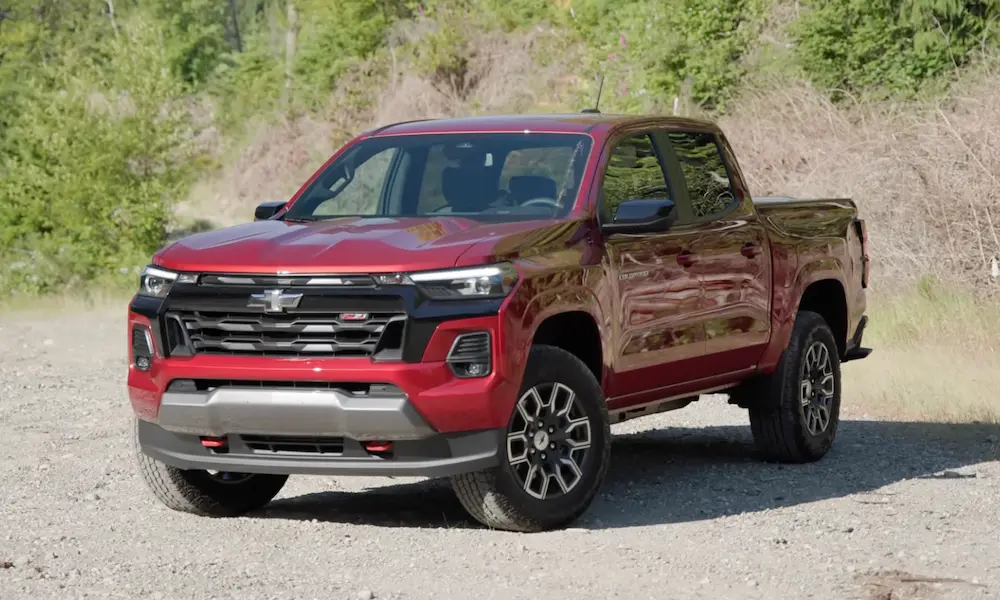
| Chevrolet | Colorado ZR2 | Front + Rear Electronic Lockers | Multimatic DSSV dampers, off-road front fascia | Varies |
| Ram | 1500 RHO / TRX | Rear Electronic Locker | 540–702 hp, Bilstein adaptive shocks, Baja launch control | $69,995+ |
The Jeep Wrangler Rubicon remains the most capable stock vehicle off the dealership floor — solid front axle, dual lockers, and a 4:1 transfer case. But according to J.D. Power, the Toyota 4Runner ties for the top spot in long-term vehicle dependability (problems after three years), while the Wrangler doesn’t crack the top three. For long-haul overlanding, reliability matters as much as raw capability.
Frequently Asked Questions
Does 4×4 mean all four wheels get power equally?
No. 4×4 locks the front and rear driveshafts together, but open differentials on each axle still route power to the path of least resistance. If two wheels are on frictionless surfaces, they spin while the grounded wheels get nothing. For guaranteed four-corner power, you need both front and rear lockers.
What’s the difference between a center diff lock and an axle diff lock?
A center differential lock (found on full-time 4WD and AWD vehicles) forces a 50/50 split between front and rear driveshafts — essentially converting AWD into 4×4. But it doesn’t prevent side-to-side wheel spin on individual axles. An axle locker forces both wheels on one axle to spin at the same speed, regardless of lateral traction loss. They solve different problems.
Can I drive with lockers engaged on the highway?
No. Locked differentials force both wheels to spin identically. On curved pavement, the outer wheel needs to travel faster than the inner wheel. If it can’t, the drivetrain binds, tires scrub violently, handling becomes unpredictable, and you risk catastrophic axle failure. Lockers are strictly for low-speed, low-traction off-road use only.
Are electronic traction control systems as capable as mechanical lockers?
Modern BLD systems are genuinely impressive and handle most moderate trails well. But they’re reactive — they engage after wheel spin occurs, not before. They also consume more engine torque because they fight your own brakes. A true mechanical locker is proactive and absolute, making it vastly superior for severe low-speed rock crawling where momentum and precision are critical.
Why is using a locker on a side slope dangerous?
On a steep off-camber slope, the downhill tire grips the ground and acts as an anchor, preventing sideways sliding. Lock the differential, and both tires are mechanically bound. If one tire breaks traction, both break at once — and the entire axle slides downhill simultaneously with nothing to catch it. That’s how rollovers happen. On side slopes, open differentials are safer.