Your dashboard just lit up like a Christmas tree. Check engine light, VSC warning, TRAC OFF — all at once. That’s the Toyota C1201 code doing its thing, and it looks scarier than it usually is. This guide breaks down exactly what’s triggering it, what’s actually broken, and what you’ll spend to fix it. Stick around — the answer might surprise you.
What Is the Toyota C1201 Code?
The Toyota C1201 code means your Skid Control ECU — the brain behind your ABS, VSC, and TRAC systems — has detected a problem with the engine control system. It’s not always a chassis or brake issue. Most of the time, it’s your engine misbehaving, and your stability system is simply reacting to that.
Think of it this way: your VSC system needs the engine to respond precisely when it asks for a torque cut during a skid. If the engine’s already struggling with its own fault, the VSC can’t trust it. So it shuts itself down and stores C1201 to let you know why.
That said, C1201 carries two different definitions depending on your diagnostic tool:
- Engine Control System Malfunction — the most common definition on Toyota/Lexus platforms, generated by the Skid Control ECU as a secondary response to engine P-codes
- ABS Inlet Valve Coil LF Circuit Short to Ground — a hardware fault definition used in some third-party databases, pointing to a solenoid issue inside the ABS actuator
Getting this distinction right is everything. Misread it, and you’ll replace the wrong part.
| Feature | Engine Control System Malfunction | ABS Inlet Valve Coil LF Short |
|---|---|---|
| Originating Module | Skid Control ECU (responding to ECM) | Skid Control ECU (internal monitor) |
| Primary Trigger | Any P-series engine fault (P0455, P0300, etc.) | Electrical short in ABS solenoid coil |
| System Status | VSC/TRAC prohibited; ABS usually functional | VSC/TRAC/ABS potentially disabled |
| Diagnostic Focus | Engine P-codes and CAN-bus communication | Solenoid resistance and actuator harness |
| Common Solution | Fix the root engine fault (gas cap, O2 sensor) | Replace ABS actuator/control module |
Why VSC and TRAC Shut Off With C1201
Your Toyota’s VSC system monitors two things constantly: where the driver wants to go (via the steering angle sensor) and where the car is actually going (via yaw rate and acceleration sensors). When those two diverge, VSC corrects the path by braking individual wheels and requesting a torque cut from the engine.
That torque cut request is the problem. If the engine already has an active fault — a misfire, a bad sensor, an EVAP leak — it can’t guarantee a clean, precise torque reduction. A botched VSC intervention could actually make a skid worse, not better.
So the system makes a calculated decision: disable VSC, set C1201, warn the driver. It picks a “known state” (no stability help) over an “unpredictable state” (unreliable stability help). That’s smart engineering, not a failure.
According to Toyota’s official diagnostic procedures, the Skid Control ECU stores C1201 when two conditions hold simultaneously for at least five seconds:
- Engine speed is at or above 500 RPM
- A malfunction signal from the engine control system is active on the CAN-bus
That five-second window filters out electrical noise and momentary glitches. A genuine fault has to persist before the code sticks.
The Most Common Causes of Toyota C1201
Since C1201 is usually a secondary code, fixing it means fixing the engine fault behind it. Here’s what typically triggers it.
A Loose or Faulty Gas Cap
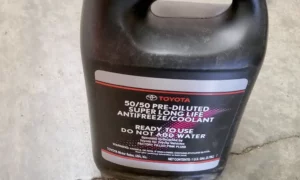
This is the most anticlimactic — and most common — cause. A loose, cracked, or worn gas cap lets fuel vapors escape, which the ECM reads as an EVAP system leak. That triggers codes like P0455 (gross leak) or P0456 (small leak). The ECM flags a fault, the Skid Control ECU picks it up, and suddenly your VSC light is on because of a $20 part.
Many Toyota owners confirm that tightening or replacing the fuel cap clears the entire warning cluster. Always start here before spending money on anything else.
Oxygen Sensor Failures
A failing O2 sensor skews the ECM’s air-fuel calculations. Codes like P0136, P0137, or P0138 follow. The engine can’t manage torque accurately, so the Skid Control ECU disables VSC and sets C1201. O2 sensor issues are especially common on the RAV4, where Bank 1 Sensor 2 tends to go lazy with age.
Mass Air Flow Sensor Issues
A dirty or defective MAF sensor (codes P0101, P0171) feeds the ECM bad data about incoming air volume. That throws off fuel trims and torque predictions. Toyota’s check engine light guide lists MAF problems among the most frequent triggers for multiple simultaneous warning lights. Try cleaning it with MAF-safe cleaner first — it’s a $10 fix before you spend $400 on a new sensor.
Ignition Misfires
A misfiring cylinder (P0300–P0308) means the engine’s torque output is choppy and unpredictable. VSC can’t work with that. Reddit threads from Tundra owners confirm that worn ignition coils are a repeat offender, especially on high-mileage 5.7L engines.
Catalytic Converter Degradation
A catalyst that’s dropped below efficiency thresholds (P0420) creates a long-term ECM fault. It doesn’t always cause noticeable performance issues, but it’s enough to keep the engine malfunction signal active — and keep C1201 stored across multiple drive cycles.
| System | Primary Code | Typical Culprit | C1201 Link |
|---|---|---|---|
| EVAP | P0455 | Loose or damaged gas cap | Immediate VSC shutdown via fail-safe |
| Fuel/Air | P0171 | Dirty MAF sensor or vacuum leak | ECM torque-request logic compromised |
| Ignition | P0303 | Faulty ignition coil on cylinder 3 | Choppy torque prevents stable VSC action |
| Emissions | P0420 | Catalytic converter below threshold | Long-term fault sustains secondary C1201 |
When C1201 Points to an ABS Hardware Problem
In some cases — particularly on vehicles with Bosch ABS actuators — C1201 is a primary fault, not a secondary one. It means the left-front ABS inlet valve solenoid coil has an internal short to ground.
You can test this yourself with a multimeter at the ABS module connector. The coil’s resistance should fall between 5 and 15 ohms. A reading near zero means an internal short. A reading way above the range means an open circuit or high resistance. Either way, the ABS actuator typically needs replacement.
Moisture intrusion is the main villain here. Water gets into the ABS actuator connector after heavy rain, a car wash, or driving through a deep puddle. Over time, that moisture corrodes the terminal pins and damages the module’s internal driver circuits permanently. If your C1201 comes and goes based on weather, this is worth investigating.
CAN-Bus Communication and Voltage Problems
If you can’t find an obvious engine P-code, the problem might be in how the modules talk to each other.
CAN-Bus Wiring Issues
Toyota’s diagnostic procedures direct technicians to monitor the “EFI COM OPN” parameter in a scan tool’s live data list. If it shows “ERROR,” there’s a momentary break in the wiring harness between the ECM and the Skid Control ECU. Frayed wires, corroded pins, or a loose connector can cause intermittent C1201 codes that appear and vanish without any clear pattern.
Low System Voltage
Toyota’s electronics need at least 11.5 volts to maintain stable communication between modules. A weak battery or a failing alternator can drop voltage during high-load moments — engine cranking, electric power steering activation — and cause the Skid Control ECU to lose sync with the ECM.
If that communication gap lasts long enough, C1201 gets stored. That’s why low voltage code C1241 often pairs with C1201. The system recognizes it can’t guarantee its safety actuators will perform, so it disables them. A $200 battery replacement has cleared C1201 for plenty of Toyota owners who never suspected that was the cause.
Model-Specific Patterns You Should Know
Toyota Tundra (2007–2021): Secondary Air Injection System
Tundra owners face a particularly painful version of C1201. The Secondary Air Injection System on these trucks — designed to cut cold-start emissions — is prone to moisture ingestion. The air pumps fail, the valves stick, and codes P2440 and P2442 follow. The ECM enters a protective mode, and C1201 locks out the VSC immediately.
Repairs range from $800 to over $1,800 depending on how much of the system needs replacing. Accurate diagnosis matters here — this is not a situation for guessing.
Toyota RAV4: The “Check 4WD” Chain Reaction
On the RAV4, C1201 often drags the AWD system down with it. The AWD system pulls wheel speed data from the VSC, so when VSC shuts off, AWD efficiency drops too. Drivers see Check Engine, VSC, and Check 4WD lights all at once. The root cause is frequently a slow oxygen sensor — a far cheaper fix than the light cluster suggests.
Toyota Camry and Corolla: TSB-0086-13
Toyota issued Technical Service Bulletin T-SB-0086-13 for 2009–2011 Camry and Corolla models experiencing intermittent ABS and TRAC warning lights with codes C1231 and C1201. The ABS ECU software was misreading normal steering angle sensor data as a fault. The fix involves replacing the ABS actuator, potentially the steering angle sensor, and performing a software recalibration.
What Does C1201 Cost to Fix?
The honest answer: it depends entirely on the root cause. Here’s the full range.
| Potential Cause | Parts Cost | Labor | Total Estimate |
|---|---|---|---|
| Loose/faulty gas cap | $20–$40 | $0–$50 | $20–$90 |
| MAF sensor cleaning | $10 (cleaner) | $50–$100 | $60–$110 |
| O2 sensor replacement | $100–$250 | $100–$150 | $200–$400 |
| Ignition coil (single) | $80–$150 | $50–$100 | $130–$250 |
| 12V battery replacement | $150–$250 | $0–$30 | $150–$280 |
| MAF sensor replacement | $200–$400 | $70–$110 | $270–$510 |
| SAIS air pump (Tundra) | $600–$1,300 | $200–$500 | $800–$1,800 |
| ABS actuator assembly | $1,000–$2,500 | $300–$600 | $1,300–$3,100 |
Research shows DIY part-swapping without a proper diagnosis succeeds less than 50% of the time. A professional scan with a bidirectional tool pushes that number past 90%. Don’t let a $20 gas cap turn into a $500 guessing game.
The Right Way to Diagnose Toyota C1201
Follow this sequence and you won’t waste money:
- Run a full global scan — not just the C1201 code. Look for every stored P-code in the ECM first
- Check system voltage — a weak battery rules out plenty of false positives
- Inspect the gas cap — tighten or replace it, clear the codes, and drive two full cycles
- Read live sensor data — monitor MAF readings, O2 sensor switching, and fuel trim values
- Check the EFI COM OPN parameter — if it shows ERROR, focus on CAN-bus wiring integrity
- Test ABS solenoid resistance — only if no engine codes exist and voltage checks out
The Toyota C1201 code is almost never what it looks like at first glance. It’s a communication between systems — your car telling you something’s wrong upstream before it risks making things worse downstream. Start simple, follow the data, and you’ll find the real problem faster than you think.