Noticed your Toyota running rough, smelling like rotten eggs, or flashing a check engine light? Your catalytic converter might be the culprit. This guide breaks down everything you need to know about Toyota catalytic converter replacement — costs, symptoms, causes, and smart ways to save money without cutting corners. Stick around to the end before you hand over your keys.
What Does a Catalytic Converter Actually Do?
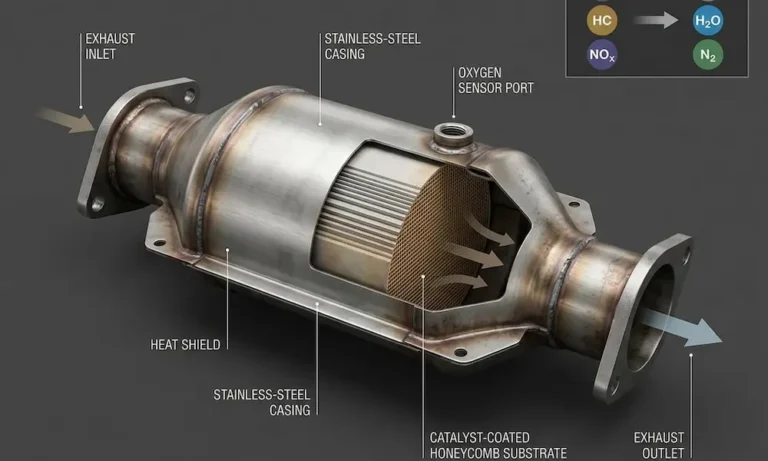
Your Toyota’s catalytic converter sits in the exhaust system between the engine and the muffler. Its job is simple but critical: it converts harmful exhaust gases — carbon monoxide, hydrocarbons, and nitrogen oxides — into less harmful water vapor and carbon dioxide.
Inside the converter sits a ceramic honeycomb coated with precious metals: platinum, palladium, and rhodium. Hot exhaust gases flow through this honeycomb, triggering chemical reactions that clean the emissions before they exit your tailpipe.
When this component fails, your Toyota fails emissions tests, loses power, and burns more fuel. The EPA requires catalytic converters to function correctly on all road vehicles — it’s not optional.
Signs You Need a Toyota Catalytic Converter Replacement
Don’t ignore these warning signs. Catching a failing catalytic converter early saves you from bigger, costlier engine problems down the road.
Watch for these symptoms:
- Check engine light — Codes P0420 or P0430 point directly at catalytic converter efficiency problems
- Rotten egg smell — Sulfur odor from the exhaust means the converter isn’t processing hydrogen sulfide properly
- Sluggish acceleration — A clogged converter restricts exhaust flow, essentially choking your engine
- Rattling noise — The internal ceramic honeycomb has broken apart and is bouncing around inside the housing
- Failed emissions test — Your Toyota won’t pass state inspection with a dead converter
- Reduced fuel economy — Your engine works harder to push exhaust through a restricted system
A rattling sound under your Toyota is the most urgent sign. Broken ceramic fragments can get sucked back into the engine and cause serious internal damage.
Why Toyota Catalytic Converters Fail
Understanding why converters fail helps you avoid repeat replacements.
The most common culprits:
Engine misfires cause raw, unburned fuel to enter the exhaust system. When this fuel ignites inside the converter, temperatures spike far beyond the component’s design limits — sometimes exceeding 2,000°F. This melts and destroys the internal honeycomb structure fast.
Oil or coolant burning coats the precious metal catalyst with a layer of contamination. The catalyst can’t do its job through a thick film of burnt oil or coolant residue, so it slowly stops working.
Physical damage from road debris or aggressive off-road driving can dent and crack the converter housing, breaking the fragile ceramic core inside.
Age and high mileage eventually depletes the precious metal coating, reducing the converter’s ability to process exhaust gases efficiently.
Short trips and cold starts prevent the converter from reaching its optimal operating temperature. Converters need heat — around 400°F minimum — to work properly. Constant cold, short-distance driving shortens their lifespan significantly.
Toyota Catalytic Converter Theft: A Real Problem
Toyota vehicles — especially the Prius, Tacoma, and 4Runner — are prime targets for catalytic converter theft. Thieves can slide under a vehicle and cut the converter off in under two minutes using a battery-powered saw.
Why Toyota? The precious metal content in Toyota converters, particularly hybrids, is higher than average. The Prius converter reportedly contains more rhodium, palladium, and platinum than most other vehicles, making it extremely valuable to scrap metal buyers.
The National Highway Traffic Safety Administration (NHTSA) has tracked a dramatic rise in catalytic converter theft reports across the United States. If your Toyota’s converter gets stolen, you’ll know immediately — the exhaust will roar loudly, and the check engine light will illuminate the moment you start the car.
Ways to reduce theft risk:
- Install a catalytic converter anti-theft shield or cage
- Park in well-lit, high-visibility areas
- Etch your VIN onto the converter housing
- Ask your dealer about Toyota’s factory-available protection hardware for Prius and Tacoma models
Toyota Catalytic Converter Replacement Cost
Costs vary considerably depending on your specific Toyota model, your location, and whether you choose OEM or aftermarket parts.
| Toyota Model | Estimated Replacement Cost Range | Key Cost Factors |
|---|---|---|
| Toyota Corolla | $800 – $1,500 | High parts availability keeps costs lower; standard bolt-on design |
| Toyota Camry | $900 – $1,800 | V6 models cost more; two converters on some trims |
| Toyota Prius | $1,500 – $3,000 | Higher precious metal content; hybrid system complexity adds labor |
| Toyota RAV4 | $950 – $2,000 | AWD models add labor time; California-spec models cost more |
| Toyota Tacoma | $1,200 – $2,500 | Truck-specific manifold design; theft replacement adds insurance variables |
| Toyota Tundra | $1,400 – $2,800 | Large V8 engine; dual converter setup on many trims |
| Toyota 4Runner | $1,100 – $2,200 | Complex exhaust routing; off-road models often have heat shields to remove |
What drives the cost up:
- OEM vs. aftermarket parts — A genuine Toyota catalytic converter costs significantly more than an aftermarket unit, but it meets factory specifications precisely
- California emissions compliance — CARB-compliant converters required in California and several other states cost 20–40% more than standard federal-spec units
- Labor rates — Shops in major cities charge $100–$175 per hour; rural shops often charge $75–$110
- Location on the vehicle — Converters mounted close to the engine (direct-fit) cost more in parts but are easier to access; underbody-mounted converters add labor time
- Oxygen sensors — Shops often recommend replacing upstream and downstream O2 sensors simultaneously, adding $150–$300 to the bill
OEM vs. Aftermarket Catalytic Converters: Which Should You Choose?
This decision affects your Toyota’s long-term performance and your wallet.
OEM (Original Equipment Manufacturer) converters:
- Exact fit, no modifications required
- Meet all emissions standards for your specific model year and state
- Typically carry a 2–5 year warranty through Toyota dealerships
- More expensive upfront
Aftermarket converters:
- Significantly cheaper — sometimes 40–60% less than OEM
- Quality varies enormously between brands
- Budget options from unknown manufacturers may fail quickly or trigger persistent check engine lights
- Reputable brands like MagnaFlow, Walker, and Davico offer solid alternatives with warranty coverage
- Make sure any aftermarket converter carries a CARB EO (Executive Order) number if you live in a CARB-compliant state
The bottom line: Don’t buy the cheapest converter you can find. A low-quality aftermarket unit that fails in 18 months costs you more than buying a quality part the first time.
The Replacement Process: What Actually Happens
A Toyota catalytic converter replacement isn’t complex in theory, but it gets tricky in practice — especially on older, high-mileage vehicles.
Here’s what a technician does:
- Lifts the vehicle and locates the converter in the exhaust system
- Removes the oxygen sensors connected to the converter housing
- Unbolts or cuts the converter free from the exhaust pipes (rusted bolts are extremely common on older Toyotas)
- Cleans the mating flanges and threads
- Installs the new converter with fresh gaskets
- Reinstalls oxygen sensors — or installs new ones
- Clears any stored diagnostic trouble codes
- Performs a test drive to confirm the check engine light stays off and the repair is complete
On vehicles with rusted exhaust hardware — common in northern states where road salt corrodes everything — the labor time can double or triple. Technicians sometimes need to cut and re-thread exhaust studs or replace entire sections of exhaust pipe, adding unexpected cost to the job.
Will Insurance Cover a Stolen or Damaged Catalytic Converter?
If your Toyota’s catalytic converter was stolen, your comprehensive auto insurance policy should cover the replacement cost minus your deductible. Theft falls under comprehensive coverage, not collision.
Important steps after theft:
- File a police report immediately — your insurance company requires it
- Document the damage with photos before anything is moved or repaired
- Contact your insurance company to open a claim before authorizing repairs
- Check if your policy covers a rental vehicle during the repair period
If your converter failed due to normal wear or an engine problem (like a misfire), insurance won’t cover it. That falls under standard mechanical repairs.
Smarter Ways to Save on Toyota Catalytic Converter Replacement
You don’t have to overpay. Here’s how to keep costs reasonable without risking your Toyota’s reliability.
- Get three quotes — Prices between shops vary dramatically. A dealership may quote $2,200 while an independent shop charges $1,400 for the same job
- Ask about aftermarket options — A reputable aftermarket converter from a brand like MagnaFlow often performs comparably to OEM at a lower price
- Fix engine problems first — If a misfire caused the converter to fail, fix the misfire before installing the new converter or you’ll destroy it again
- Check for recalls — Some Toyota models have had emissions-related technical service bulletins or recalls that cover converter issues at no cost to you
- Use a reputable independent shop — ASE-certified independent mechanics often charge less than dealerships and do equally good work
FAQs About Toyota Catalytic Converter Replacement
Do you need to replace both catalytic converters at the same time?
Not necessarily. Many Toyota V6 models — including the Camry and Highlander — have two converters, one for each bank of cylinders. If only one shows a fault code or efficiency failure, you only need to replace the faulty one. However, if both have high mileage and one has failed, replacing both at the same time saves labor costs since the exhaust is already disassembled.
Will a bad catalytic converter damage my Toyota’s engine?
Yes — if you ignore it long enough. A severely clogged converter restricts exhaust flow, which creates back pressure in the engine. This causes overheating, poor performance, and can eventually damage exhaust valves. A converter with a broken internal core can send ceramic fragments into the engine. Don’t delay this repair.
Can I drive my Toyota with the check engine light on for a P0420 code?
Technically you can drive it short distances, but it’s not smart. The P0420 code means your converter isn’t working efficiently. Your Toyota is emitting higher levels of harmful exhaust gases, it won’t pass an emissions test, and the underlying problem causing the failure — like a misfire or oil leak — may be getting worse with every mile you drive.
How long does a Toyota catalytic converter last?
A well-maintained Toyota catalytic converter typically lasts 100,000 to 150,000 miles. The converter’s lifespan depends heavily on how well the engine is maintained. Regular oil changes, fixing engine misfires promptly, and addressing coolant leaks before they become major problems all protect your converter and extend its life.
Is a Toyota catalytic converter replacement covered under warranty?
Federal law requires manufacturers to warranty the catalytic converter for 8 years or 80,000 miles under federal emissions warranty. If your Toyota is within that window and the converter failed due to a defect rather than physical damage or owner neglect, the replacement should be covered at no cost. Check your Toyota warranty documentation or contact your nearest dealership to confirm coverage for your specific model year.