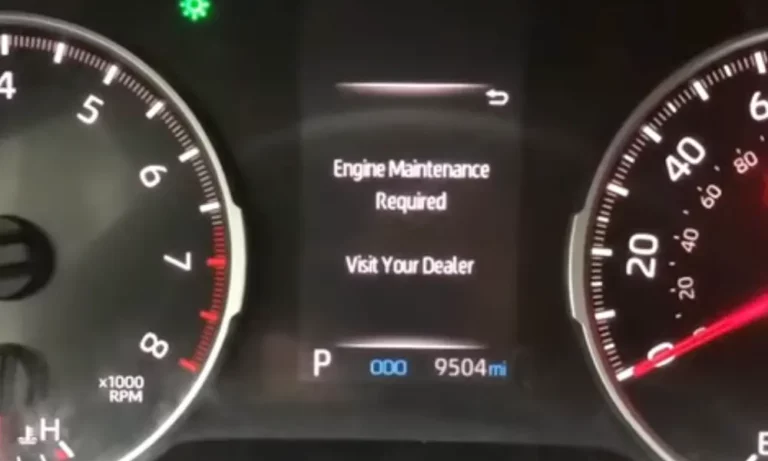
Your Toyota’s dashboard just flashed “Engine Maintenance Required,” and you’re wondering if it’s serious or just time for an oil change. Here’s the thing—that specific wording isn’t asking for routine service. It’s signaling a real problem that needs attention now. Let’s break down what’s happening and how to fix it without getting ripped off.
The Critical Difference Between Two Similar Messages
Toyota uses two dashboard alerts that look nearly identical but mean completely different things.
“Maintenance Required” – The Routine Reminder
This is your basic oil change timer. It pops up every 5,000 miles like clockwork, regardless of what’s happening under the hood. You can reset it yourself using the trip meter button or through your steering wheel menu. It’s annoying but harmless—just a digital sticky note reminding you to schedule service.
“Engine Maintenance Required” – The Actual Problem
This one’s different. When you see “Engine Maintenance Required” (with “Engine” in front), your car’s computer has detected a fault and stored a diagnostic trouble code. It’s not mileage-based—it can appear at 8,000 miles or 80,000 miles. You can’t permanently clear it by holding down buttons. Even if it disappears after restarting, it’ll come back because the underlying problem is still there.
Many owners get confused and think they just need an oil change. They reset the light, drive for a few days, and then panic when it reappears. That’s because Toyota engine maintenance required warnings stem from actual component failures, not service intervals.
What’s Actually Failing in Your Toyota
If you’re driving a 2019-2022 RAV4, Camry, or Corolla with the 2.0L or 2.5L engine, the culprit is almost always the Engine Coolant Bypass Valve—also called the Flow Shutting Valve.
Why This Part Exists
Modern Toyotas ditched the old-school wax thermostat for a computer-controlled valve that actively manages engine temperature. Instead of just reacting to heat, this valve anticipates it. During cold starts, it blocks coolant flow to help the engine warm up faster (better emissions, better fuel economy). Once warm, it opens pathways to the radiator, heater core, or transmission cooler as needed.
It’s thermodynamically brilliant but introduces a weak point: an electronic component sitting in 200°F coolant that cycles between freezing winters and scorching summers.
How It Fails
The valve housing is tough plastic, but the internal seals that keep coolant away from the electric motor eventually fail. Pressurized coolant seeps into the connector housing. You won’t see drips on your garage floor initially—the leak is internal.
Once coolant contacts the electrical terminals, corrosion accelerates fast. The voltage difference between power and ground pins causes electrolysis, eating through copper and forming conductive salt deposits. Your car’s computer sees this as a circuit short or open connection and triggers Toyota engine maintenance required on your dash.
The Diagnostic Codes You’ll See
When a shop scans your Toyota, they’ll pull one or both of these codes:
| Code | What It Means | Why It Happens |
|---|---|---|
| P268111 | Coolant Bypass Valve Circuit Short to Ground | Coolant is bridging the circuit to the metal chassis, causing a voltage drop |
| P268115 | Coolant Bypass Valve Circuit Short to Battery or Open | Corrosion has severed a connection, or the motor coil burned out from fluid contamination |
These aren’t “maybe” codes that might clear themselves. They indicate permanent physical damage requiring part replacement.
How to Confirm It’s the Bypass Valve (No Tools Required)
Before you book a repair, try this field test that exploits how your climate control system works:
The Max Heat Test
- Turn off your engine
- Crank your climate control to maximum heat (Hi setting)
- Turn off the A/C button
- Set the fan to high
- Start the engine
What You’re Looking For: If “Engine Maintenance Required” doesn’t appear immediately but shows up later when you adjust the temperature or turn on A/C, you’ve confirmed the bypass valve is the problem. When set to max heat, the computer commands the valve to stay fully open—bypassing the sensor position that’s failing. It’s a diagnostic trick shared widely in owner forums.
Visual Confirmation: Pop your hood and locate the valve (driver’s side of the engine on RAV4s, near the firewall). Look for dried pink coolant residue around the black plastic housing or electrical connector. Disconnect the harness—if you see liquid or crusty buildup on the pins, that’s definitive proof.
Is It Safe to Keep Driving?
Technically, yes—for a short distance. Practically? Don’t push it.
The valve typically fails in an open position, which prevents catastrophic overheating. Your engine will take forever to warm up, your heater won’t work well, and fuel economy tanks. However, if it fails closed (less common but possible), coolant can’t reach the radiator, and you’ll overheat within minutes.
The bigger risk is coolant wicking up the wiring harness into your ECU connector. That turns a $400 valve replacement into a $2,000+ computer module replacement. Some owners report driving for weeks with the light on without incident, but you’re gambling.
The Free Fix: Toyota’s Extended Warranty Program
Here’s the good news: Toyota knows this is a widespread defect and launched Customer Support Program 24TE04 to cover repairs.
What’s Covered
- All eligible vehicles through November 30, 2025, regardless of mileage
- Extended coverage for 10 years from the first date of use OR 100,000 miles (whichever comes first)
- Affected models: 2019-2021 RAV4 (gas, hybrid, Prime), 2018-2021 Camry (gas, hybrid), 2019-2021 Corolla and Corolla Hatchback, plus Avalon, Highlander Hybrid, Sienna, and Venza from those years
The official Toyota service bulletin (T-SB-0112-24) lists the qualifying condition as displaying “Engine Maintenance Required” with codes P268111 and/or P268115. You don’t need an external coolant leak to qualify—early dealer confusion on this point has been corrected.
If You Already Paid for the Repair
Toyota will reimburse you. You’ll need:
- Your repair order showing the complaint and part number
- Proof of payment (receipt, credit card statement)
- Proof you owned the vehicle at the time
Submit through the Toyota Owners portal under Recalls/Campaigns or mail to the Toyota Brand Engagement Center.
DIY vs. Dealer Repair: What It Costs
If your vehicle isn’t covered or you’re outside the program window, here’s the financial breakdown:
| Repair Option | Parts Cost | Labor Time | Labor Rate | Total |
|---|---|---|---|---|
| Dealership | $250-$350 | 3-4 hours | $160-$220/hr | $730-$1,230 |
| Independent Shop | $150-$200 | 2-3 hours | $120-$150/hr | $390-$650 |
| DIY | $80-$120 | 3-5 hours | $0 | $105-$150 |
Updated Part Numbers (Use These Only)
Toyota superseded the original defective parts with improved versions. Make sure your shop uses these:
| Vehicle | Engine | Old Part # | New (Updated) Part # |
|---|---|---|---|
| Corolla/Hatchback | 2.0L M20A | 16671-F2010 | 16671-F2030 |
| RAV4/Camry (Gas) | 2.5L A25A | 16260-F0010 | 16260-F0300 |
| RAV4/Camry Hybrid | 2.5L Hybrid | 16260-F0021 | 16260-F0310 |
| Highlander/Sienna Hybrid | 2.5L Hybrid | 16260-F0100 | 16260-F0330 |
The RAV4 and Camry parts include pre-attached hoses. The Corolla part is just the valve itself.
How to Replace It Yourself (RAV4 Guide)
The RAV4 is the toughest because the valve is buried against the firewall. You’ll need:
- Socket set (10mm, 12mm)
- Long extensions (6-inch minimum)
- Remote hose clamp pliers (cable-actuated type—essential for reaching rear clamps)
- Coolant drain pan
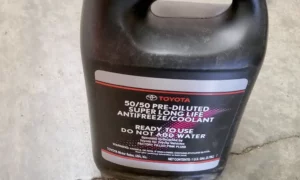
- 2 gallons of Toyota pink Super Long Life Coolant
- Spill-free funnel kit for bleeding
Step-by-Step Process
- Drain coolant: Engine must be cold. Remove radiator cap, then open the petcock on the passenger-side bottom corner. This won’t fully drain the heater core loop, so have rags ready.
- Access the valve: Remove the engine cover and air intake tube. The valve sits on the driver’s side near the firewall.
- Disconnect: Unplug the electrical connector (inspect for corrosion). Use remote pliers to slide back the hose clamps—they’re rotated downward by the factory and nearly impossible to reach with standard tools.
- Remove: Two 12mm bolts hold the bracket. Wiggle the assembly free.
- Install new valve: Lubricate hose ends with coolant for easier insertion. Ensure hoses seat fully past the barb. Torque bolts to 18 ft-lbs.
- Refill and bleed: This is critical. Attach the spill-free funnel, fill with coolant, start the engine with heat on max. Run until the cooling fan cycles. Then rev to 2,000-2,500 RPM for 10 seconds, idle for 10 seconds, repeat for 5-10 minutes. This forces air bubbles out of the heater core and head passages.
Corolla owners have it easier—the valve is front-facing and accessible after removing the air cleaner box. Experienced DIYers finish in under an hour.
Dealing with Dealer Pushback
Some service advisors initially refused warranty coverage if the valve wasn’t externally leaking. If you encounter this, print the official NHTSA-filed service bulletin (T-SB-0112-24) and highlight the qualifying condition section. It explicitly states that displaying “Engine Maintenance Required” with those DTCs qualifies—no external leak required.
Ask to speak with the service manager. Reference CSP 24TE04 by name. If they still refuse, contact Toyota’s customer service line directly and open a case file.
What This Means for Toyota Owners Long-Term
This issue highlights the trade-off in modern engine design. Toyota swapped a bulletproof $20 mechanical thermostat for a $200 computer-controlled valve to gain 1-2% better fuel economy and faster emissions compliance. The engineering works beautifully—until a 50-cent seal fails and grounds the entire system.
The good news? Toyota’s extended warranty program is unusually generous, likely influenced by pending class-action litigation. The updated parts appear to address the seal deficiency, though only time will tell if they’ve truly solved the root cause.
Your action plan:
- Don’t ignore “Engine Maintenance Required”—it’s not an oil change reminder
- Use the max heat test to confirm the bypass valve before booking service
- Reference CSP 24TE04 when scheduling your dealer appointment
- Keep the DTC code active (don’t clear it) to streamline warranty approval
- If you’re outside warranty, the DIY repair is straightforward if you’re mechanically inclined
The Toyota engine maintenance required message doesn’t have to be a wallet-draining experience. Armed with the right information, you can get it fixed quickly—and in most cases, for free.