Thinking about leveling your Tundra to get rid of that factory rake? You’re not alone in wanting a more aggressive stance, but there’s a pile of engineering headaches hiding behind those simple spacers. Let’s dig into the real problems you’ll face—and how to avoid turning your truck into a money pit.
The CV Axle Nightmare (2022+ Tundra Owners, Listen Up)
If you own a 2022 or newer Tundra, you’re sitting on a ticking time bomb—and most people don’t know it until it’s too late.
Toyota uses two completely different front CV axles depending on your trim level. Non-TRD Off-Road models get what the community calls “Black” axles—basic tripod-joint units designed for stock ride height. TRD Pro and Off-Road packages get “Red” axles with high-angle ball joints that can actually handle being lifted.
Here’s the problem: when you add even a 2-inch leveling kit to a truck with Black axles, you’re forcing the CV joint to operate at an angle it was never designed for. The tripod rollers get pushed to the edge of their race. Hit a bump while accelerating in 4WD? The joint can bind, fracture, or literally explode. Owners report catastrophic failures at surprisingly low mileage—some under 10,000 miles.
Even if you don’t grenade the joint immediately, the steeper angle causes the CV boot to rub against itself or nearby hardware. The constant friction generates heat, tears the boot, and dumps grease everywhere. Once contamination gets inside, you’re on borrowed time.
The fix isn’t optional: If you’re lifting more than 2 inches on a non-TRD truck, budget $800–$1,200 for upgraded Red axles (OEM part numbers 43420-0C020 and 43410-0C020) or aftermarket extended-travel units from ReadyLIFT or RCV. Skip this step and you’re gambling with a repair that’ll cost more than the lift itself.
Your Safety Systems Will Freak Out
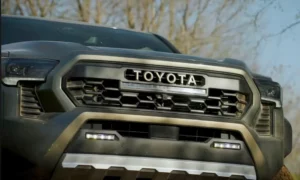
Modern Tundras don’t just ride on suspension—they rely on it for electronic safety. The Toyota Safety Sense suite (Pre-Collision System, Dynamic Radar Cruise Control, Lane Tracing Assist) is calibrated to a specific vehicle pitch angle. Change that angle with a lift, and the radar sensor in your grille is now pointing at the sky instead of the road.
What happens? False emergency braking. Random “PCS Unavailable” warnings. Cruise control that refuses to lock onto the car ahead. Lane assist that fights you instead of helping.
Toyota’s official response is brutal: if the sensors can’t be recalibrated properly after modification, they recommend permanently disabling the safety systems. That’s not a bug—it’s their liability waiver.
You’ll need a Zero Point Calibration, which requires dealer-level diagnostic tools like Techstream. The process resets the yaw rate and acceleration sensors to recognize your new lifted attitude as “level.” Problem is, many dealers flat-out refuse to calibrate modified trucks. Those who will charge $250–$550 for the service.
Some owners try physically shimming the radar sensor to tilt it back down, but this is automotive duct tape. Millimeter-wave radar needs precision alignment within fractions of a degree. A DIY shim job can create blind spots that won’t show up until something’s in your path and the system fails to react.
The Rear End “Wag” That Ruins Highway Drives
If you own a 2022+ Tundra, your rear suspension uses a 5-link coil spring setup with a Panhard bar (track bar). This is a huge upgrade over the old leaf springs—until you lift the truck.
The Panhard bar is supposed to be horizontal at ride height. When you level or lift the rear, you’re raising the frame end while the axle end stays low. Now the bar is angled. Because it’s a fixed-length rod, the axle has to follow an arc when the suspension moves. A steep bar means big lateral (side-to-side) movement for every inch of vertical travel.
Hit a bump on the highway? The rear axle doesn’t just compress—it steers sideways. Drivers describe it as a “wag” or the feeling that the back end is walking out from under you. It’s unsettling at 70 mph and downright sketchy in corners.
An adjustable track bar lets you re-center the axle so your wheels don’t poke out unevenly, but it doesn’t fix the angle problem. The only real solution is a track bar relocation bracket that drops the frame mount point back to horizontal. This eliminates the bump steer geometry and restores stable handling. It’s a mandatory add-on for any rear lift over 2 inches.
The Second-Gen Differential Time Bomb
Own a 2007–2021 Tundra? Your front differential is a different beast, but it’s got its own Achilles’ heel: the driver-side needle bearing.
Toyota’s 8-inch clamshell diff uses a ball bearing on the passenger side and a needle roller bearing on the driver side. Needle bearings are compact and great for radial loads—but terrible under angular stress. When you lift the front end, the CV axle angle increases, introducing a bending moment on the stub shaft. The needle bearing starts getting edge-loaded instead of evenly supporting the shaft.
The result is a low-frequency growl or grinding noise between 30–50 mph that disappears when you engage 4WD. That’s your diagnostic clue—4WD locks the hub to the axle, stabilizing the shaft and silencing the worn bearing temporarily.
Replacing the needle bearing with another needle bearing is pointless. The geometry hasn’t changed, so it’ll fail again. The permanent fix is the ECGS bushing—a solid PTFE-lined bearing with vastly more surface area. It’s engineered to handle the angular loads a lift creates. Install it before the lift, not after the damage is done.
Ride Quality: Why Your “Leveling Kit” Rides Like a Brick
Not all leveling methods are created equal, and the cheap route usually feels exactly like what you paid for.
Spacer lifts are simple: a puck sits on top of your strut, lowering the assembly relative to the frame. They keep your stock spring rate, so the ride stays soft on smooth roads. But they allow excessive suspension droop, which is what causes ball joints to bind and upper control arms to smash into coil springs.
Preload collars (like Westcott Designs) compress the factory spring to push the chassis up. This doesn’t change the spring rate mathematically, but it increases the force needed to start compressing the suspension. You get a firmer, more controlled feel—until you hit a pothole and the shock top-outs with a harsh clunk. You’ve sacrificed down-travel for lift, and your suspension has less room to absorb impacts.
Full coilovers (Fox 2.0, Bilstein 6112, Icon) cost 5–10 times more, but they solve both problems. You get longer shock bodies with more total wheel travel, tuned valving for the increased weight of bigger tires, and internal bump stops that prevent metal-to-metal contact. The ride quality difference between a $200 spacer and a $1,500 coilover kit is night and day.
| Lift Method | Cost | Ride Feel | Major Risk | Best For |
|---|---|---|---|---|
| Spacer Lift | $100–$300 | Soft/Floaty | Ball joint bind, UCA collision | Budget-conscious pavement use |
| Preload Collar | $400–$600 | Firm/Harsh | Top-out, reduced travel | Mid-range TRD Pro owners |
| Full Coilover | $1,500+ | Controlled/Plush | None (if installed correctly) | Serious off-road or mixed use |
Warranty? Don’t Count on It
The Magnuson-Moss Warranty Act says dealers can’t void your entire warranty just because you added aftermarket parts. But here’s the catch: they can (and will) deny claims for parts directly affected by your modification.
Torn CV boot? Leaking axle seal? Worn ball joint? If your truck has a lift, expect the dealer to stamp “out of spec due to lift” on the work order and send you packing. The causal link is obvious—you changed the operating angles, so Toyota argues the failure is your fault.
Some dealers are mod-friendly and look the other way for mild lifts. Others will flag your VIN in Toyota’s national database the moment they spot a spacer. It’s dealer roulette, and you won’t know which kind you have until you’re sitting in the service drive arguing about a $900 repair.
Technical Service Bulletins for clicking CV joints or front differential noise specifically exempt modified vehicles. If there’s a TSB that would’ve covered your failure on a stock truck, tough luck—the lift disqualifies you.
What Actually Works: A Systems Approach
Here’s the truth nobody wants to hear: a reliable leveled Tundra isn’t a $200 weekend project. It’s a systems modification that requires addressing every downstream consequence.
For 2022+ Tundra owners:
- Lifting more than 2 inches? Upgrade to Red CV axles or aftermarket extended units before you install the lift.
- Any rear lift over 1 inch needs a track bar relocation bracket, not just an adjustable bar.
- Budget for Zero Point Calibration at a shop with Techstream, or be prepared to disable your safety systems.
For 2007–2021 Tundra owners:
- Install the ECGS bushing as preventative maintenance if you’re lifting. Don’t wait for the growl.
- Consider upgraded upper control arms with uniball joints if you’re going over 2.5 inches to prevent binding.
For all generations:
- If ride quality matters, skip spacers and collars. Save up for quality coilovers from Fox, Icon, or King.
- Understand that your warranty coverage for suspension and driveline components is functionally dead the moment you modify ride height.
The Instagram-perfect leveled Tundra with 35s doesn’t show you the $3,000 in supporting mods it took to make it reliable. A leveling kit isn’t just a cosmetic change—it’s a geometric alteration that ripples through your entire drivetrain. Do it right, or plan on becoming very familiar with your local Toyota service department’s waiting room.