Trying to figure out what the Toyota Tacoma tow package actually includes — and whether your trim even has one? You’re in the right place. This guide breaks down every component, every trim difference, and every number you need to tow safely and confidently. Stick around to the end, because the payload section alone could save you from a costly mistake.
What Is the Toyota Tacoma Tow Package?
The Toyota Tacoma tow package isn’t just a hitch bolted to the frame. It’s a complete system of mechanical and electrical upgrades that work together to keep your truck — and your trailer — stable under load.
Here’s what the current 2024/2025 tow package includes:
| Component | What It Does |
|---|---|
| Class IV Receiver Hitch | Structural connection point rated for heavy loads |
| 4/7-Pin Connector | Powers trailer lights and electric brakes |
| Transmission Cooler | Dumps heat from the 8-speed auto during hard pulls |
| Engine Oil Cooler | Keeps internal engine temps in check |
| 130-Amp Alternator | Powers trailer systems without killing your battery |
| Heavy-Duty Battery | Handles the extra electrical demand |
| Trailer Sway Control | Uses brake intervention to kill dangerous trailer wobble |
Without these components, towing near the Tacoma’s rated limit puts serious stress on the transmission and engine. The coolers aren’t optional extras — they’re what makes the difference between a truck that tows reliably for 200,000 miles and one that fries its transmission fluid on a mountain pass.
How Much Can a Toyota Tacoma Tow?
Here’s the honest answer: it depends heavily on which trim, cab, and engine you picked.
The maximum is 6,500 pounds, but that number only applies to specific configurations. The base SR trim with an automatic? Just 3,500 pounds. Same truck, manual transmission? Up to 6,400 pounds.
Towing Capacity by Trim (2024–2025)
| Trim | Engine | Max Towing (lbs) | Max Payload (lbs) |
|---|---|---|---|
| SR (Auto) | i-FORCE | 3,500 | 1,460 |
| SR5 XtraCab | i-FORCE | 6,500 | 1,605 |
| SR5 Double Cab | i-FORCE | 6,400 | 1,690 |
| TRD PreRunner XtraCab | i-FORCE | 6,500 | 1,405 |
| TRD Sport Double Cab | i-FORCE | 6,400 | 1,700 |
| TRD Off-Road Double Cab | i-FORCE | 6,400 | 1,705 |
| Limited Double Cab | i-FORCE | 6,300 | 1,590 |
| TRD Pro Double Cab | i-FORCE MAX | 6,000 | 1,680 |
| Trailhunter Double Cab | i-FORCE MAX | 6,000 | 1,475 |
If you need the full 6,500-pound rating, the SR5 or TRD PreRunner in XtraCab configuration is your starting point. The XtraCab is lighter, which frees up more of the truck’s Gross Combined Weight Rating for the trailer.
How Has Tacoma Towing Capacity Changed Over the Years?
The Tacoma has been pulling trailers since 1997, and the numbers have climbed steadily. Here’s the historical picture:
| Generation | Years | Max Towing (lbs) | Primary Engine |
|---|---|---|---|
| First | 1997–2004 | 5,000 | 3.4L V6 |
| Second | 2005–2015 | 6,500 | 4.0L V6 |
| Third | 2016–2023 | 6,800 | 3.5L V6 |
| Fourth (Gas) | 2024–2026 | 6,500 | 2.4L Turbo I4 |
| Fourth (Hybrid) | 2024–2026 | 6,000 | 2.4L Hybrid |
The third-gen peak of 6,800 pounds came from the 3.5L V6, a strong naturally-aspirated engine that worked hard at higher RPMs to move heavy loads. The fourth gen dropped slightly to 6,500 pounds, but it gained a fully boxed high-strength steel frame shared with the Tundra — a significant structural upgrade that makes the platform more capable overall.
i-FORCE vs. i-FORCE MAX: Which Engine Is Better for Towing?
This is probably the most common question Tacoma shoppers ask. The short answer: both are excellent, but for different reasons.
i-FORCE (2.4L Turbo Gas)
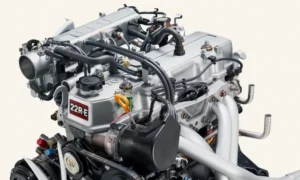
The standard i-FORCE turbocharged four-cylinder produces 278 horsepower and 317 lb-ft of torque. It delivers peak torque as low as 1,700 RPM — much lower than the old V6 — which means it pulls hard right off the line without needing to rev out.
It tows up to 6,500 pounds, making it the capacity leader in the lineup.
i-FORCE MAX (2.4L Hybrid)
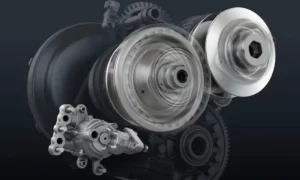
The i-FORCE MAX adds a 48-hp electric motor directly into the transmission bellhousing. The result? A truck that makes 326 horsepower and a massive 465 lb-ft of torque — more than most V8 trucks from a decade ago.
That electric motor delivers instant torque the moment you press the accelerator. Launching a boat on a steep ramp or merging with a loaded trailer? The hybrid system makes both feel effortless.
The trade-off: the i-FORCE MAX is rated for 6,000 pounds maximum, not 6,500. The hybrid components add weight, and that 500-pound difference in towing capacity is the trade you make for the extra torque and lower-speed control.
Quick comparison:
| Metric | i-FORCE (Standard) | i-FORCE MAX (Hybrid) |
|---|---|---|
| Horsepower | 278 hp | 326 hp |
| Torque | 317 lb-ft | 465 lb-ft |
| Max Towing | 6,500 lbs | 6,000 lbs |
| Best For | Max capacity hauling | Torque-heavy, launch-control towing |
The Payload Problem Nobody Talks About
Towing capacity gets all the attention. Payload is where most people make mistakes.
Payload is the combined weight of passengers, bed cargo, and trailer tongue weight. Overload it, and your rear suspension bottoms out, steering gets light, and stopping distances increase dramatically.
Here’s how the math works in the real world: Toyota recommends keeping tongue weight between 10% and 15% of total trailer weight. So on a 6,500-pound trailer, you’re looking at 650–975 pounds of tongue weight. That comes directly out of your payload budget.
| Trim | Max Payload (lbs) | Left for Passengers/Gear (at 975-lb tongue weight) |
|---|---|---|
| TRD Off-Road i-FORCE | 1,705 | ~730 lbs |
| Limited i-FORCE | 1,590 | ~615 lbs |
| Trailhunter i-FORCE MAX | 1,475 | ~500 lbs |
| SR5 XtraCab RWD | 1,460 | ~485 lbs |
That’s not a lot of room. If you’re hauling two adults, a dog, and a toolbox, you can eat through your remaining budget quickly. Check your door jamb sticker — it shows the exact payload rating for your specific truck.
For trailers over 5,000 pounds, Toyota recommends a weight-distributing hitch. These use spring bars to spread tongue weight across both axles, keeping your nose up and your steering responsive.
What Towing Tech Does the 2024+ Tacoma Include?
The fourth-gen Tacoma brought a serious tech upgrade for towing. Here’s what’s available:
- Integrated Trailer Brake Controller (ITBC): Lets you adjust electric trailer brake gain from the dash. Standard on Limited, TRD Pro, and Trailhunter — optional on other trims.
- Trailer Back Up Guidance: Uses the electric power steering and rearview camera to help you reverse in a straight line without jackknifing.
- Panoramic View Monitor with Hitch View: 360-degree camera view that helps you align the ball to the coupler without a spotter.
- Blind Spot Monitor with Trailer Support: Extends detection range to cover the full length of your trailer.
- Wireless Trailer Camera: Optional camera mounts on the trailer and feeds into the digital rearview mirror so you can “see through” your trailer on the highway.
The Brake Controller Issue You Should Know About
There’s a real catch with the ITBC on lower trims. Many 2024/2025 Tacomas don’t include the wiring harness needed for a hardwired aftermarket controller unless they were ordered with the Tow Technology Package.
Unlike the third-gen, there’s no simple plug-and-play port. Adding a hardwired controller to a non-equipped truck means opening the existing harness and running new wires — time-consuming and costly.
The popular workaround? Wireless controllers like the Curt Echo, which plug into the 7-pin port and operate via smartphone app. They work well, but if you prefer a dash-mounted controller, check your trim’s equipment list before you buy.
How the Tacoma Stacks Up Against the Competition
The 6,500-pound rating is impressive for the segment, but it’s not the class leader. Here’s the honest comparison:
| Truck | Max Towing (lbs) |
|---|---|
| Chevrolet Colorado | 7,700 |
| Ford Ranger | 7,500 |
| Nissan Frontier | 6,640 |
| Toyota Tacoma | 6,500 |
| Honda Ridgeline | 5,000 |
| Ford Maverick | 4,000 |
The Colorado and Ranger both out-tow the Tacoma on paper. But the Tacoma counters with a rust-proof composite bed, best-in-class resale value, and — in hybrid form — 465 lb-ft of torque that makes it feel more confident near its limit than competitors towing higher numbers.
The i-FORCE MAX hybrid models also include a 2,400W on-board inverter, turning the truck into a mobile power station at camp. None of the other trucks in this segment currently match that feature.
Towing Maintenance Schedule You Can’t Ignore
Toyota classifies towing as severe-duty operation. That means a tighter maintenance schedule if you pull a trailer regularly:
- Engine oil and filter: Every 5,000 miles (not the standard 10,000-mile interval)
- Transmission fluid: Inspect regularly for signs of thermal degradation
- Differential fluid: Check more frequently under towing loads
- Brake pads and rotors: Inspect for glazing or cracking — towing generates significantly more heat
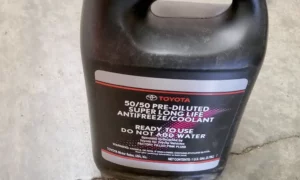
- Hybrid cooling circuits: Check coolant levels in the dedicated inverter and PCU loops on i-FORCE MAX models
Before every trip, verify tire pressures on both the truck and trailer, confirm safety chains are crossed correctly, and check that the 4/7-pin connection is secure and all trailer lights work.
The Tacoma’s tow package is built to last — but only if you treat towing as the demanding task it actually is.