Got a check engine light and a scanner showing Toyota P1346? You’re probably wondering if your engine is about to self-destruct—or if it’s something simpler. This post breaks down exactly what causes this code, how to diagnose it correctly, and what fixes actually work. Stick around to the end, because the real culprit often surprises people.
What Is the Toyota P1346 Code?
Toyota P1346 is a manufacturer-specific diagnostic trouble code (DTC). It stands for VVT Sensor (Camshaft Position Sensor) Circuit Range/Performance Problem on Bank 1.
Here’s the key thing to understand: this isn’t a “sensor died” code. It’s a correlation error. Your engine’s computer (ECM) compares signals from two sensors—the Camshaft Position (CMP) sensor and the Crankshaft Position (CKP) sensor. When those signals don’t line up the way they should, P1346 fires.
Think of it like this: the ECM expects the camshaft and crankshaft to be dancing in sync. If one partner is even slightly off-beat, the code sets.
According to Toyota’s official diagnostic documentation, the ECM uses 2-trip detection logic—meaning the fault has to appear on two separate driving cycles before the Malfunction Indicator Lamp (MIL) lights up. So if your light just came on, the ECM already caught this happening twice.
How the VVT-i System Actually Works
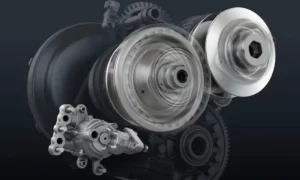
Toyota’s Variable Valve Timing with intelligence (VVT-i) system uses oil pressure to rotate the intake camshaft. This lets the engine adjust valve timing based on speed, load, and temperature. The OCV (Oil Control Valve) directs pressurized oil into the VVT actuator hub, advancing or retarding cam timing as needed.
The ECM monitors the relationship between camshaft and crankshaft signals constantly. On many Toyota engines like the 2AZ-FE, the CMP sensor generates three signals per two crankshaft revolutions. If that ratio drifts even 10–12 degrees out of spec, P1346 sets.
P1346 vs. Similar Toyota Codes: Know the Difference
Before you start replacing parts, it helps to understand where P1346 sits in the Toyota DTC family:
| DTC | Definition | What It Points To |
|---|---|---|
| P1345 | VVT Sensor Circuit Malfunction | Wiring, connector, open/short in circuit |
| P1346 | VVT Sensor Range/Performance | Timing belt/chain, skipped tooth, ECM |
| P1349 | VVT System Malfunction | OCV, VVT phaser, oil pressure, sludge |
| P0011 | Camshaft Over-Advanced (Bank 1) | OCV stuck open, VVT hub failure |
| P0016 | Cam/Crank Correlation (Bank 1) | Mechanical timing, reluctor wheel damage |
P1346 and P1349 confuse a lot of people. P1346 is about signal alignment—where the camshaft sits relative to the crank. P1349 is about system operation—whether the cam actually moves when commanded. Same VVT system, different failure points.
The Most Common Causes of Toyota P1346
Stretched Timing Chain or Jumped Timing Belt
This is the #1 mechanical cause. As technical field data shows, a significant number of P1346 cases appear immediately after timing belt service. If the technician misaligns the timing marks even slightly, or the tensioner shifts the marks when engaged, the ECM catches it within two drive cycles.
In chain-driven engines like the 1ZZ-FE, 2AZ-FE, and 2ZR-FE, chain stretch over high mileage eventually exceeds what the hydraulic tensioner can compensate for. The cam-to-crank relationship drifts, and P1346 sets.
On interference engines, ignoring a stretched chain is genuinely risky—a chain that jumps enough teeth can cause piston-to-valve contact and serious engine damage.
Dirty or Clogged VVT Filter (The Most Overlooked Fix)
Toyota engineers built a small mesh strainer into the VVT circuit to protect the OCV solenoid from debris. It’s often called the VVT or OCV filter strainer, and it sits behind a hex plug in the cylinder head near the solenoid.
This filter gets clogged with sludge, especially in engines with infrequent oil changes. When it’s blocked, oil flow to the VVT actuator drops—and the camshaft either can’t reach its commanded position or can’t hold it. The result: P1346.
Cleaning the VVT filter on a 2AZ-FE is a low-cost step that fixes this code surprisingly often. Here’s where each common engine family hides that filter:
| Engine | VVT Filter Location | How Hard to Access |
|---|---|---|
| 1ZZ-FE | Behind alternator, in cylinder head | Difficult |
| 2AZ-FE | Cylinder head near intake OCV | Moderate |
| 2ZR-FE | Cylinder head, under a cap | Behind alternator |
| 1NZ-FE | Front of cylinder head | Accessible |
Degraded Engine Oil and Sludge Buildup
The VVT-i system is hydraulically actuated. Dirty, thick, or low oil directly impacts VVT performance. If your 2AZ-FE shows “muddy oil” around the camshaft area, that sludge has likely already blocked the VVT filter and restricted the phaser’s movement.
The VVT actuator hub contains a lock pin that releases via oil pressure. Contaminated oil can prevent that pin from releasing properly, causing a correlation error the ECM reads as P1346.
The 2ZR-FE Startup Rattle Problem
If you own a later Toyota Corolla or Matrix with the 1.8L 2ZR-FE and hear a harsh metallic rattle for 1–2 seconds on cold starts, pay attention. That’s the VVT actuator gear’s internal locking pin failing. The pin is supposed to secure the gear when the engine is off. If the pin or return spring fails, the gear rattles until oil pressure builds.
Reddit’s Corolla community has documented this fix in detail. While it starts as noise, it can eventually cause P1346 if the gear fails to index correctly at startup. Some DIYers stretch the internal spring as a temporary fix; the proper repair is replacing the intake camshaft gear assembly.
Weak or Failing CMP/CKP Sensor
The sensor itself isn’t the most common cause, but don’t rule it out. A sensor that’s starting to fail may produce a weak, intermittent signal—not dead enough to throw P0340, but inconsistent enough for the ECM to see a timing drift.
Measure sensor resistance at the sensor and at the ECM connector. Here are the specs:
| Sensor | Condition | Resistance (Ohms) |
|---|---|---|
| CKP Sensor | Cold | 1,630–2,740 |
| CKP Sensor | Hot | 2,065–3,225 |
| CMP Sensor | Cold | 835–1,400 |
| CMP Sensor | Hot | 1,060–1,645 |
If resistance checks out but the code persists, use an oscilloscope to check waveform quality. The CMP sensor circuit uses shielded wiring to block electromagnetic interference. A compromised shield ground introduces noise that mimics a timing error.
How to Diagnose Toyota P1346 the Right Way
Throwing parts at this code gets expensive fast. Work through this in order:
Step 1 — Pull freeze frame data. Check when the fault occurred. Cold start fault? Look at oil viscosity and the VVT locking pin. Fault under load? More likely a mechanical timing or oil flow issue.
Step 2 — Check oil level and quality. Low oil is a surprisingly frequent VVT-i trigger. If it’s dark, overdue, or low—change it first with the correct OEM-specified viscosity.
Step 3 — Clean the VVT filter strainer. Remove the hex plug near the OCV, pull the filter screen, and clean it with brake cleaner. If there’s heavy sludge or metal particles, that’s your smoking gun.
Step 4 — Test the OCV solenoid. Remove it, apply 12V to the terminals, and confirm the internal spool valve moves freely. A solenoid saturated with sludge or failing the bench test needs replacement. Here’s a practical walkthrough of the full VVT valve and filter testing process.
Step 5 — Verify mechanical timing. If the code persists after addressing the hydraulics, pull the valve cover and check the timing marks at TDC on cylinder 1’s compression stroke. The camshaft sprocket marks must align precisely. One tooth off is enough to set P1346.
Step 6 — Run oscilloscope analysis. For stubborn cases, back-probe the G2+ (CMP) and NE+ (CKP) signal wires at the ECM and display both waveforms simultaneously. A clean cam/crank correlation waveform will show the CMP pulse occurring at a consistent point within the CKP pattern. Use PicoScope’s rotation rulers to measure the exact angle and spot deviations beyond 10–12 degrees.
You can also dynamically test the VVT actuator by commanding the OCV to advance timing at idle via a scan tool. The CMP waveform should visibly shift relative to the CKP waveform. No movement, or sluggish movement, points to a hydraulic restriction—not a sensor problem.
What Happens If You Ignore Toyota P1346?
Driving with P1346 isn’t the end of the world short-term, but it’s not harmless either. Here’s what can go wrong:
- Rough idle and stalling — A camshaft stuck in an advanced position creates too much valve overlap at idle
- Sluggish acceleration — Incorrect timing at high RPM chokes airflow and kills power
- Worse fuel economy — The ECM may default to fixed timing maps and richer fuel trims
- Catalytic converter damage — Unburned hydrocarbons from incorrect timing wear out the cat prematurely
- Engine damage — In interference engines, a stretched chain that keeps jumping teeth can eventually cause piston-to-valve contact
In Toyota’s hybrid lineup, accurate VVT control is even more critical. On the Prius with its 2ZR-FXE engine, the Atkinson cycle depends on precise cam timing. A VVT failure there hits hybrid system efficiency hard. The NHTSA-documented 2ZR-FXE oil consumption TSB highlights how lubrication neglect in this engine leads directly to VVT system failures.
Toyota TSBs Related to VVT and P1346
Toyota has released several Technical Service Bulletins addressing VVT-i issues across different engine families.
T-SB-0041-13, documented by NHTSA, specifically covers the brief engine knock or rattle noise on cold startup in 1AR and 2AR engines—the same symptom family as VVT gear locking pin failures. It includes the procedure for replacing the intake VVT gear assembly. TSBs aren’t recalls, but they give technicians updated procedures for known issues and can point you toward the right repair the first time.
You can check for any open recalls or service campaigns affecting your vehicle directly at Toyota’s official recall lookup tool.
Prevention: How to Keep P1346 Away
Most P1346 cases trace back to one thing: neglected oil maintenance.
- Change your oil on schedule using the OEM-specified viscosity
- Use a quality synthetic oil, especially in VVT-heavy engines like the 2AZ-FE
- Don’t skip the oil filter—the VVT system depends on clean oil for rapid phaser adjustments
- After any timing belt or chain service, verify timing marks twice before startup
- If you own a 2ZR-FE, listen for that cold-start rattle and address it proactively before it escalates
The iCarsoft overview of OBD-II codes in the P1336–P1346 range puts it plainly: the ECM expects the camshaft to reach its commanded position within a specific timeframe. Clean oil, a healthy chain, and functional sensors give it the best chance of doing exactly that.
Toyota P1346 looks intimidating on a scanner, but in most cases, it’s the engine telling you something straightforward: it needs clean oil, a clean VVT filter, or correctly indexed timing. Start with the simple stuff before you go digging into the engine block.