Trying to figure out what cars have CVT transmissions before you buy? You’re in the right place. CVTs are everywhere now — but not all of them work the same way. This guide breaks down exactly which cars use them, how the tech differs, and what it means for your wallet and your driving experience. Stick around to the end.
What Is a CVT Transmission, Anyway?
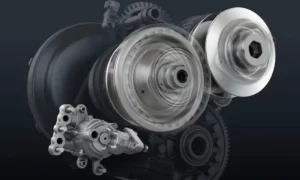
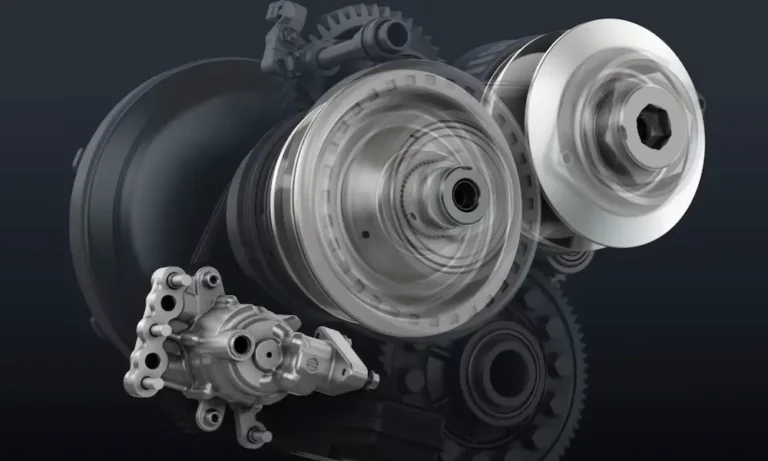
A CVT (continuously variable transmission) skips fixed gears entirely. Instead of shifting through set ratios, it uses two variable-diameter pulleys connected by a steel belt to create a seamless, stepless range of ratios.
The result? Your engine stays in its sweet spot for efficiency — no gear hunting, no shift shocks.
The trade-off? Some drivers hate the “rubber-band” feel. Hit the gas hard, and the engine revs loudly while the car slowly catches up. Manufacturers have worked hard to fix this — and many have succeeded.
The 4 Types of CVT You’ll Actually Find in Cars Today
Not every CVT works the same way. Here’s a quick breakdown:
1. Belt-and-Pulley CVT
The classic setup. Used by Nissan (Xtronic), Subaru (Lineartronic), and Honda. Common in gas-only economy cars and compact crossovers.
2. Electronic CVT (eCVT)
Don’t let the name fool you — this one uses a planetary gearset, not a belt. It blends engine and electric motor power seamlessly. Toyota and Ford hybrids rely on it heavily. It’s extremely durable.
3. Intelligent Variable Transmission (IVT)
Hyundai and Kia’s answer to the rubber-band complaint. Uses a chain belt and simulates gear shifts so the drive feels more natural. Smarter software, more engaging feel.
4. Dynamic-Shift CVT
Toyota’s clever fix. A physical first gear handles launch stress up to about 25 mph. Then the belt takes over for cruising efficiency. Best of both worlds.
What Cars Have CVT Transmissions by Brand
Toyota and Lexus
Toyota is the biggest CVT user in America — especially for eCVTs in hybrids.
Key Toyota models with eCVT:
- Toyota Camry (now hybrid-only in the US — every single one uses an eCVT)
- Toyota Prius and Prius Prime
- Toyota Sienna (hybrid-only)
- Toyota RAV4 Hybrid and RAV4 Prime
- Toyota Highlander Hybrid and Grand Highlander Hybrid
- Toyota Crown and Crown Signia
Toyota models with Dynamic-Shift CVT (gas engine):
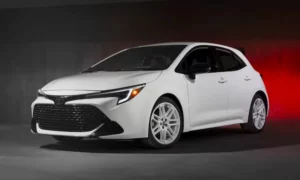
- Toyota Corolla Sedan and Hatchback
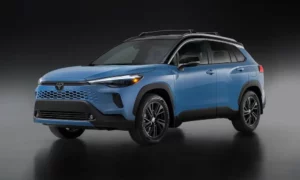
- Toyota Corolla Cross (gas trims)
| Toyota Model | Powertrain | CVT Type |
|---|---|---|
| Camry | Hybrid only | Electronic CVT |
| Prius | 2.0L Hybrid (194 HP, 57 MPG combined) | Electronic CVT |
| RAV4 Hybrid | 2.5L Hybrid | Electronic CVT |
| Corolla | 2.0L Gas | Dynamic-Shift CVT |
| Corolla Cross | 2.0L Gas | Dynamic-Shift CVT |
| Corolla Cross Hybrid | 2.0L Hybrid (196 HP) | Electronic CVT |
| Sienna | Hybrid only | Electronic CVT |
Lexus mirrors Toyota’s strategy across its entire hybrid lineup. The ES 300h, LS 500h, LC 500h, UX 250h, NX 350h, NX 450h+, RX 350h, RX 450h+, and TX 550h+ all use eCVTs. Smooth, quiet, and incredibly reliable.
Subaru
Subaru is arguably the most committed CVT brand in America. Their Lineartronic CVT is engineered to sit longitudinally, so it pairs perfectly with their Symmetrical All-Wheel Drive system.
| Subaru Model | Transmission | Max Towing |
|---|---|---|
| Impreza | Lineartronic CVT | Not rated |
| Crosstrek | Lineartronic CVT | 3,500 lbs (Wilderness) |
| Forester | Lineartronic CVT | 3,000 lbs (Wilderness) |
| Outback | Lineartronic CVT | 3,500 lbs (XT) |
| Ascent | Lineartronic CVT | 5,000 lbs |
| WRX | Lineartronic CVT (optional) | Not rated |
The Wilderness trims add heavy-duty transmission cooling to protect the belt during off-road crawling. Smart engineering for a belt-driven system under stress.
Worth noting: The Subaru Legacy is gone. After 35 years and 1.3 million US sales, production ended in 2025. Americans want crossovers. The Legacy was a CVT-powered sedan. Demand simply dried up.
Honda and Acura
Honda uses a belt-and-pulley CVT with a twist — their G-Design Shift feature coordinates the pulleys with the torque converter to mimic stepped shifts. The result feels noticeably more natural than older CVTs.
Honda CVT models (gas):
- Honda Civic Sedan and Hatchback (base trims)
- Honda Accord (lower trims)
- Honda HR-V
Honda eCVT models (hybrid):
- Honda Civic Hybrid — 50 MPG city, 47 highway
- Honda Accord Hybrid — up to 51 MPG city
- Honda CR-V Hybrid
The CR-V uses G-Design Shift for the turbo gas trims and a dual-motor eCVT for hybrids. Two different systems, same platform.
Acura uses a CVT only on the base Integra (1.5L turbo, 200 HP). It gets paddle shifters to keep things sporty. The high-performance Integra Type S? Six-speed manual only. Acura keeps the CVT away from its halo car on purpose.
Nissan
Nissan’s Xtronic CVT is everywhere in their entry and mid-level lineup. They’ve pushed CVT harder than almost anyone.
Nissan CVT models:
- Nissan Versa (S, SV, SR)
- Nissan Sentra (S, SV, SR, SL)
- Nissan Altima (SV, SR, SR Midnight Edition)
- Nissan Kicks — redesigned for 2025 with a new 141 HP 2.0L engine, 0-60 in 9.0 seconds
- Nissan Rogue (all trims)
Big shift for 2026: The Murano dumped its CVT entirely. Gone. Replaced by a nine-speed traditional automatic paired with a 241 HP variable-compression 2.0L turbo. Nissan clearly decided premium buyers don’t want CVT acoustics at $40,000+.
Infiniti still pairs a CVT with their 2.0L variable-compression turbo in the QX50 and QX55. Impressive engineering — but the engine’s drone through the CVT under hard acceleration draws complaints. Both models may not survive beyond 2025.
Hyundai and Kia
Both brands use the Intelligent Variable Transmission — a chain-belt system with software-simulated gear steps.
Hyundai IVT models:
- Hyundai Venue (1.6L, 121 HP — 29 city / 33 highway)
- Hyundai Elantra base trims (2.0L, 147 HP — 30 city / 40 highway)
- Hyundai Kona base trims (2.0L, 147 HP)
The Elantra N Line and Elantra Hybrid skip the CVT completely — seven-speed dual-clutch only. The sporty and efficient trims both go a different direction. The Kona Limited and N Line (190 HP turbo) use an eight-speed automatic instead.
Kia IVT models:
- Kia Soul
- Kia Seltos (starting at $23,790)
- Kia K4 Sedan and Hatchback — replaces the Forte, 30 city / 40 highway
The K4 starts at $27,235 for the Hatchback GT-Line and pairs a 147 HP 2.0L engine with the IVT. Clean, efficient, affordable. Larger Kia models like the Telluride and Sorento use eight-speed automatics — torque demands are just too high for a CVT.
General Motors
GM is selective. Very selective.
The Chevy Trailblazer and Buick Encore GX use a CVT for front-wheel-drive trims only. Add AWD, and the system switches to a nine-speed automatic. GM draws a hard mechanical line based on drivetrain load.
| GM Model | Drivetrain | Transmission |
|---|---|---|
| Chevy Trailblazer (1.2L / 1.3L FWD) | FWD | CVT |
| Chevy Trailblazer (1.3L) | AWD | 9-Speed Auto |
| Buick Encore GX (1.3L) | FWD | CVT |
| Buick Encore GX (1.3L) | AWD | 9-Speed Auto |
The Buick Envista (starting at $23,800) skips the CVT entirely — six-speed automatic only. The Chevy Malibu? Canceled. Its CVT-equipped final years were dominated by fleet sales. Without a hybrid or a refresh, GM pulled the plug after 2025.
Ford and Stellantis
Ford uses eCVT almost exclusively for hybrids.
The Ford Maverick Hybrid (2.5L Atkinson + electric motor, 191 HP combined) is a standout. It now offers AWD. Its eCVT handles up to 4,000 lbs towing. Ford’s eCVT has a legendary durability record — early Escape Hybrid taxis racked up over 500,000 miles in NYC.
The Ford Maverick with the 250 HP EcoBoost gas engine? Eight-speed automatic. Ford clearly separates the tools based on what each powertrain demands.
The Ford Escape Hybrid and Lincoln Corsair and Nautilus Hybrid all use eCVTs too.
Stellantis uses an eCVT in exactly one vehicle: the Chrysler Pacifica Hybrid. That’s it.
Mitsubishi
Mitsubishi uses traditional CVTs across the Outlander Sport, Eclipse Cross, and Outlander. The Outlander pairs a CVT with a 174 HP 1.5L turbo for 27 MPG combined with Super All-Wheel Control.
The Mirage is dead. Mitsubishi confirmed sales dropped 44% in the first half of 2023. Budget hatchbacks with CVTs couldn’t survive the crossover wave. Its death leaves the Nissan Versa as the only new car in America under $20,000 — also CVT-equipped.
CVT Quality Scores: Which Cars Actually Score Well?
Automotive research firm iSeeCars ranked CVT-equipped vehicles for quality and reliability. Here’s what they found:
| Model | CVT Type | iSeeCars Score (out of 10) |
|---|---|---|
| Toyota Prius | Electronic CVT | 8.8 |
| Toyota Camry Hybrid | Electronic CVT | 8.7 |
| Toyota Sienna | Electronic CVT | 8.5 |
| Toyota RAV4 Hybrid | Electronic CVT | 8.3 |
| Subaru Forester Hybrid | Belt CVT | 8.0 |
| Honda Insight | Electronic CVT | 8.0 |
| Toyota Prius Prime | Electronic CVT | 7.9 |
eCVT wins across the board. Planetary gears handle more torque, more mileage, and more abuse than friction belts. If long-term reliability matters most to you, hybrid eCVT vehicles are the safest bet.
The Big Picture: What’s Happening to CVTs
Here’s what the 2025-2026 market tells us clearly:
- Belt CVTs are shrinking to entry-level vehicles. Kicks, Versa, Venue, K4, Crosstrek — budget-focused, low-torque, compact. Cost efficiency is the whole point.
- eCVTs are taking over. Toyota’s all-hybrid Camry and Sienna signal that the eCVT is no longer niche. It’s becoming the default transmission for mainstream American family cars.
- Premium buyers are rejecting CVTs. Nissan’s Murano swap to a nine-speed automatic says it plainly: customers spending $40,000+ want defined shifts, not belt drone.
- Sedans with CVTs are disappearing. The Legacy, the Malibu, the Mirage — all gone. Americans want crossovers. CVT-equipped sedans didn’t adapt fast enough.
The CVT isn’t dying. It’s splitting into two very different futures: lean, affordable belt-driven city cars, and durable, high-tech eCVT hybrids that quietly move the whole family.
Whatever you drive, knowing which type of CVT you’re getting — and what it’s designed for — makes all the difference.