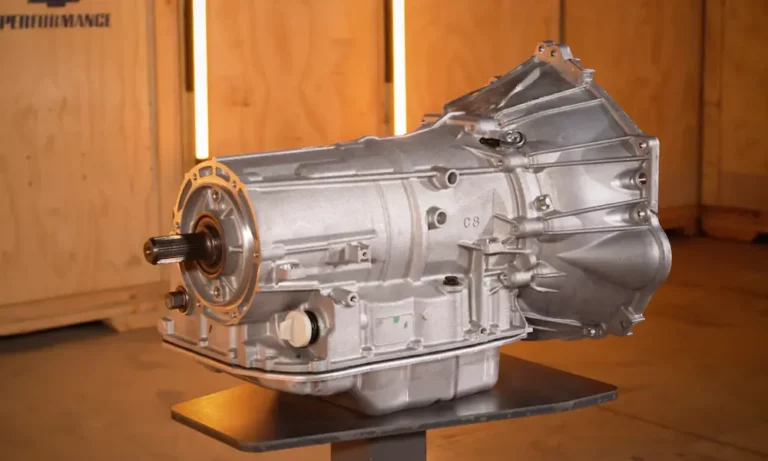
Got a GM truck, SUV, or performance car with a 6L80 transmission? Then you already know how important it is to keep that gearbox happy. But here’s the thing — the fluid capacity isn’t a single number. It changes depending on what type of service you’re doing. Get it wrong, and you’re looking at a costly repair. Read this guide to the end, and you’ll know exactly how much fluid your 6L80 needs.
Why 6L80 Transmission Fluid Capacity Isn’t One-Size-Fits-All
The 6L80 (RPO MYC) is a fully electronic six-speed automatic transmission that first appeared in GM vehicles in 2006. It replaced the old 4L60E and 4L80E units, and it brought a lot more sophistication with it — including a transmission control module inside the pan, a clutch-to-clutch shifting strategy, and a hydraulic system that stores fluid in multiple locations at once.
That last point is what trips people up. Your 6L80 doesn’t just hold fluid in the pan. It also stores it inside the torque converter, cooling lines, and clutch apply circuits. So when you drop the pan and drain 6 quarts, that’s not all the fluid in the system. Not even close.
Understanding this distinction is the first step toward doing the job right.
The Three Types of 6L80 Fluid Service (And Why Each Needs a Different Volume)
There are three distinct service scenarios for the 6L80, and each one requires a different fluid volume.
Pan Drop (Standard Service): You remove the pan, swap the filter, and reinstall. This is the most common DIY service. It only recovers the fluid sitting in the pan — typically 6.0 to 6.5 quarts, depending on the application.
Overhaul Fill: The transmission is removed and partially or fully disassembled. The torque converter is drained or replaced. This requires significantly more fluid — usually 10.0 to 12.5 quarts.
Complete System Fill (Dry): Everything is empty — the transmission, the converter, the cooler lines, the auxiliary cooler. You’re filling it from scratch. This is the highest volume scenario.
Here’s a clear breakdown by application:
| Application | Pan Drop (Qts) | Overhaul Fill (Qts) | Dry System Fill (Qts) |
|---|---|---|---|
| 6L80 – Silverado/Sierra/Tahoe/Escalade | 6.0 – 6.5 | 10.0 – 10.5 | 12.2 |
| 6L80 – w/ HD Cooling (RPO KNP) | 6.5 | 10.5 | 12.4 |
| 6L80 – Chevrolet Corvette (Transaxle) | 6.5 | 12.5 | 13.5 |
| 6L90 – GMC Sierra 2500 HD | 6.0 | 10.5 | 12.4 |
The Corvette’s higher capacity makes sense once you know it’s a rear-mounted transaxle. The cooling lines run the full length of the car, which adds significant volume to the system.
One more thing worth knowing: owners of 2015 Chevrolet Silverados have reported draining up to 8.0 quarts when the vehicle sat overnight. Fluid from the torque converter bleeds back into the pan over time. So your actual drain volume can vary — don’t panic if it’s a little higher or lower than expected.
Model-Specific 6L80 Fluid Capacity Reference Table
Here’s a quick-reference chart covering the most common platforms:
| Vehicle | Year Range | Pan Type | Service Fill (Qts) | Dry Fill (Qts) |
|---|---|---|---|---|
| Chevrolet Silverado 1500 | 2009 – 2018 | Standard Deep | 6.0 | 10.0 |
| Chevrolet Silverado 1500 | 2019 – 2024 | No Dipstick | 6.5 | 11.5 |
| Cadillac Escalade | 2015 – 2017 | Standard Deep | 7.5 – 8.0 | 13.0 – 14.0 |
| Chevrolet Corvette C6 | 2006 – 2013 | Transaxle | 6.5 | 12.5 |
| Chevrolet Camaro SS | 2010 – 2015 | Standard Deep | 6.0 | 10.0 |
| Pontiac G8 | 2008 – 2009 | Shallow | 5.5 | 9.5 |
| GMC Sierra 2500 (6L90) | 2011 – 2016 | Standard Deep | 6.0 | 10.5 |
Quick note on the Escalade: Between 2015 and 2017, Escalades came with either the 6L80 or the newer 8L90 eight-speed. Always confirm your RPO code before buying fluid or setting capacity targets. MYC = 6-speed. M5U = 8-speed. The 8L90 has a different capacity and fluid spec entirely.
What Pan You Have Changes Everything
GM used several pan designs across different 6L80 platforms, and the pan depth directly affects both fluid capacity and which filter you need.
| Pan Type | Internal Depth | Typical Vehicles | Filter Type |
|---|---|---|---|
| Standard “Deep” | 3.3 inches | Silverado, Sierra, Tahoe, Escalade | Deep Filter w/ Spacer |
| Shallow | 2.25 inches | Pontiac G8, Caprice PPV | Shallow Filter |
| Aftermarket Deep (PML, B&M) | 4.0+ inches | Performance/Tow Applications | Stock Deep Filter |
Install the wrong filter in the wrong pan, and the pump’s intake won’t stay submerged. That causes air ingestion, line pressure loss, and eventual clutch pack failure. It’s an avoidable mistake — just double-check your pan depth before ordering a filter.
If you tow regularly or take your truck off-road, an aftermarket cast-aluminum deep pan from a brand like PML or B&M adds about 2 extra quarts of capacity and can drop operating temperatures by 10°F to 35°F. That’s a real-world win for transmission longevity.
The Right Fluid for Your 6L80
Start With DEXRON-VI
The 6L80 was originally designed for DEXRON-VI full synthetic fluid. It offers better shear stability and oxidation resistance than older DEXRON formulations and works fine for most standard service intervals.
The TCC Shudder Problem (And the Fluid Fix)
Here’s something that catches a lot of owners off guard. Over time, the Torque Converter Clutch (TCC) in the 6L80 uses a pulse-width modulated strategy that allows controlled slip during lockup. When the fluid loses its frictional consistency — which happens naturally as the additive package degrades — you start feeling a vibration at steady highway speeds. Drivers describe it as “driving over rumble strips.”
That’s TCC shudder, and it’s a known failure mode.
GM addressed it directly with Technical Service Bulletin 18-NA-355, which mandates a complete fluid exchange using Mobil 1 Synthetic LV ATF HP (the Blue Label). Here’s what makes it different:
| Fluid Property | Mobil 1 Synthetic LV ATF HP | Test Method |
|---|---|---|
| Viscosity @ 40°C | 27 mm²/s | ASTM D445 |
| Viscosity @ 100°C | 5.7 mm²/s | ASTM D445 |
| Viscosity Index | 152 | ASTM D2270 |
| Pour Point | -54°C | ASTM D5949 |
| Flash Point | 233°C | ASTM D92 |
The “LV” (low viscosity) designation matters because the 6L80’s internal control module runs tiny solenoid valves that need precise, clean hydraulic response — especially in cold weather. A thicker fluid slows that response down and causes harsh or delayed shifts.
The TCC Shudder Fluid Exchange Procedure
A standard 6-quart pan drop won’t fix TCC shudder. Old fluid stays trapped in the torque converter. TSB 18-NA-355 calls for a complete exchange using a TransFlow flush machine — here’s the process:
- Disconnect the transmission cooler lines.
- Connect the TransFlow machine, loaded with 20 quarts of Mobil 1 Synthetic LV ATF HP.
- Start the engine so the transmission’s own pump expels old fluid while the machine feeds in new fluid at the same rate.
- Cycle through all gear ranges to flush every internal circuit.
- Drive up to 200 miles for the fluid to fully saturate the TCC friction material.
Twenty quarts sounds like a lot — and it is. But anything less leaves contaminated fluid in the converter, and the shudder comes right back.
How to Check the Fluid Level (No Dipstick? No Problem)
Many 6L80-equipped vehicles don’t have a traditional dipstick. Instead, they use a level control plug on the bottom of the transmission pan. The fluid level check is temperature-dependent, and getting it wrong leads to either an overfill (which causes foaming and vent discharge) or an underfill (which causes pump cavitation and clutch wear).
| Condition | Fluid Temp Range | What You Should See |
|---|---|---|
| Initial Fill/Check | 86°F – 122°F (30°C – 50°C) | Fluid just begins to drip from hole |
| Service Fast Learn | 158°F – 239°F (70°C – 115°C) | Level must be re-verified after relearn |
| Normal Operating Temp | 160°F – 200°F (71°C – 93°C) | Drip or light trickle |
Step-by-Step Level Check
- Park on a level surface with the parking brake on.
- Start the engine and monitor the Transmission Fluid Temperature (TFT) with a scan tool or the Driver Info Center (DIC).
- Shift through P-R-N-D-M, hold each for 3 seconds, then return to Park.
- With the engine idling and TFT between 86°F and 122°F, remove the level control plug from the pan.
- If no fluid drips out, add fluid through the fill port until it starts to drip.
- If a heavy stream pours out, let it drain down to a light drip.
- Reinstall the plug and torque to factory specification — roughly 18–25 Nm depending on your model.
Temperature: The Invisible Killer
Heat is the 6L80’s biggest enemy. The transmission’s internal control module sits submerged in fluid, so if that fluid gets too hot, the electronics suffer along with the clutches and seals.
Here’s what happens at each temperature stage:
- 175°F – 200°F: Ideal range. Fluid protection is at its best.
- 220°F: Oxidation begins. Fluid service life cuts in half for every 20°F above this point.
- 250°F: Clutch material glazes. Seals lose elasticity.
- 275°F: Varnish forms on valve body surfaces. Pump failure risk climbs.
- 285°F: Transmission enters thermal protection mode to prevent total destruction.
The Thermal Bypass Valve Fix
GM’s factory thermal bypass valve in 2014–2019 trucks opens at 194°F (90°C) — which sounds fine until you’re towing in summer and real-world temps exceed 210°F. A common and effective fix is replacing that valve with a 70°C (158°F) version, keeping the transmission in its ideal operating window even under load.
6L80 vs. 6L90: How Their Fluid Capacities Compare
The 6L80 and 6L90 share about 75% of their internal parts, but the 6L90 is physically larger — its case is 1.375 inches longer — and built for heavier applications. That extra size means more clutch material to saturate and more internal volume to fill.
| Feature | 6L80 (RPO MYC) | 6L90 (RPO MYD) |
|---|---|---|
| Input Torque Rating | 440 lb-ft | 531 lb-ft |
| Output Torque Rating | 664 lb-ft | 885 lb-ft |
| Pinion Gears | 4 | 6 |
| Overhaul Fluid Capacity | 10.0 – 10.5 qts | ~10.5 – 11.0 qts |
The 6L90 also often uses a larger diameter torque converter, which bumps total system volume slightly higher than the 6L80 in a comparable vehicle.
Recommended Service Intervals
The “lifetime fluid” label that GM put on these transmissions in the mid-2000s has been largely discredited by real-world failure rates. Units that hit 100,000 miles without a service show a dramatically higher rate of clutch and converter failure.
Here’s a realistic schedule:
- Every 30,000 miles — If you tow, haul, off-road, or push the truck hard.
- Every 50,000 – 60,000 miles — Standard highway-driven vehicles.
- After any hard-part failure — Replace the transmission cooler entirely. Don’t just flush it. Plate-type coolers trap metallic debris in passages too small to clean effectively. Reusing a contaminated cooler will kill a rebuilt transmission fast.
The Adaptive Shift System and Why Fluid Changes Need a Reset
The 6L80’s internal TEHCM “learns” shift behavior over time — it tracks how long each gear change takes and adjusts pressure accordingly. After any major fluid service, those learned values need to be reset through a Service Fast Learn procedure using a GM-compatible scan tool.
Skip this step, and the transmission might shift harshly or hunt between gears because it’s still using pressure calculations from the old, degraded fluid.
If you don’t have access to a scan tool, you can perform a manual Garage Shift Adapt instead:
- Cycle R to D, 10 times, holding each for a few seconds.
- Cycle N to D and N to R, 5 times each, with brief pauses.
This gives the TEHCM enough data to calibrate basic engagement behavior and prevents that jarring clunk when you first shift into gear after a service.