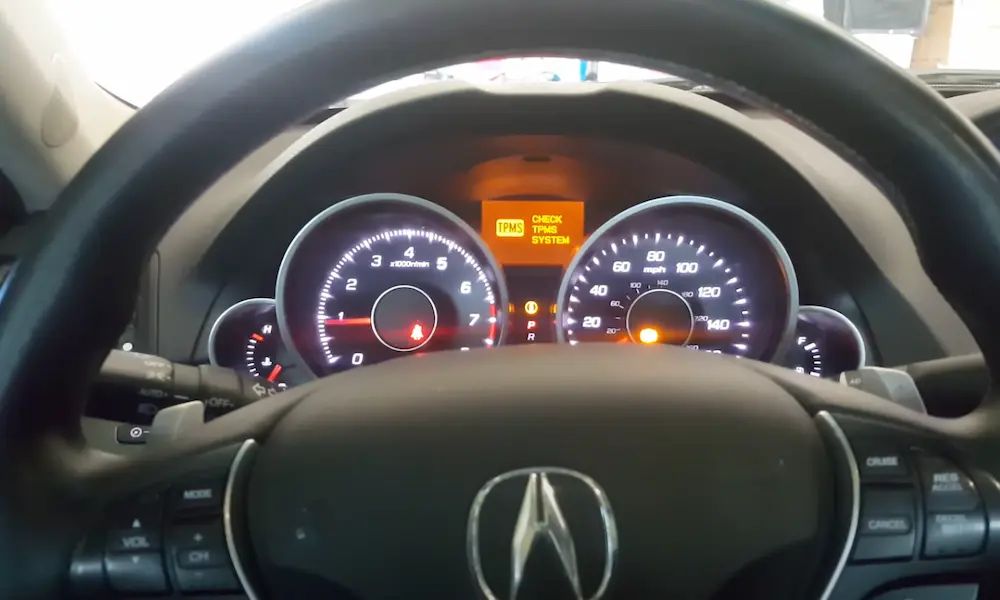
Your dashboard just flashed a B13 code and now you’re wondering how worried to be — and how much cash to set aside. Good news: it’s routine maintenance, not a crisis. Bad news: skip it, and you’ll pay for it later. Here’s exactly what the Acura B13 service covers, what it costs, and whether you should DIY it or hand over the keys.
What Does the Acura B13 Service Code Actually Mean?
The B13 code isn’t random. It’s your Acura’s Maintenance Minder system talking to you — and it’s surprisingly smart. Instead of just counting miles, it tracks engine revolutions, operating temperature, trip length, and ambient air conditions to decide when you actually need service.
Here’s how the code breaks down:
- B = Oil change, oil filter replacement, and a full multi-point inspection
- 1 = Tire rotation and pressure check
- 3 = Transmission fluid and transfer case fluid replacement
So a B13 isn’t one job — it’s four jobs stacked into one visit. That’s why it costs more than a standard oil change.
The Maintenance Minder shows you oil life as a percentage. When it hits 15%, you’ll see a “Service Due Soon” alert. At 5%, it’s “Service Due Now.” Let it hit 0% and it reads “Past Due” — which means you’ve already left your engine running on degraded oil.
The “B” Service: Oil Change + Inspection
What Goes Into the Oil Change
The B in Acura B13 service starts with an oil and filter swap — but it’s more precise than a quick lube shop special.
Modern Acura engines — including the turbocharged 2.0L four-cylinder in the RDX and the 3.5L V6 in the MDX — require full synthetic motor oil. Depending on your model and year, that’s typically 0W-20 or 5W-30. Synthetic oil holds up better under high heat and protects better during cold starts because its molecular structure stays uniform instead of breaking down.
If you drive a turbocharged RDX, your oil must meet the Honda HTO-06 specification. Turbo bearings spin above 150,000 RPM. They need the right fluid.
The technician also replaces the aluminum crush washer on the drain plug — a small but important detail. Skip it, and you risk oil leaks from a compromised seal. The plug torques to roughly 30 ft-lbs. Over-tighten it and you’ll strip the aluminum oil pan. Under-tighten it and you’ll find oil on your driveway.
The Multi-Point Inspection
The B service includes a thorough checkup of every system that keeps you safe on the road. Think of it as a health screening for your car.
| Inspection Area | What Gets Checked |
|---|---|
| Brakes | Pad thickness, rotor condition, caliper lubrication, ABS/VSA lines |
| Steering & Suspension | Tie rods, ball joints, bushings, steering gearbox |
| Driveline | CV joint boots, driveshaft, transfer case seals |
| Fluids | Coolant, brake fluid, washer fluid levels and condition |
| Exhaust & Fuel | Catalytic converter, heat shields, fuel line connections |
The brake inspection deserves a mention. Technicians use a thickness gauge to measure pad and rotor wear. In snowy or salty climates, they’ll often pull the brake pads apart completely to clean and re-lubricate the contact points. This prevents calipers from seizing — a repair that costs far more than a cleaning.
One detail most people don’t know: if your Acura has a temporary tire repair kit instead of a spare, the inspection includes checking the expiration date on the sealant bottle. Old sealant won’t work when you need it.
Sub-Code 1: Tire Rotation
Why Tire Rotation Matters More Than You Think
Front tires wear faster. They handle steering, most of the braking load, and — in front-wheel-drive-based models — power delivery. That combination grinds down the outer shoulders quickly.
Rotating your tires every 7,500 to 10,000 miles spreads that wear evenly across all four, so you’re not replacing two tires while the other two still have plenty of life.
For MDX and RDX owners with Super Handling All-Wheel Drive (SH-AWD), this matters even more. The SH-AWD system uses planetary gear sets and electromagnetic clutches to distribute torque to the rear wheels. If your tires wear unevenly, the system reads the different wheel speeds as wheel slip and starts engaging the clutches unnecessarily. That causes premature wear — and eventually, rear differential damage.
Technicians also adjust tire pressures to the spec printed on your driver-side door jamb and check sidewalls for bubbles or cracking.
Sub-Code 3: Transmission and Transfer Case Fluid
This is the most expensive and most important part of the Acura B13 service. Don’t skip it.
Which Transmission Fluid Does Your Acura Need?
Not all Acura transmissions use the same fluid. Using the wrong one causes shifting problems, clutch pack damage, or worse.
| Transmission Type | Required Fluid |
|---|---|
| 6-Speed Automatic | Acura ATF DW-1 |
| 9-Speed Automatic (ZF) | Acura ATF Type 3.1 |
| 10-Speed Automatic | Acura ATF Type 2.0 |
| 8-Speed Dual-Clutch (DCT) | Acura DCT Fluid |
| CVT | Acura CVT Fluid (Gen 1 or 2) |
The 9-speed ZF transmission found in several MDX and TLX models is particularly sensitive. It needs ATF Type 3.1 — full stop. Using a generic ATF causes gear hunting, harsh shifts, and can destroy the clutch packs entirely. This isn’t a “close enough” situation.
The 3x Drain and Fill Method
Here’s something most people don’t know: a single drain of your transmission pan only removes about 3–4 quarts out of a total 9–12 quart capacity. The rest stays trapped in the torque converter and internal passages.
Acura recommends a triple drain and fill procedure:
- Drain and refill with fresh fluid
- Drive the car through all gears to mix old and new fluid
- Drain and refill again
- Repeat one more time
After three rounds, your transmission contains over 80% fresh fluid. That’s a massive improvement over a single drain — and it’s much safer than a pressurized flush machine, which can damage seals in high-mileage transmissions.
Checking the Fluid Level (It’s Not Simple)
If you have a 9-speed or 10-speed transmission, forget the dipstick — there isn’t one. These transmissions use a side-mounted level-check plug, and you must check the level within a specific temperature window: 104°F to 113°F (40°C–45°C).
Check it when the fluid is too hot, and thermal expansion tricks you into draining too much. Too little fluid causes cavitation and pump damage — expensive damage that’s completely preventable.
Transfer Case Fluid
SH-AWD models have a transfer case that splits power from the transmission to the rear differential. It runs a hypoid gear set that handles extreme sliding friction under high torque.
The required fluid is Acura Genuine Hypoid Gear Oil (HGO-1), or a high-quality SAE 75W-85 or 80W-90 with an API GL-5 rating. That GL-5 rating means the oil contains extreme-pressure additives that form a sacrificial protective layer on the gear teeth. Without it, the gears gall under load.
The fill plug is often tucked awkwardly above the subframe, so getting the new fluid in requires a hand pump and a flexible tube. Neglect this fluid long enough and you’ll hear a distinct whining from your drivetrain — right before it fails.
Electronic Parking Brake: Don’t Skip the Reset
Most newer Acuras use an Electronic Parking Brake (EPB) instead of a cable-operated handbrake. The B13 checklist includes verifying the EPB applies sufficient clamping force.
If rear brake service happens alongside your B13, the technician must put the car into Maintenance Mode first. This electronically retracts the caliper pistons. If you manually compress the pistons without doing this, you’ll destroy the internal screw mechanism inside the actuator. That’s a caliper replacement — for a mistake that takes 30 seconds to avoid.
After the service, the system runs a re-learn procedure so the computer knows exactly where the new brake pads sit relative to the rotor.
How to Reset the Maintenance Minder After B13 Service
Once the work is done, you need to clear the B13 code. There are two ways:
Steering Wheel Method:
Navigate to “Maintenance Info” or “Oil Life” on the multi-information display. Hold “Enter” or “Reset” for 10 seconds to enter reset mode, then select the specific items or “All Due Items” to clear.
Infotainment Method:
Go to Settings → Vehicle Settings → Maintenance Info → Maintenance Reset. Select the B13 items and confirm.
Both methods sync the system to your new service date and restart the countdown.
What Does the Acura B13 Service Cost?
Here’s where it gets real. The B13 is one of the pricier routine services in the Acura ownership cycle — but it’s a fraction of what you’d pay if you skipped it.
Dealership: $500–$800 depending on location and whether they perform the full 3x transmission exchange. You get OEM fluids and access to Honda’s diagnostic system (HDS) for transmission recalibration after the fluid change.
Independent Shop: $300–$500. Lower labor rates and quality aftermarket fluids that meet Acura specs. Just make sure they know how to handle the temperature-sensitive level check on ZF transmissions.
DIY: $150–$250 in parts and fluids. Here’s the breakdown:
| Component | Spec | Estimated Cost |
|---|---|---|
| Full Synthetic Oil | 5–6 qts (0W-20 or 5W-30) | $35–$50 |
| Engine Oil Filter | OEM or premium (Bosch/Wix) | $10–$15 |
| Transmission Fluid | 4–10 qts (varies by trans) | $60–$180 |
| Transfer Case Oil | 1 qt HGO-1 or GL-5 80W-90 | $15–$25 |
| Crush Washers | Drain and fill plugs | $5–$10 |
DIY requires an 8mm hex socket, torque wrench, and either a scan tool or infrared thermometer to monitor transmission fluid temperature. Miss that temperature window and you’ll underfill — which causes more problems than the service was supposed to prevent.
For context: Acura vehicles consistently cost less to maintain over 10 years than European luxury competitors. A B13 service at $500–$800 sounds steep until you compare it to a transmission replacement at $5,000+ or a transfer case failure.
How Often Does the Acura B13 Service Come Up?
The Maintenance Minder triggers the B13 based on actual driving conditions, not a fixed mileage. For most drivers, that’s somewhere between 30,000 and 45,000 miles — though your specific driving habits shift that number in either direction. Frequent short trips in cold weather? You’ll see it sooner. Steady highway miles? You might stretch it further.
The key point: when your Maintenance Minder says B13, that’s not a suggestion. It’s a calculated call based on real data from your engine and drivetrain. Follow it.