You’re standing in the oil aisle, wallet ready, staring at two premium bottles. One’s American, claiming aerospace tech. The other’s German, promising factory-perfect fit. Both cost more than your lunch. Here’s the truth: picking the wrong one could cost you way more than the price difference. Let’s cut through the marketing and figure out which oil belongs in your engine.
What Makes These Oils Different From Regular Stuff?
Most oils come from refined crude. AMSOIL and Liqui Moly don’t play that game.
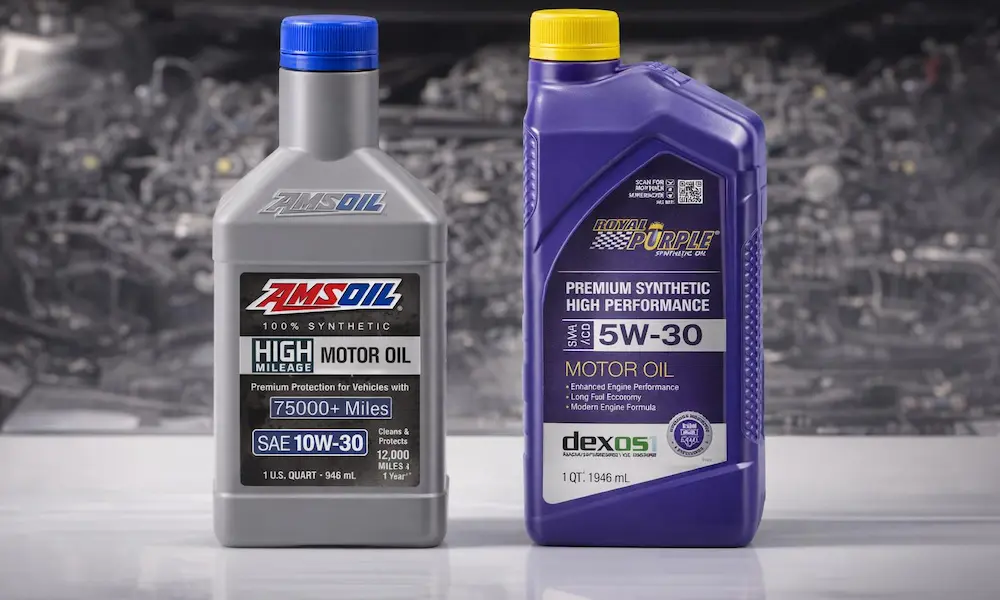
AMSOIL builds from jet fuel roots. Founded by a fighter pilot in 1972, they brought aerospace synthetic technology to car engines. Their Signature Series uses Group IV PAO base oils—chemically engineered molecules, not refined petroleum. Think of it as designing oil in a lab instead of pumping it from the ground.
Liqui Moly started with a World War II secret. Their 1957 foundation wasn’t about base oil at all. It was about Molybdenum Disulfide—a solid lubricant that kept shot-up aircraft engines running long enough to land. They’re additive chemists first, oil blenders second.
That split defines everything: AMSOIL obsesses over the base liquid. Liqui Moly obsesses over what’s dissolved in the liquid.
The Base Oil Battle: PAO vs Hydrocracked
Here’s where science meets your wallet.
AMSOIL’s PAO Advantage
Group IV Polyalphaolefin (PAO) isn’t refined—it’s synthesized from ethylene gas. Every molecule is identical. No impurities. No weak links.
This uniformity delivers two massive wins:
Low volatility: PAO molecules don’t boil off easily. AMSOIL Signature Series 5W-30 loses just 6.7% to evaporation at extreme heat. Less oil vapor means less carbon buildup on your intake valves—critical for direct injection engines that don’t wash their valves with fuel.
Natural thickness stability: PAO doesn’t thin much when hot or thicken much when cold. It needs fewer polymer additives to maintain viscosity. Those polymers can shear apart in high-stress engines. Less polymer means more durability.
Liqui Moly’s Hydrocracked Strategy
Most Liqui Moly oils use Group III base stocks. These start as mineral oil, then get hammered with extreme pressure and heat to reorganize the molecules. It’s refined oil on steroids.
Group III can’t be called “fully synthetic” in Germany (though it can in the US after a 1999 legal ruling). But it brings serious benefits:
Better solvency: Group III holds additives in suspension better than slippery PAO. It also swells rubber seals more effectively. This explains why owners of high-mileage German cars swear Liqui Moly stopped their oil leaks. Pure PAO sometimes shrinks old seals.
Lower cost: Group III costs half what PAO does. Liqui Moly banks that savings and dumps it into expensive friction modifiers—Tungsten, Molybdenum—that AMSOIL can’t afford at their price point.
The Secret Sauce: Additive Technology Showdown
Base oil is the canvas. Additives are the art.
AMSOIL: The ZDDP Maximalist
Zinc Dialkyldithiophosphate (ZDDP) is the classic anti-wear shield. Under heat and pressure, it forms a sacrificial glass-like film on metal parts.
AMSOIL Signature Series packs high ZDDP levels—often exceeding modern API limits designed to protect catalytic converters. This is why Signature Series doesn’t carry API certification. They deliberately “overdose” the oil with zinc and phosphorus because they prioritize metal protection over catalyst longevity.
It’s over-engineering. Very American.
Liqui Moly: The Friction Modifier Artist
Molybdenum Disulfide (MoS₂): This solid lubricant physically plates to metal surfaces in thin layers. Even if your oil film breaks down, the MoS₂ coating remains, preventing metal-to-metal contact. It’s emergency lubrication—the same tech that kept WWII planes flying with punctured oil tanks.
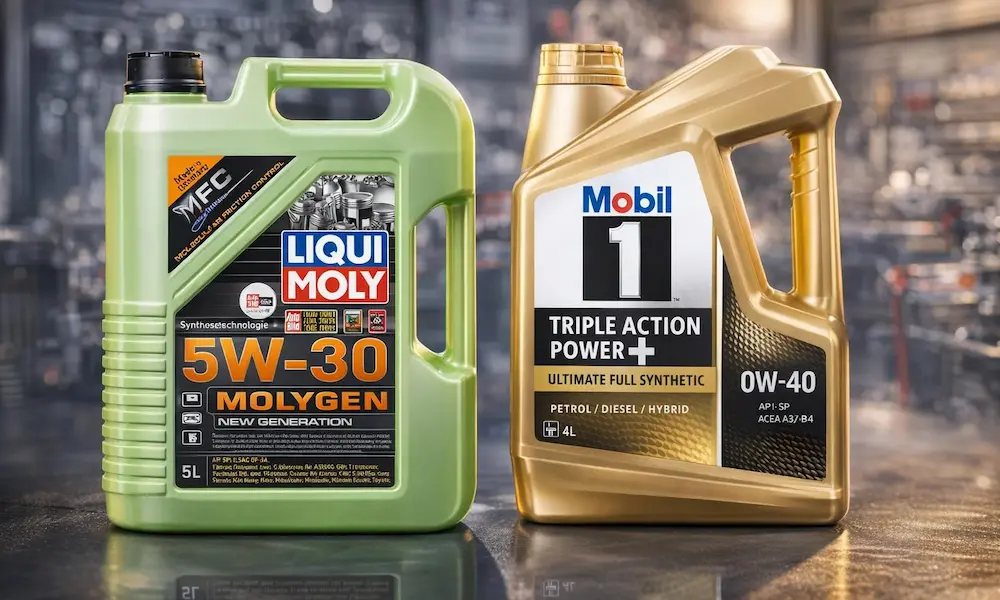
Tungsten (Molygen line): The green-glowing Molygen oils use tungsten-based friction control. Tungsten ions chemically react with iron surfaces under friction, forming ultra-hard, smooth mixed crystals. It literally polishes your engine’s internals at the molecular level, reducing friction up to 15%.
The downside? MoS₂ turns your oil grey. Tungsten dyes it fluorescent green. Visual oil checks become harder.
Real-World Performance: The Numbers Don’t Lie
Talk is cheap. Lab data isn’t.
| Test | AMSOIL Signature 5W-30 | Liqui Moly Special Tec 5W-30 | What It Means |
|---|---|---|---|
| NOACK Volatility | 6.7% | 9.7% | AMSOIL boils off 31% less. Huge for GDI engines. |
| Pour Point | -50°C (-58°F) | -41.6°C (-43°F) | AMSOIL flows better in arctic cold. |
| Total Base Number (TBN) | 12.5 mg KOH/g | 11.7 mg KOH/g | AMSOIL neutralizes acid longer—supports 25k-mile drains. |
| Viscosity Index | 162 | 160 | Nearly identical thermal stability. |
AMSOIL wins volatility and cold-flow. But here’s the twist: high TBN comes from high ash content. That ash clogs diesel particulate filters. Use AMSOIL Signature in a modern VW TDI, and you’re looking at a $2,000 DPF replacement.
The Warranty Minefield: Approved vs. Recommended
This is where most people screw up.
Liqui Moly: Factory-Blessed
Liqui Moly maintains official OEM approvals from Volkswagen (502.00, 504.00, 507.00), BMW (LL-01), and Mercedes-Benz (229.5). These aren’t cheap—each approval costs over $500,000 in testing and requires specific engine torture tests.
Your Liqui Moly receipt is legal armor. If your Audi dealer tries denying a warranty claim, you hand them the bottle. The oil is on VW’s official ErWin list. Case closed.
AMSOIL: The Maverick
AMSOIL Signature Series carries zero official API or European OEM approvals.
Their argument? Approvals lock formulations. If they invent a better additive next month, they want to use it immediately. Official certification prevents that innovation without expensive re-testing.
Instead, they say the oil “meets or exceeds” specifications. That’s AMSOIL’s claim, not Volkswagen’s endorsement.
Legal reality: Under the Magnuson-Moss Warranty Act, dealers can’t void warranties just for using aftermarket oil. But if your engine grenades and the oil isn’t approved, the burden of proof shifts. The dealer can deny your claim, and you’ll rely on AMSOIL’s own warranty to fight it.
For a car under factory warranty, Liqui Moly is the safer bet. For an out-of-warranty build, AMSOIL’s lack of approval doesn’t matter—performance does.
Which Oil for Which Engine?
Stop asking “which is better.” Start asking “which is better for my car.”
High-Mileage German Cars (BMW, Audi, Mercedes Over 100k Miles)
Winner: Liqui Moly
Older German engines—especially Audi’s 2.0 TFSI and BMW’s N54—burn oil like it’s going out of style. Low-tension piston rings and worn valve seals are the usual culprits.
Community fixes consistently point to Liqui Moly’s Pro-Line Engine Flush, followed by Leichtlauf High Tech 5W-40 with MoS₂ additive. The Group III base swells aging seals. The solid lubricant fills microscratches in cylinder walls. Users report drops from 1 quart per 1,000 miles to negligible consumption.
AMSOIL’s ester-heavy formula sometimes cleans too aggressively, removing carbon deposits that were acting as “false seals” in very old engines.
Turbocharged GDI Engines (Subaru WRX, Ford EcoBoost, VW TSI)
Winner: AMSOIL
These engines generate brutal heat and suffer from Low Speed Pre-Ignition (LSPI)—a condition where oil droplets ignite early, shattering pistons.
AMSOIL’s magnesium-based detergent package prevents LSPI. Their low NOACK volatility (6.7%) means less oil vapor contaminating the combustion chamber. Independent testing shows AMSOIL resists viscosity breakdown longer than competitors under high shear stress.
For a WRX pushed hard or an EcoBoost towing, AMSOIL’s thermal stability is worth the extra cost.
Modern Diesels With DPF (VW TDI, BMW 328d, Mercedes GLK 250)
Winner: Liqui Moly Top Tec 4200
No contest. These engines require Low-SAPS (Sulfated Ash, Phosphorus, Sulfur) oil. High ash physically clogs the diesel particulate filter—a repair that costs more than a year’s worth of oil changes.
Liqui Moly Top Tec 4200 is specifically engineered for VW/Audi’s 507.00 spec. It disperses soot aggressively while keeping ash below DPF-killing thresholds.
AMSOIL Signature Series? Strictly forbidden. Its high TBN comes from high ash. You’d destroy the DPF. AMSOIL’s European Car Formula (AEL) is Low-SAPS compliant, but Liqui Moly owns this category.
Track Cars and Performance Builds
Winner: AMSOIL
If you’re tracking a Civic Type R or building a boosted Miata, you don’t care about OEM approvals. You care about film strength under sustained 7,000 RPM runs.
Project Farm’s independent testing showed AMSOIL consistently outlasting competitors in wear scar tests and viscosity retention. The PAO base and high ZDDP loading create a film that holds even when oil temps spike past 250°F.
The Real Cost: It’s Not Just the Bottle Price
Oil cost isn’t what you pay per quart. It’s what you pay per mile.
AMSOIL Pricing Strategy
- Retail: ~$15.49/quart
- Preferred Customer: ~$11.89/quart (requires $20/year membership)
- Distribution: Mostly direct-to-consumer; shipping costs add up
Liqui Moly Pricing Strategy
- Retail: ~$45-$60 for 5 liters (~$9-$12/quart)
- Distribution: Available at NAPA, AutoZone, major online retailers
But here’s the economic twist: FCP Euro’s Lifetime Guarantee.
FCP Euro offers lifetime replacement on all parts, including used oil. Buy 5L of Liqui Moly, use it, drain it, pour it back into the bottle, ship it back. They refund your purchase. You’ve effectively gotten a free oil change minus shipping (~$15).
For DIYers with European cars, this loophole makes Liqui Moly radically cheaper than AMSOIL.
Extended Drain Economics
AMSOIL’s value proposition depends on you actually using their extended drain intervals.
Scenario: 15,000 miles/year
- Liqui Moly strategy: 3 changes at 5k intervals × $60 = $180/year
- AMSOIL strategy: 1 change at 15k interval × $90 = $90/year
AMSOIL is cheaper if you trust the 15,000-mile interval. If you’re neurotic and change it at 5,000 miles anyway, you’re wasting money.
What the Used Oil Analysis Reveals
Blackstone Labs and Bob Is The Oil Guy forums provide thousands of real-world data points.
AMSOIL findings:
- TBN remains above 8.0 even after 10,000+ miles
- Iron wear metals consistently among the lowest recorded
- Confirms extended drain capability in normal driving
Liqui Moly findings:
- Solid wear protection, especially with Molygen’s tungsten
- TBN depletes faster than AMSOIL (expect 5,000-7,500 mile drains)
- Lower iron counts in European engines versus conventional oils
The data backs marketing claims—mostly. AMSOIL lasts longer. Liqui Moly protects German engines better at shorter intervals.
The Philosophy Split: Choose Your Religion
This isn’t about which oil is “better.” It’s about which philosophy matches your needs.
AMSOIL is the over-engineer. It’s designed to exceed every spec, outlast every interval, and protect under conditions your engine will never see. It’s American maximalism: if some is good, more is better.
Liqui Moly is the precision instrument. It’s designed to integrate perfectly with specific engines, matching exact emissions systems, seal materials, and metallurgy. It’s German exactness: the right amount, in the right place, at the right time.
Your Decision Matrix
| Your Situation | Choose This | Why |
|---|---|---|
| Warranty-covered car | Liqui Moly | OEM approvals prevent legal headaches |
| Out-of-warranty performance car | AMSOIL | Max protection without approval constraints |
| High-mileage German car (100k+) | Liqui Moly | Seal conditioning stops leaks |
| Turbocharged GDI engine | AMSOIL | Lowest volatility prevents carbon buildup |
| Modern diesel with DPF | Liqui Moly Top Tec | Low-SAPS formulation protects filter |
| Extended oil change intervals | AMSOIL | Proven 15k-25k mile capability |
| Frequent short trips in cold climate | AMSOIL | -58°F pour point wins arctic starts |
| DIY with FCP Euro account | Liqui Moly | Lifetime guarantee = near-free oil |
Neither oil will wreck your engine. Both are light-years ahead of conventional oils. The “wrong” choice isn’t catastrophic—it’s just suboptimal.
Pick the oil that matches your engine’s specific needs, your warranty status, and your change interval philosophy. Then stop overthinking it and actually change the damn oil on time. That matters more than the brand on the bottle.