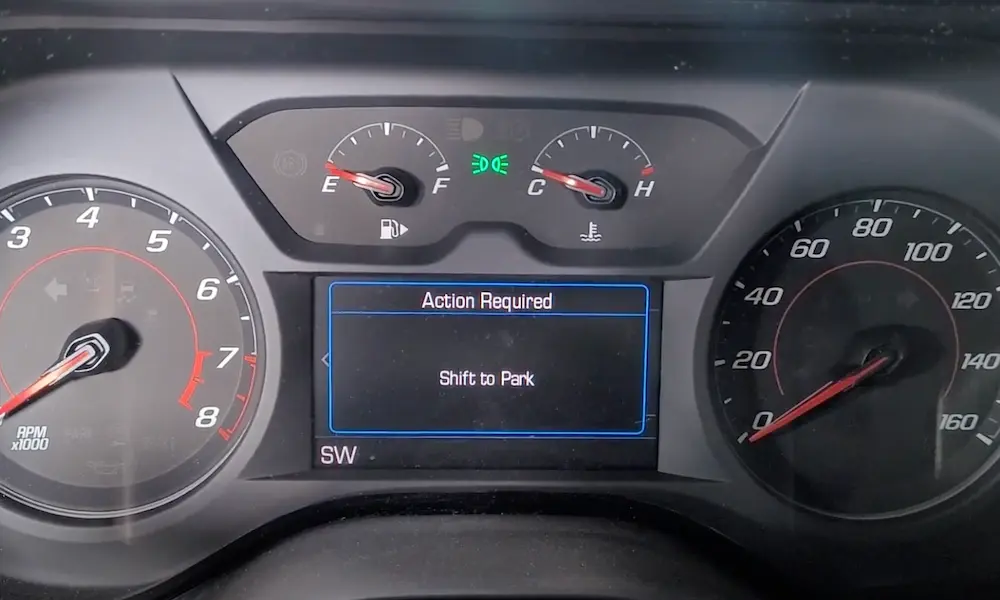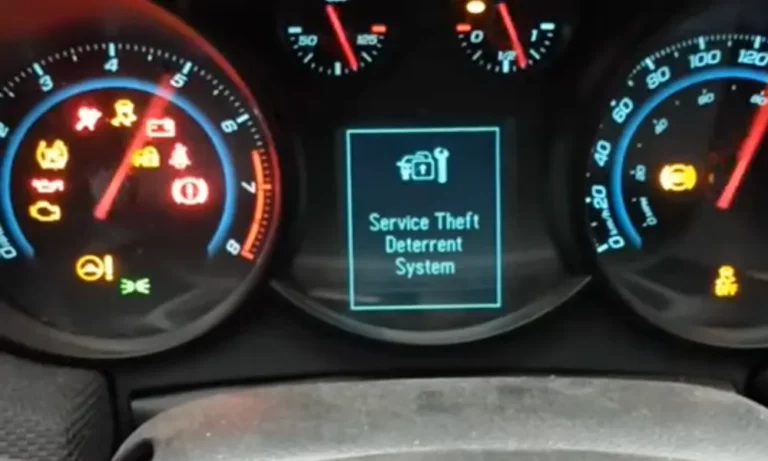
You turn the key, and nothing happens. The dash lights up with “Service Theft Deterrent System,” and your Cruze sits there like a brick. Before you panic and call a tow truck, here’s what you need to know. This problem has a pattern, and most fixes don’t require a mechanic. Let’s get your car running.
What “Service Theft Deterrent System” Actually Means
Here’s the thing most people get wrong: this isn’t your car being paranoid about theft. It’s a component failure.
The message means a part in your immobilizer system has failed its self-check. Your Cruze can’t verify your key is legit because the reader is broken, not because your key is wrong. That’s why trying your spare key often doesn’t work.
Think of it like a broken card reader at a store. Your credit card is fine, but the machine can’t read it.
The Two Different Security Systems (Don’t Mix Them Up)
Your Cruze has two separate security systems. Mixing them up wastes money.
The Immobilizer
This stops the engine from starting without the correct electronic key. When it fails, you get a no-start condition and the “Service” message. This is what we’re fixing.
The Alarm
This is the honking, flashing lights system that scares off break-ins. It includes glass sensors and a battery-backed siren. Alarm problems cause false alarms, not no-start issues.
If your car won’t start, don’t chase alarm system fixes. The immobilizer controls engine starting, not the alarm.
How Your Key Talks to Your Car
Your Cruze uses the PASS-Key III system. Here’s the chain of events when you turn the key:
- An antenna ring in the ignition energizes a chip in your key
- The chip broadcasts an encrypted code
- The Theft Deterrent Module reads this code
- The Body Control Module (BCM) validates it
- The Engine Control Module gets the “start approved” signal
- Your engine cranks and fires up
Break any link in this chain, and you’re stuck. The system defaults to “secure” (no start) when confused.
The Classic Symptoms to Watch For
No-Crank or Crank-No-Start
You turn the key to nothing, or the engine turns over but won’t fire. The ECM is blocking the starter or cutting fuel.
Security Light Behavior
A solid security light means hard fault detected. A rapidly flashing light after a failed start confirms immobilizer trouble.
The “No Remote Detected” Message
On push-button models, this is your equivalent warning. The BCM can’t sense your key fob.
The Critical Clue Everyone Misses
Here’s the diagnostic gold: these failures are almost always intermittent. One minute your Cruze works fine, the next it’s dead.
Even better: the theft warning appears alongside other weird electrical issues. Your radio cuts out. Traction control warnings pop up. The HVAC display flickers.
A bad key gives consistent, repeatable failures. It doesn’t randomly kill your radio or trigger StabiliTrak warnings.
This combination screams one thing: bad power or ground connection affecting multiple systems. Not a security problem—an electrical supply problem.
Fix #1: Check Your Key Fob Battery First
For Push-Button Start Models
That “No Remote Detected” message? It’s usually a dead CR2032 battery in your fob. The proximity broadcast needs power, even though the emergency transponder doesn’t.
Replace it for $3 and see if your problem vanishes.
Dead Fob Bypass Trick
If your fob battery is dead right now, you can still start your car. Find the key transmitter pocket in your center console or cupholder area. Drop the “dead” fob inside and try starting. The pocket’s antenna reads your key’s passive chip directly.
Flip-Key Users: Extend It Fully
GM issued a Technical Service Bulletin for 2011-2014 Cruze models with flip keys. If the key isn’t fully extended and locked straight, it inserts at an angle. The transponder chip misaligns with the antenna ring, and your car won’t crank.
Pull the key out. Extend it completely until it clicks. Reinsert it straight. That’s it.
Fix #2: Test Your 12V Battery (Not Just Look at It)
A weak battery is the most common cause of “ghost” electrical failures. Your BCM is a computer. Low voltage makes it crash and log false faults.
Don’t just check if your battery “has 12 volts.” That’s meaningless. A dying battery can show 12.4V on the dash but drop to 9V when the starter engages. That voltage drop kills the BCM mid-handshake.
Get a proper load test. If your battery is over three years old, replace it before doing anything else.
Fix #3: The 2011-2015 Cruze “Smoking Gun”
If you own a 2011-2015 Cruze and you’re seeing the theft warning plus StabiliTrak errors plus radio issues, stop everything. Don’t buy a new BCM. Don’t reprogram keys.
Check Special Coverage Bulletin 14311B.
The Problem
GM’s negative battery cable has a bad crimp at the terminal. Over time, internal resistance builds up. This creates a high-resistance ground at the source of your entire electrical system.
The Symptoms
GM lists exactly what you’re experiencing:
- Radio/HVAC display turning off and on
- “Service StabiliTrak” messages
- “Service Traction System” warnings
- “Battery Saver Active” message
- And yes, “Service Theft Deterrent System”
This isn’t five separate problems. It’s one bad ground cable causing network-wide voltage drops and cascading failures.
The Fix
Replace the negative battery cable (GM part #22754271). It’s $25-50 and takes 15 minutes to swap. This is the single most cost-effective fix for these model years.
Visual inspection won’t catch this. The crimp looks fine from outside. It’s the internal resistance that’s killing you.
Fix #4: Check Your Ignition Assembly
Mechanical Lock Cylinder Issues
If your key sticks, jams, or won’t turn at all, the lock cylinder tumblers are worn. Try wiggling the steering wheel while turning the key to disengage the steering lock.
If that doesn’t work, the cylinder needs lubrication or replacement. This is a $97-140 repair.
Electrical Ignition Switch Failure
The ignition switch is behind the lock cylinder. It routes power to different systems. If the “ON” contacts fail, the BCM never wakes up to read your key.
Symptoms: no crank, no start, and dashboard lights that don’t work correctly when you turn the key to “ON.” This perfectly mimics a theft fault but it’s just a worn switch. The fix costs $120-154.
The 30-Minute Relearn: Why It Won’t Fix This
You’ll find this procedure all over the internet: turn the key to ON, wait 10 minutes for the security light to go out, turn it OFF, repeat three times.
Here’s why it fails: this procedure programs new keys to a working system. It doesn’t reset a broken system.
The “Service” message means a component has failed. The BCM isn’t in “learn mode”—it’s offline or has detected a hard fault.
Trying the 30-minute relearn on a Cruze with a bad ground cable or failed ignition switch is like installing software on an unplugged computer. It can’t work.
This procedure only helps if you’ve replaced your BCM or keys and need to teach them to talk to each other. That’s it.
The Battery Disconnect “Temporary Fix”
Disconnecting your battery for 30 seconds clears the BCM’s fault memory. Your car starts once. Then the BCM runs its self-tests, re-detects the underlying problem, and triggers the fault again.
If this “works” temporarily, you’ve confirmed the fault is electronic, not mechanical. You haven’t fixed anything—you’ve just hit the reset button.
What the Diagnostic Codes Tell You
A cheap OBD2 scanner won’t help here. You need a GM-compatible tool that reads “B” (Body) and “U” (Network) codes.
DTC B3055: “No Transponder”
Translation: “I can’t hear the key.”
Check these in order:
- Is your flip-key fully extended? (TSB PIT5030E)
- Is your key damaged or wet?
- Try your spare key
- Remove other keys/fobs from the keychain (RF interference)
DTC B3060: “Unprogrammed Key”
Translation: “I hear the key, but it’s wrong.”
Either you’re using a new unprogrammed key (the 30-minute relearn will work here), or the BCM’s memory got corrupted and “forgot” your valid keys.
DTC U0167: “Lost Communication with Immobilizer”
Translation: “The ECM can’t talk to the immobilizer at all.”
This is the big one. Combined with StabiliTrak codes, this points directly to TSB 14311B (bad ground cable) for 2011-2015 models. If you see this code, replace that cable before doing anything else.
When You Need Professional Help
Some failures require specialized tools and programming.
BCM Replacement
If you’ve ruled out battery, ground cable, keys, and ignition assembly, and codes point to the BCM, it’ll need replacement and programming.
Here’s the trap: a new BCM costs $160-350, but it’s a non-functional brick until programmed to your VIN. That programming requires dealer-level software. Factor in $115-169 for programming labor.
Total BCM replacement: $666-725+.
Used BCM Complications
Salvage yard BCMs can’t be reprogrammed at dealers. The only way to use a used BCM is EEPROM cloning—physically copying the chip from your old BCM to the replacement. This costs $100+ for the service alone.
What Won’t Work (Save Your Money)
The Resistor Bypass
You’ll see guides showing how to wire a resistor into the steering column to “bypass” GM anti-theft. That’s for old VATS/Passlock systems.
Your Cruze uses PASS-Key III, which is an encrypted RF transponder system. It’s not looking for a resistance value—it’s performing a cryptographic handshake. Wiring in a resistor does nothing or damages your BCM.
Aftermarket “Bypass Modules”
These are designed for remote starter installations. They don’t fix broken immobilizer components. Don’t waste money here.
The Right Diagnostic Path
Follow this order to avoid throwing money at the wrong parts:
- Test your key fob battery (push-button models) or verify flip-key is fully extended (keyed models)
- Load-test your 12V battery (replace if over 3 years old or fails test)
- For 2011-2015 models: Replace negative battery cable if you have multiple ghost faults
- Scan for B and U codes with a proper tool
- Check ignition assembly (mechanical cylinder and electrical switch)
- Diagnose BCM only after eliminating all other causes
Repair Costs at a Glance
| Repair | Parts | Labor | Total |
|---|---|---|---|
| Key fob battery (CR2032) | $1-5 | DIY | $1-5 |
| Transponder key replacement | $35-80 | $70-150 | $170-320 |
| Negative battery cable (TSB 14311B) | $25-50 | DIY-$75 | $25-125 |
| Ignition lock cylinder | $61-86 | $37-54 | $97-140 |
| Ignition switch | $50-51 | $70-102 | $120-154 |
| Body Control Module (BCM) | $160-556 | $115-169 | $666-725+ |
| Professional diagnostic scan | N/A | $61-120 | $61-120 |
Prevent This From Happening Again
Replace Your Battery Proactively
Don’t wait for it to die. Modern electronics are voltage-sensitive. Replace your 12V battery every 3-5 years.
Change Key Fob Batteries Regularly
Swap the CR2032 every 2-3 years. Keep fobs dry and don’t drop them.
2011-2015 Owners: Do the TSB Fix Now
If you haven’t replaced your negative battery cable yet, do it preventively. It’s $25 and 15 minutes. This eliminates the most common electrical nightmare these Cruzes experience.
The Bottom Line
The “Service Theft Deterrent System” warning isn’t mysterious. It’s a broken component in a simple chain.
For most people, the fix is either a dead fob battery, a weak vehicle battery, or—if you’ve got a 2011-2015 model with weird electrical issues—that bad negative battery cable from TSB 14311B.
Start with the cheap, simple fixes. Test your batteries. Replace that ground cable if your model year matches. Don’t jump straight to expensive BCM replacements or dealer visits.
The 30-minute relearn won’t fix a hardware failure. A battery disconnect is a temporary band-aid. And resistor bypasses don’t work on modern transponder systems.
Follow the diagnostic path, and you’ll find the real problem without emptying your wallet on parts you don’t need.