That check engine light is staring you down, and your code reader just spit out Chevy P0101. Before you drop $300 on a new MAF sensor, stop. This code is one of the most misdiagnosed faults on Chevrolet vehicles, and buying the wrong part first is a very common (and expensive) mistake. Read through this guide and you’ll know exactly what’s causing it and how to fix it right.
What Is the Chevy P0101 Code?
The P0101 code officially means “Mass or Volume Air Flow ‘A’ Circuit Range/Performance.” Your Engine Control Module (ECM) is essentially saying: “The airflow reading I’m getting doesn’t match what I’m calculating based on everything else I see.”
Here’s what makes P0101 different from its cousins:
- P0102 = MAF signal too low (electrical fault)
- P0103 = MAF signal too high (electrical fault)
- P0101 = MAF signal is there, but it’s lying to the ECM
Your MAF sensor is working. It’s just sending bad data. That’s why this code is tricky — and why a lot of parts get replaced unnecessarily.
How the MAF Sensor Actually Works
Your Chevy’s MAF sensor sits in the intake duct, right after the air filter and before the throttle body. It uses a heated platinum wire — a design called hot-wire anemometry. Air passing over that wire cools it down. The sensor measures how much electrical current it needs to keep the wire at temperature, then sends that data to the ECM as a frequency signal (measured in Hz on most modern GMs).
The ECM uses this number to calculate how much fuel to inject to maintain the ideal 14.7:1 air-fuel ratio.
But here’s where P0101 comes in. The ECM also runs a MAP sensor as a cross-check. The MAP sensor measures vacuum inside the intake manifold. If the MAF says “tons of air coming in” but the MAP says “throttle’s barely open,” the ECM knows something’s off. When that conflict lasts around four seconds, P0101 gets logged.
| Sensor | What It Measures | Where It Lives | Role in P0101 |
|---|---|---|---|
| MAF Sensor | Air mass entering the engine | Intake duct, after air filter | The sensor being questioned |
| MAP Sensor | Pressure inside intake manifold | On the intake manifold | Cross-checks the MAF reading |
Chevy P0101 Symptoms You’ll Actually Notice
Don’t expect every symptom to show up at once. Sometimes P0101 just lights the check engine light and that’s it. Other times, your Silverado feels like it’s falling apart at a stoplight.
Common symptoms include:
- Rough idle or stalling — especially right after a cold start or at a stop
- Hesitation under acceleration — noticeable when towing or climbing a hill
- Poor fuel economy — the ECM defaults to a rich fuel map to protect the engine
- Black smoke from the exhaust — unburned fuel making it out the tailpipe
- Reduced Engine Power mode — your Equinox or Malibu may limp home at reduced throttle
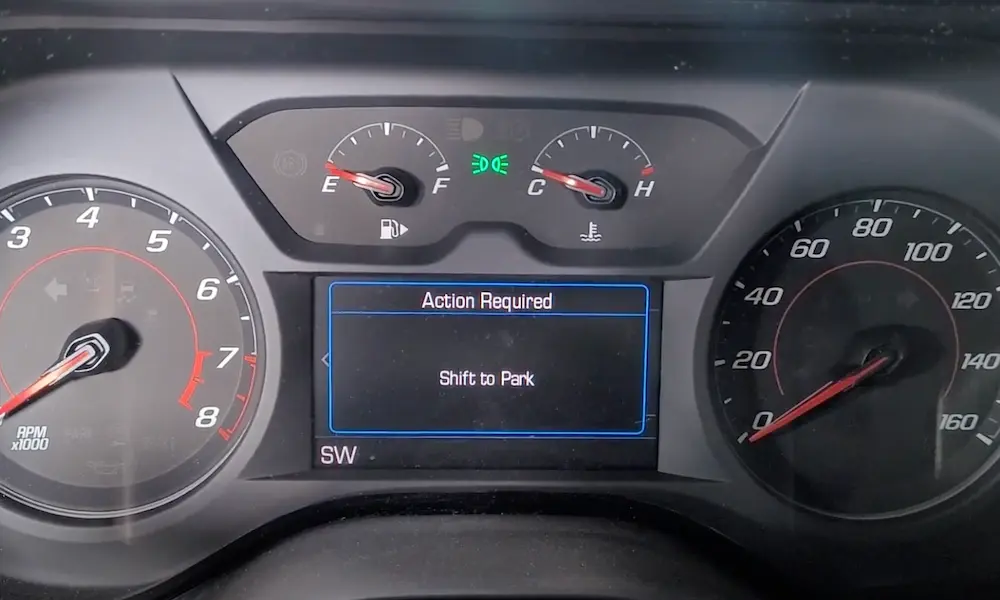
If your DIC is showing “Engine Power Reduced,” pay attention. That’s your Chevy protecting itself from damage — but it also means the problem needs attention soon.
What Other Codes Show Up With P0101?
The codes stored alongside P0101 tell you a lot about the root cause. Don’t ignore them.
| Companion Code | What It Means | What It Suggests |
|---|---|---|
| P0171 / P0174 | System Too Lean (Bank 1 / Bank 2) | Unmetered air leak past the MAF sensor |
| P0172 / P0175 | System Too Rich | MAF contamination; sensor over-reporting airflow |
| P0102 | MAF Circuit Low | Wiring or power supply issue |
| P1101 | MAF Out of Self-Test Range | Startup self-check failure; common in turbocharged GM engines |
| P0299 | Turbo Underboost | Possible CAC outlet tube disconnect |
The Real Causes of Chevy P0101 (Start Here Before Buying Parts)
Contaminated MAF Sensor
This is the most common cause. Over time, oil and dust coat the hot wire inside the sensor. That insulating layer throws off the readings — the sensor under-reports airflow, and the ECM logs P0101.
One major culprit? Over-oiled aftermarket air filters like K&N. If there’s too much oil on the filter, the airstream carries oil droplets directly onto the MAF wire, where they bake on. This is a well-documented issue among technicians working on Chevy trucks.
The fix is simple: grab a can of MAF sensor cleaner and spray the sensing element gently. Don’t touch the wire. Let it dry completely before reinstalling. This costs about $10 and fixes the problem surprisingly often.
Cracked or Torn Intake Boot
The rubber boot (or snorkel) between the MAF sensor and the throttle body is a common failure point on Chevy trucks and SUVs. Heat and age make it brittle. Small cracks develop — and they often open wider under load when the engine torques.
When this happens, air sneaks into the engine after the MAF sensor. The ECM measures less air than is actually entering the cylinders. That triggers a lean condition, and P0101 follows.
How to find it: Run your hand along the intake boot while someone revs the engine. Or better yet, use a smoke test (more on that below).
A Clogged Catalytic Converter
This one trips up a lot of people — including some technicians. When the catalytic converter clogs up, exhaust gases can’t leave efficiently. During the intake stroke, spent exhaust gas takes up space in the cylinder, so less fresh air gets pulled in.
The ECM expects more airflow based on throttle position. It gets less. It blames the MAF sensor. P0101 gets set. The MAF sensor gets replaced. The code comes back. Sound familiar?
If you’ve replaced the MAF sensor and P0101 keeps returning, check the catalytic converter before you do anything else.
Vacuum and Intake Leaks
Any air entering the engine after the MAF sensor is “unmetered” — the ECM doesn’t know about it. Cracked vacuum lines, leaking intake manifold gaskets, and loose connections all qualify. These lean-condition leaks are particularly sneaky because they can be tiny and still trigger P0101.
Electrical Connection Problems
Don’t overlook the wiring. A corroded connector or a weak crimp can cause intermittent signal issues that look exactly like a failing sensor.
Chevy-Specific Technical Service Bulletins You Need to Know
GM has issued several TSBs directly related to Chevy P0101. Always check these before replacing anything.
TSB 22-NA-224 — Equinox and Malibu (2016–2022)
This NHTSA-documented bulletin covers a Charge Air Cooler (CAC) outlet tube that disconnects from the throttle body on turbocharged engines. When it pops off, the engine sees a massive air leak. You’ll get P0101, P0172, P0299, and P1101 together. The fix isn’t a new MAF sensor — it’s a specific retainer kit (Part #13434668) to lock the tube in place.
TSB 21-NA-032 — Silverado and Tahoe (2014–2018)
This bulletin from NHTSA identifies a faulty wire crimp inside the Underhood Bussed Electrical Center (UBEC) at connector X3, position H6. It sets P0101 and P1682 together. The bulletin explicitly says: do not replace the MAF sensor. Fix the wiring crimp.
TSB 18-NA-118 — Cruze and Malibu (2016–2018)
Smaller turbocharged engines (1.4L and 1.5L) in the Cruze and Equinox suffer from PCV system blockages. Oil deposits clog the PCV orifice in the camshaft cover. This messes with crankcase pressure, which throws off the MAF sensor’s readings. P1101 often shows up alongside P0101 here. Diagnosis requires measuring crankcase pressure at the oil dipstick port.
| TSB | Affected Models | Root Cause | Fix |
|---|---|---|---|
| 22-NA-224 | Equinox, Malibu (2016–2022) | CAC outlet tube disconnection | Install retainer kit #13434668 |
| 21-NA-032 | Silverado, Tahoe (2014–2018) | UBEC X3-H6 wire crimp | Repair wire crimp |
| 18-NA-118 | Cruze, Malibu (2016–2018) | PCV orifice blockage | PCV and intake cleaning |
How to Diagnose Chevy P0101 at Home
The Barometric Pressure Truth Test
This is one of the quickest ways to test your MAF sensor without expensive tools. Many Chevy MAF sensors also function as a barometer, measuring ambient air density.
With the key on and engine off, check the BARO reading on your scan tool. At sea level, it should read roughly 101 kPa (29.9 inHg). If you’re at sea level and your scan tool shows 26.5 inHg, the sensor is calculating the wrong altitude. That’s a confirmed bad sensor — it will keep setting P0101 because the ECM’s fuel calculations will always be off.
Electrical Testing With a Multimeter
A standard Chevy MAF sensor uses three key circuits. Here’s what you should see:
- Power (Pink wire) — Key on, should read battery voltage (~12V)
- Ground (Black/White wire) — Should read less than 0.1V against battery negative
- Signal (Yellow wire) — Carries the frequency signal back to the ECM
On newer 8-pin sensors (2017+ Silverados), check for 12V on pin 5, 5V reference on pin 6, and ground on pin 7. If these readings are off, the problem is in the wiring or ECM, not the sensor itself.
Smoke Testing for Air Leaks
If the sensor and wiring both check out, shift focus to physical leaks. A smoke machine pumps pressurized smoke into the intake. Any crack, split, or loose connection shows up immediately as a wisp of smoke escaping.
No smoke machine? Try the carburetor cleaner field test. With the engine idling, carefully spray small amounts around suspected leak areas — intake boot joints, vacuum lines, intake manifold gaskets. If the idle speed changes, you’ve found your leak. Use extreme caution; these chemicals are flammable.
What Does It Cost to Fix Chevy P0101?
The answer ranges from $10 to over $1,800 depending on what’s actually broken.
| Repair | Parts Cost | Labor Cost | Total Estimate |
|---|---|---|---|
| MAF Sensor Cleaning | ~$10 | $20–$50 | $30–$60 |
| Air Filter Replacement | $20–$45 | $10–$25 | $30–$70 |
| MAF Sensor Replacement | $100–$330 | $50–$150 | $150–$600 |
| Intake Boot Replacement | $40–$110 | $40–$70 | $80–$180 |
| Intake Manifold Gasket | $50–$90 | $250–$550 | $300–$640 |
| Catalytic Converter | $600–$1,400 | $200–$450 | $800–$1,850+ |
One important note: if you do need a new MAF sensor, use an OEM part from ACDelco or Delphi. Cheap aftermarket sensors often have slightly different calibration curves. They might not throw a circuit code, but they’ll keep setting P0101 because the ECM’s internal airflow model expects a specific output — and an off-brand sensor won’t match it.
Should You Keep Driving With P0101?
Short answer: not for long. Running with an incorrect air-fuel mixture causes real damage. A lean condition spikes combustion temperatures and can melt pistons or burn exhaust valves. A rich condition sends unburned fuel into the exhaust, where it can ignite inside the catalytic converter and destroy the ceramic core. A clogged converter then creates enough backpressure to stall the engine entirely.
The P0101 is telling you something is wrong. The check engine light isn’t going away on its own.
Quick Prevention Tips
- Replace your air filter every 15,000–30,000 miles (more often in dusty areas)
- If you use an oiled performance filter, apply oil exactly as directed — less is more
- Inspect the intake ductwork during every oil change; catch small cracks before they grow
- Clean the throttle body periodically to prevent carbon buildup that eventually migrates to the MAF sensor
- Run a quick scan tool check if the idle feels rough — catching P0101 early saves you from catalytic converter replacement costs later