Got a mystery Chevy engine sitting in your garage? Chevy block casting numbers tell you exactly what you have — the displacement, factory configuration, and even which plant built it. This guide covers everything from vintage small-blocks to modern LS platforms, so stick around to the end.
What Are Chevy Block Casting Numbers?
Casting numbers are raised digits formed directly into the engine block during the molding process. Molten iron or aluminum gets poured into sand molds, and these numbers become a permanent part of the block’s structure. You can’t grind them off without leaving obvious damage.
These numbers tell you:
- The engine family and cylinder bore spacing
- The original displacement boundaries
- Whether the block is production, replacement, or racing spec
Don’t confuse casting numbers with the stamped pad codes. The pad stamp is a separate alphanumeric sequence hand-stamped onto a machined flat surface after casting. They serve completely different purposes, and you need both to tell the full story of an engine.
Where to Find Casting Numbers on Chevy Engines
Location changes depending on the engine type. Here’s where to look:
Small-Block and Big-Block V8 Engines
Check the rear driver-side of the block, cast directly into the bellhousing or transmission mounting flange behind the cylinder head.
Inline-Six Engines
Look on the passenger side of the block, positioned below and to the right of the distributor.
Modern LS Engines
Find them at the rear of the block, on either the driver or passenger side near the bellhousing flange.
The stamped ID pad sits on the front passenger side of the block, extending from the deck surface just below the cylinder head. Alternator brackets sometimes hide it, so you may need to remove components to get a clear look.
What Happens When the Pad Stamp Gets Machined Away?
Engine rebuilders frequently “deck” a block — shaving the deck surface flat for a better head gasket seal. When that happens, the stamped numbers disappear completely. You lose the original vehicle identity, horsepower rating, and assembly plant history in one machining pass. At that point, the permanent casting numbers on the rear flange become your only reliable identification tool.
Service Replacement Blocks
GM stamped replacement blocks with a “CE” prefix (Chevrolet Engine) instead of standard production stampings. Later crate and replacement engines built in Mexico carry distinct “Hecho en Mexico” markings. These aren’t factory original production units.
How to Read Chevy Casting Date Codes
The casting date is a raised alphanumeric code cast right alongside the primary casting number at the foundry. For small-block V8s, find it at the rear of the block on the passenger-side bellhousing flange. For big-blocks, it sits on the bellhousing flange, near the lower freeze plugs, or above the oil filter boss on early W-series engines.
The standard format breaks down like this:
| Code Position | What It Means | Example |
|---|---|---|
| First character (letter) | Month — A = January, L = December | “F” = June |
| Middle digits (number) | Day of the month (1–31) | “10” = 10th |
| Final digit (number) | Last digit of the production year | “5” = 1955, 1965, or 1975 |
So a code reading F 10 5 means June 10th, in a year ending in 5. To pin down the exact decade, cross-reference with the known production range of that casting number.
Flint vs. Tonawanda: A Critical Difference
Flint, Michigan castings used a single-digit year format while Tonawanda, New York castings frequently used a double-digit format (e.g., “66” instead of “6”). This matters enormously for Corvette authentication — factory Corvette engines came almost exclusively from Flint. A double-digit year code is a clear sign the block didn’t originate in a production Corvette.
Decoding the Assembly Pad Stamp
Once a block was machined, the assembly plant stamped its identification code onto the front passenger-side pad. The Lime Book breaks down the standard format used from 1957 through 1991:
A code like T0214HE decodes as:
- T — Tonawanda, New York assembly plant
- 02 — February
- 14 — 14th day
- HE — vehicle suffix code (model, transmission, horsepower)
Watch out for this stamping quirk: Assembly plants didn’t use the number “1” — they stamped the capital letter “I” instead. A code reading F4IID means April 11th with a suffix of “D,” not three letters of “IID.” This trips up a lot of people searching databases.
Here’s the quick reference for assembly plant codes:
| Plant Code | Location | Notes |
|---|---|---|
| F / V | Flint, Michigan | F used 1955–1966, V used 1967–present |
| T | Tonawanda, New York | 1957–present |
| K | St. Catharines, Canada | 1957–present |
| S | Saginaw, Michigan | 1957–present |
| M | Toluca, Mexico | 1957–present |
Starting in 1960, GM also stamped a partial VIN onto the pad to tie each engine directly to its chassis — a huge help for matching-numbers verification.
2-Bolt vs. 4-Bolt Main: The Big Misconception
Here’s where a lot of builders get burned. Four-bolt main caps provide nearly double the clamping force of 2-bolt setups. They prevent crankshaft flex under high cylinder pressure, high RPM, and forced induction. That’s why they were reserved for performance cars, Corvettes, and heavy-duty trucks.
The persistent myth is that you can identify a 4-bolt block by looking at the casting number. You can’t. The ultra-common 3970010 small-block 350 casting was manufactured in both 2-bolt and 4-bolt versions. The casting number just tells you bore size and journal specs — the drilling for 2-bolt or 4-bolt caps happened later during machining based on intended application.
| Feature | 2-Bolt Main | 4-Bolt Main |
|---|---|---|
| Fasteners per cap | Two vertical bolts | Four bolts on center caps |
| HP threshold | Up to ~400 HP (SBC) | Recommended above 450–500 HP |
| Best suited for | Standard stroke applications | Long-stroke stroker builds (e.g., 383) |
| Forced induction | Marginal | Highly recommended |
| Reinforcement option | Steel main girdle | Inherently robust |
The only reliable ways to verify main cap configuration:
- Decode the pad stamp suffix — if the block hasn’t been decked, the suffix identifies the original factory configuration
- Pull the oil pan — physically inspect the center three main caps yourself
No shortcut exists for a definitive answer.
Small-Block Chevy Casting Number Reference
The key SBC castings. Here are the most important ones:
| Casting Number | Years | CID | Main Caps | Key Notes |
|---|---|---|---|---|
| 3703524 | 1955 | 265 | 2-bolt | First-year Corvette block; no oil filter boss |
| 3737739 | 1958–1964 | 283 | 2-bolt | High-production standard passenger and truck |
| 3782870 | 1962–1967 | 327 | 2-bolt | Standard performance passenger and Corvette |
| 3956618 | 1968–1969 | 302/327/350 | 2 or 4-bolt | Camaro Z28 DZ302 (4-bolt) and standard models |
| 3970010 | 1969–1980 | 350 | 2 or 4-bolt | Most common SBC casting ever produced |
| 14093638 | 1987–1995 | 350 | 2 or 4-bolt | One-piece rear main seal; roller cam machined |
| 10243880 | 1995–1999 | 350 | 4-bolt | Vortec truck and ZZ4 crate engines |
Big-Block Chevy Casting Numbers
The Mid-America Chevelle Club’s big-block casting database covers the W-series through Mark IV production:
| Casting Number | CID | Years | Main Caps | Key Notes |
|---|---|---|---|---|
| 3732811 | 348 W-Series | 1958 | 2-bolt | First-year 348 passenger car |
| 3788068 | 409 W-Series | 1962 | 2-bolt | Early high-performance passenger car |
| 3855962 | 396 | 1965–1966 | 4-bolt | High-performance Corvette and Chevelle Z16 |
| 3963512 | 427/454 | 1968–1971 | 2 or 4-bolt | Late Corvette, COPO Camaro, LS6 Chevelle |
| 3999289 | 454 | 1972–1979 | 2 or 4-bolt | High-production 454; Corvette and trucks |
Identifying Modern LS Engines by Casting Number
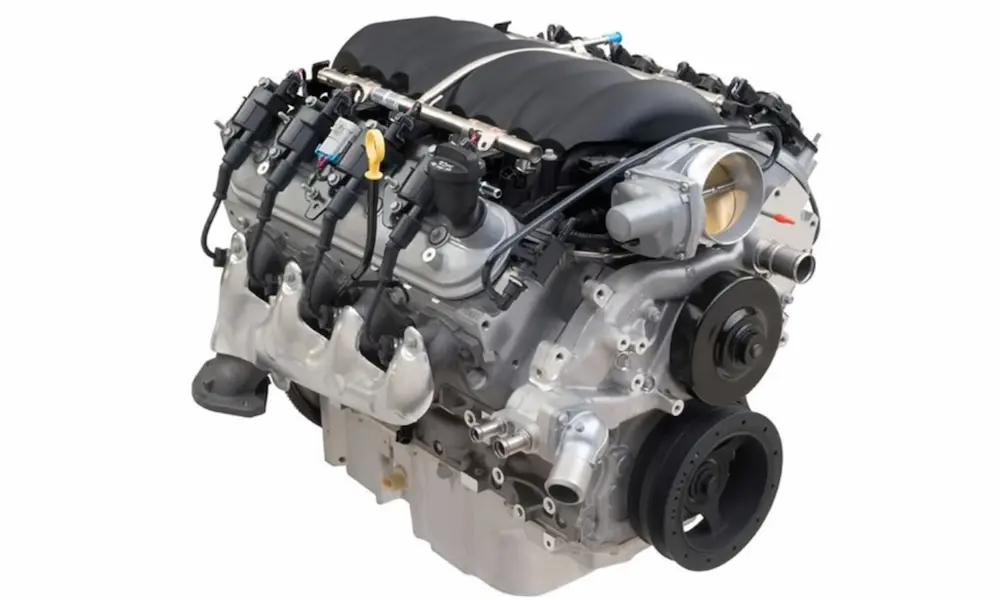
The LS platform arrived in 1997 as a clean-sheet redesign. It shares only connecting rod bearings and lifters with traditional small-blocks — everything else is different.
Quick material check: Run a magnet over the block. Cast iron is magnetic. Aluminum isn’t. That single test rules out half the guesswork immediately.
LS blocks also have their displacement cast directly into the exterior surface — look for markings like “6.0” or “6.0L” near the cylinder head mounting surface. On 4.8L and 5.3L truck blocks, both metric displacements often appear side by side, so you’ll need internal inspection to confirm the exact stroke.
Gen III vs. Gen IV identification:
Check the front timing cover. Gen IV blocks (2005–2020) have camshaft position and knock sensors integrated into the timing cover itself. Gen III blocks (1997–2007) locate those sensors under the intake manifold valley cover.
LS Cylinder Head Casting Numbers
Because LS components are highly interchangeable, the cylinder head casting numbers matter as much as the block numbers. Find the raised three-digit number on the lower outer corner of each head, just below the valve cover rail.
| Casting | Port Shape | Chamber | Typical Engines | Notes |
|---|---|---|---|---|
| 241 | Cathedral | 66.7cc | LS1 Corvette/Camaro | Baseline aluminum passenger casting |
| 243 | Cathedral | 64.45cc | LS6, LS2 | Improved velocity; smaller chamber |
| 799 | Cathedral | 64.45cc | 5.3L Truck | Often called the “truck 243” |
| 823 | Rectangle | 82.0cc | LS3, L92 | High-airflow for large bores |
| 356 | Rectangle | 68.0cc | LSA, LS9 | Built for forced induction |
Cathedral port heads only work with cathedral-style intakes. Rectangle port heads need rectangle-style intakes. Mixing them creates serious fitment headaches. Also, passenger car intake manifolds sit lower and more contoured than truck manifolds — truck manifolds are roughly three inches taller with a boxier shape optimized for low-end torque.
Key LS Block Casting Reference
| Casting Number | RPO Code | Displacement | Material | Years | Application |
|---|---|---|---|---|---|
| 12551358 | LM7 | 5.3L | Cast Iron | 1999–2007 | High-volume light truck |
| 12581769 | LC9 | 5.3L | Aluminum | 2007–2013 | Active fuel management truck |
| 12621766 | LS3/LSA | 6.2L | Aluminum | 2008+ | Performance car and supercharged LSA |
| 12680457 | LS9 | 6.2L | Aluminum | 2009–2013 | Corvette ZR1 supercharged |
| 12623968 | LS7/LS9 | 7.0L/6.2L | Aluminum | 2006–2015 | Dry sump and forced induction platforms |
Understanding Chevy block casting numbers saves you from buying the wrong engine, overpaying for a misidentified block, or building on a foundation that won’t handle your power goals. Whether you’re chasing a matching-numbers Corvette, pulling an LS from a junkyard truck, or building a stroker 454, these numbers tell you exactly what you’re working with — before you spend a dime.