Your Chevy just threw a P0121 code and the “Reduced Engine Power” light is staring you down. Don’t panic — this is one of the most common throttle-related codes across the entire Chevrolet lineup, and it’s very fixable. Stick around because we’re covering everything from what triggers it to how much it’ll cost you to make it go away.
What Is the Chevy P0121 Code?
The P0121 code means your Powertrain Control Module (PCM) has detected a “Throttle/Pedal Position Sensor A Circuit Range/Performance Problem.” In plain English? Your throttle position sensor is sending data that doesn’t match what the engine’s other sensors are reporting.
Here’s the key thing to understand: P0121 isn’t a dead sensor. It’s a rationality code. The sensor is working — it’s just telling the PCM something that doesn’t add up. For example, the throttle might report being 30% open while the manifold pressure sensor says the throttle is nearly closed. That mismatch triggers the code.
This makes P0121 trickier to diagnose than a simple “sensor died” fault. You’re chasing inconsistency, not absence.
How the Electronic Throttle System Works (And Why It Fails)
Modern Chevy vehicles use a drive-by-wire system — there’s no physical cable connecting your foot to the throttle plate. Instead:
- Your accelerator pedal has sensors (APP sensors) that read how hard you’re pressing
- Those signals go to the PCM
- The PCM commands an electric motor (the Throttle Actuator Control motor) to open the throttle plate
- The Throttle Position Sensor (TPS) reports back confirming the plate actually moved
The PCM constantly cross-checks TPS data against the MAP sensor, MAF sensor, and RPM. If the throttle angle doesn’t match what those sensors expect, it flags P0121.
Two TPS sensors live inside the throttle body. They work in opposite directions — as Sensor A’s voltage rises, Sensor B’s falls. This inverse relationship lets the PCM instantly spot a bad reading. P0121 specifically targets Sensor A (Circuit “A”).
What Causes Chevy P0121?
Carbon Buildup — The Most Common Culprit
The number one cause of P0121 across the Silverado, Equinox, and Impala is carbon buildup inside the throttle bore. Here’s how it happens:
Your PCV system routes oil vapors from the crankcase back into the intake manifold. Over tens of thousands of miles, those vapors condense on the throttle body walls. The carbon layer builds up around the butterfly valve edge, creating what technicians call “stiction” — static friction that makes the throttle plate move in jerky, unpredictable snaps instead of smooth arcs.
The TPS sits directly on the throttle shaft, so it reports every erratic movement. The PCM sees the plate jumping around when it didn’t command a large movement, and it fires the P0121 code.
Corroded Connector Terminals
The throttle body uses a 6-pin connector. Engine vibration causes microscopic movement at the connector terminals over time — a process called fretting corrosion. This wears away the metal surface and creates a high-resistance oxidation layer.
Because the TPS signal is a low-voltage analog signal, even tiny resistance changes distort the voltage reading at the PCM. A small voltage shift the PCM interprets as a significant change in throttle angle — one that doesn’t match the MAP sensor — and P0121 gets stored.
GM has addressed this in multiple service bulletins, recommending dielectric grease and terminal pigtail replacement to restore circuit integrity.
Worn TPS Potentiometer
Inside older-style sensors, a wiper slides along a resistive carbon track. Since most driving happens at a constant speed or idle, the wiper parks in the same small zone for millions of cycles. Eventually, it wears a groove into the track, creating a “flat spot” where voltage suddenly drops. The PCM catches that dropout instantly.
Vacuum Leaks (Turbocharged Models)
On turbocharged Chevys like the 2018-2022 Equinox and Malibu, a loose or damaged charge air cooler tube can trigger P0121. Air entering the engine through the leak doesn’t get measured by the MAF sensor, so the PCM sees a massive mismatch between throttle position and actual airflow. Always check the charge air path on turbo models before touching any sensors.
Symptoms You’ll Notice
The P0121 code rarely stays quiet. Here’s what drivers report:
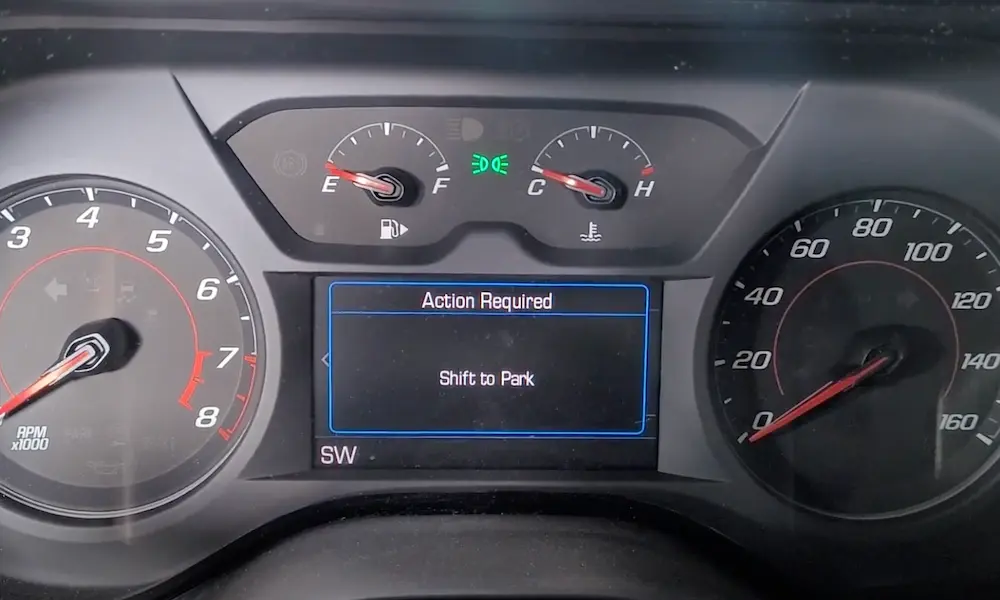
- Reduced Engine Power warning on the Driver Information Center — the PCM enters limp mode, capping your speed at 20-40 mph
- Rough or hunting idle — RPM bouncing between 500 and 1,000 RPM
- Hesitation or flat spot when pressing the accelerator
- Engine stalling at stops, especially when the A/C kicks on
- Poor fuel economy from incorrect fuel injection timing
- Check Engine Light illuminated
The Reduced Engine Power warning is the big one. The PCM deliberately limits throttle response when it can’t trust TPS data — it’s a safety measure to prevent unintended acceleration. Driving in this state on a highway is genuinely dangerous.
P0121 vs. P2135 — Don’t Confuse Them
These two codes show up together often enough that they’re worth comparing directly.
| Code | Definition | Most Likely Cause | Diagnostic Focus |
|---|---|---|---|
| P0121 | TPS “A” Circuit Range/Performance | Carbon buildup, mechanical stiction | Rationality check vs. MAP/MAF sensors |
| P2135 | TPS 1/2 Voltage Correlation | Electrical failure, wiring fault | Internal sensor disagreement |
P0121 is usually a mechanical problem first. P2135 is almost always electrical. If you replace the throttle body for a P0121 without addressing carbon buildup or a PCV issue, the new unit will eventually fail the same way.
How to Diagnose Chevy P0121 Step by Step
Step 1: Pull Freeze Frame Data
Connect an OBD-II scanner and read the freeze frame data — this is the snapshot of engine conditions when the code was set.
- Code set at high RPM/speed? Look for an intake air leak, especially on turbo engines
- Code set at idle or cold start? Carbon buildup or stiction is very likely
Step 2: Manual Signal Sweep
With the ignition on and the engine off, watch the TPS voltage on your scanner while slowly pressing the accelerator from floor to fully open. The voltage should rise smoothly and linearly — no drops, no spikes, no flat spots.
If it looks clean on the scanner, you may still have a problem. Scan tools sample data every 100-200 milliseconds, but a voltage glitch lasting just 10 milliseconds is enough to trigger P0121. An oscilloscope catches what a scanner misses.
Step 3: Electrical Validation
If you spot a dropout, you need to isolate whether it’s the sensor or the wiring.
- Check reference voltage — confirm a stable 5V at the throttle body connector
- Check ground integrity — low-reference circuit should show near 0V, not a ground offset
- Wiggle test — manipulate the wiring harness while watching TPS voltage live. If voltage jumps when you wiggle the connector, you’ve found a broken wire or loose terminal
GM Special Coverage Programs — You Might Get a Free Fix
GM has acknowledged higher-than-normal throttle failure rates across specific model years and issued Special Coverage Adjustments that cover repairs at no cost to the owner.
SCA 11273 and 14582 — Targeted V8 and V6 engines between 2008 and 2011. GM extended throttle body warranty coverage to 10 years or 120,000 miles. For Bosch throttle bodies, GM replaced the entire assembly. For Hitachi units, a sensor cover kit was installed first.
Impala APP Sensor SCA (2009-2011) — On the 2009-2011 Chevrolet Impala, broken solder connections inside the accelerator pedal position sensor triggered “Reduced Engine Power” and P0121 or P2138 codes. GM provided free accelerator pedal assembly replacement for 10 years or 120,000 miles.
Always check your VIN against current coverage programs before paying for any throttle body repair. A dealer service advisor can run this check in minutes.
Repair Costs by Chevrolet Model
When cleaning doesn’t solve the issue, throttle body replacement is the next step. Costs vary significantly by model.
| Chevrolet Model | Parts Cost | Labor Cost | Total Estimate |
|---|---|---|---|
| Silverado 1500 (V8) | $329 – $465 | $77 – $113 | $406 – $578 |
| Silverado 2500 HD | $298 – $494 | $89 – $130 | $387 – $625 |
| Equinox (1.5L Turbo) | $146 – $246 | $146 – $215 | $292 – $461 |
| Equinox (Pre-2018) | $246 – $353 | $125 – $183 | $371 – $536 |
| Impala (3.6L V6) | $300 – $450 | $128 – $224 | $428 – $674 |
| Malibu (1.5L Turbo) | $250 – $380 | $169 – $204 | $419 – $584 |
| Tahoe (5.3L V8) | $350 – $480 | $89 – $157 | $439 – $637 |
| Cruze (1.4L Turbo) | $220 – $340 | $123 – $131 | $343 – $471 |
Cleaning vs. Replacing the Throttle Body
Since carbon buildup causes most P0121 cases, cleaning the throttle body is always the first move — it’s cheap and often solves the problem completely.
Cleaning protocol:
- Use a dedicated throttle body cleaner — not carburetor cleaner, which strips protective coatings
- Use a soft-bristled brush or lint-free cloth to remove the carbon ring from the bore
- Never spray cleaner directly into the motor housing or sensor connector
- Open the throttle plate manually with care — forcing it too fast can strip the plastic gears on the TAC motor
Replace instead of clean when:
- Signal sweep shows voltage dropouts even after cleaning
- The TAC motor fails a resistance test
- There’s physical damage to the throttle shaft or internal gears
- Fretting corrosion at the connector is severe enough that new terminals won’t hold
The Throttle Relearn Procedure — Don’t Skip This
After any throttle body service — cleaning, disconnecting, or replacing — the PCM needs to relearn the throttle’s airflow characteristics. Skip this step and you’ll likely end up with a rough idle or a new P0507 code (Idle Speed Too High).
Manual relearn (no scan tool needed):
- Warm the engine to operating temperature, then turn everything off — A/C, radio, lights
- Start the engine and let it idle in Park for 3 minutes
- Turn the ignition off and wait 60 seconds
- Restart and idle in Park for another 3 minutes
- Drive at varying speeds above 44 mph with a few decelerations — the PCM refines idle values throughout this drive cycle
Scan tool relearn: A factory-level tool like GDS2 can command an Idle Learn Reset, wiping old adaptive data and running a full throttle sweep to find the new mechanical stops. It’s faster and more reliable than the manual method.
Preventing Chevy P0121 From Coming Back
The fix sticks longer when you address the root cause.
Clean the throttle body every 30,000 miles — most carbon buildup reaches a performance-affecting level around that interval. Cleaning proactively prevents the stiction that triggers P0121 in the first place.
Use Top Tier detergent gasoline — it reduces deposit formation throughout the intake tract.
Keep the PCV system healthy — since carbon comes from crankcase oil vapors, a functioning PCV valve and high-quality synthetic oil with low volatility (low NOACK rating) reduces how much vapor reaches the throttle plate. Fixing an oil consumption issue is the real long-term solution.
Check the charge air tubes regularly on turbocharged engines — a loose charge air cooler tube on 2018-2022 turbo models is a known failure point that creates the exact MAP-vs-TPS correlation error P0121 describes. A two-minute visual inspection can save you hundreds in unnecessary sensor replacements.