Your Chevy just threw a “Reduced Engine Power” warning and a P2135 code. Now it crawls like a golf cart. This post breaks down exactly what’s happening inside your throttle system, what’s causing it, and what it’ll cost to fix it — stick around, because the answer might surprise you.
What Is the Chevy P2135 Code?
The Chevy P2135 code is officially called “Throttle/Pedal Position Sensor/Switch A/B Voltage Correlation.” That’s a mouthful, but the concept is simple.
Your truck uses two throttle position (TP) sensors instead of one. They both watch the same throttle plate, but they work like mirror images of each other. When sensor one’s voltage goes up, sensor two’s voltage goes down — and together, they should always add up to around 5 volts.
When the Engine Control Module (ECM) sees these two readings drift apart by more than roughly 0.2 volts for over two seconds, it decides it can’t trust either one. It sets the P2135 code and slaps the brakes on your engine’s power.
Why two sensors? GM borrowed the idea from aerospace “fly-by-wire” systems. If one sensor lies, the other catches it. It’s a safety net, not a design flaw.
How the Two Sensors Actually Work Together
Here’s a quick look at what normal voltage behavior looks like across the throttle’s range:
| Throttle Position | TP Sensor 1 | TP Sensor 2 | Combined Total |
|---|---|---|---|
| Idle | ~0.35V – 0.7V | ~4.3V – 4.65V | ~5.0V |
| Partial Throttle | Rising | Falling | ~5.0V |
| Wide Open Throttle | ~4.3V – 4.65V | ~0.35V – 0.7V | ~5.0V |
The ECM tracks this sum constantly. If it strays outside the 4.87V–5.13V window, the signal rationality check fails. That’s your P2135 trigger.
One overlooked detail: the MAP sensor, A/C pressure sensor, and your TP sensors all share the same 5-volt reference circuit from the ECM. If another component on that circuit develops an internal short, it can drag the reference voltage down — and your TP sensors will read incorrectly even if they’re perfectly fine.
What Reduced Engine Power Actually Does to Your Truck
When the Chevy P2135 code sets, the ECM doesn’t just log the fault and move on. It enters a fail-safe mode designed to prevent uncontrolled acceleration.
Here’s what happens to your engine:
- Throttle opening locks at 15%–20% regardless of how hard you press the pedal
- Top speed drops to roughly 20–25 mph — enough to pull over safely, not enough to merge on the freeway
- In severe cases, the throttle actuator motor fully shuts down, and internal default springs hold the plate just barely open for a limited idle with zero pedal response
You’ll also notice these symptoms right away:
- Check engine light comes on
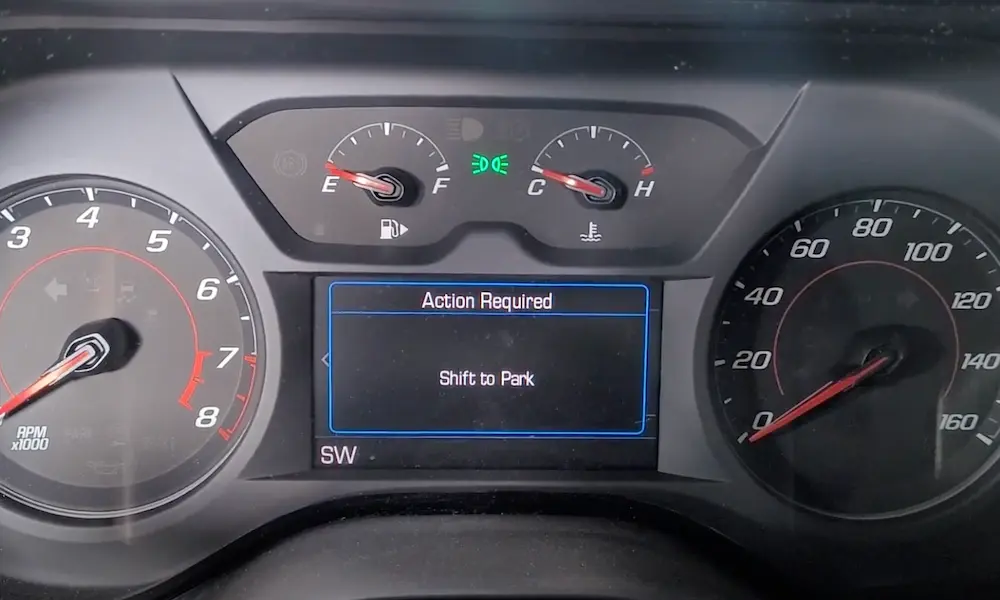
- “Reduced Engine Power” message appears on your dash
- Engine may surge or hesitate briefly before entering limp mode
- RPMs fluctuate or sit unusually high at idle
The 4 Most Common Causes of the Chevy P2135 Code
1. Fretting Corrosion at the Throttle Body Connector
This is the single biggest culprit on GM trucks between 2007 and 2017 — Silverado, Sierra, Tahoe, Yukon, all of them.
Fretting corrosion happens when engine vibration causes microscopic rubbing between the metal terminals inside the throttle body connector. That rubbing creates oxidized debris that acts like a resistor. Since the ECM’s tolerance is so tight — as low as 0.13V — even a small resistance spike is enough to throw off the correlation and set the code.
You don’t need a broken wire. You need a bad connection, and that’s much harder to spot with your eyes.
2. Worn Carbon Track Inside the Throttle Position Sensor
The TP sensors are potentiometers. A tiny wiper arm drags across a carbon-coated track thousands of times every drive. Over years of heat cycles and mileage, that track wears down. It develops dead spots where the voltage drops out for a millisecond.
The ECM catches it immediately. Even a single bad reading can log the code in history mode. Regular bad readings push it into current fault status.
3. Carbon Buildup on the Throttle Plate
Your PCV system vents oily air right before the throttle body. Over time, that oil vapor bakes into a black sticky coating on the butterfly valve and its bore. When the plate can’t return smoothly to its idle stop, the physical position lags behind what the actuator motor commands. The ECM notices the mismatch and correlation errors follow.
4. A Failing Accelerator Pedal Assembly
The accelerator pedal has its own set of position sensors. If those sensors send incorrect signals, the ECM can’t reconcile what the driver is asking for versus what the throttle is doing. A faulty pedal assembly is less common than throttle body issues, but it’s a real cause — especially on higher-mileage vehicles.
How to Diagnose the Chevy P2135 Code Step by Step
Don’t grab parts yet. The P2135 code points to a system problem, not always a specific component. A smart diagnosis saves you from replacing the wrong thing.
Step 1: Check If the Code Is Current or History
Plug in a scan tool and note whether P2135 shows as “Current” or “History.”
- Current = the fault is active right now
- History = it happened before and cleared itself, which often points to fretting corrosion or a heat-related issue
Step 2: Run a Throttle Sweep Test
With the ignition on and engine off, watch TP Sensor 1 and TP Sensor 2 in live data while you slowly press the accelerator pedal from idle to full travel.
Look for:
- Smooth, linear movement — no sudden jumps or drop-outs
- “TP Sensor 1 and 2 Agree” status on your scan tool — it must stay in “Agree” the entire time
Any glitch, spike, or flip to “Disagree” tells you the internal sensor track is damaged.
Step 3: Wiggle the Wiring Harness
If the sweep looks clean, keep the live data running and physically wiggle the wiring harness at the throttle body connector and near the ECM. A voltage change or a flip to “Disagree” during the wiggle confirms a wiring or terminal issue — not a sensor failure.
Also check the female terminals inside the connector for spread or lost tension. Loose terminals cause intermittent faults that are notoriously hard to find.
Step 4: Verify the 5-Volt Reference and Ground
Use a multimeter to back-probe the connector:
- 5-volt reference should sit stable and as close to 5.00V as possible
- Ground circuit voltage drop should be less than 0.1V between the sensor ground and battery negative
A sagging reference voltage points to a shared-circuit issue, not the throttle body itself.
GM’s Official Response: Special Coverage and TSBs
The failure rate on these sensors was high enough that GM took formal action.
Special Coverage Adjustments 11273 and 12177
For many 2008–2011 Chevy and GMC models, GM acknowledged the TP sensor design was defective. They covered repairs through a Special Coverage Adjustment program:
| Program Detail | Specification |
|---|---|
| Coverage Duration | 10 Years or 120,000 Miles |
| Eligible Models | Silverado, Tahoe, Suburban, Avalanche, Express, Colorado, Impala, TrailBlazer |
| Required Action | TP Sensor Cover replacement + ECM reprogramming |
| Cost to Customer | $0 (within coverage limits) |
The 10-year window has expired for most of these vehicles now. But the repair procedure — replacing just the sensor cover rather than the entire throttle body — is still the preferred fix.
TSB 11-06-04-007B
This NHTSA Technical Service Bulletin is the definitive repair guide. It explicitly tells technicians not to replace the full throttle body unless a specific test failure demands it. The correct steps are:
- Clean the throttle bore and plate with approved cleaners (never Methyl Ethyl Ketone)
- Replace the sensor cover with the updated kit
- Reprogram the ECM with the latest calibration for 2008–2010 models
What Does It Cost to Fix the Chevy P2135 Code?
Your repair cost depends heavily on which component actually failed. Here’s how the options break down:
| Repair Option | Part Cost (Est.) | Labor Cost (Est.) | Total Range |
|---|---|---|---|
| TP Sensor Cover Kit | $50 – $120 | $150 – $250 | $200 – $370 |
| Full Throttle Body | $150 – $450 | $100 – $180 | $250 – $630 |
| Harness Pigtail Repair | $20 – $60 | $150 – $300 | $170 – $360 |
| Accelerator Pedal Assembly | $60 – $150 | $100 – $200 | $160 – $350 |
RepairPal puts Silverado throttle body replacement in the $250–$630 range. The throttle position sensor alone typically runs $200–$370 at a shop.
One important note: don’t cheap out on parts here. Aftermarket throttle bodies and sensors have a well-documented high failure rate on GM platforms because the resistance curves of budget potentiometers drift outside the ECM’s tight tolerances when they heat up. Stick with ACDelco or GM Genuine parts. The money you save on a cheap part evaporates the moment it fails again in three months.
Don’t Skip the Throttle Relearn After Repair
This step gets skipped constantly, and it’s a mistake every time.
After any throttle body or sensor replacement, the ECM still holds old “adaptive values” from the previous worn-out component. If you bolt on a new part and drive away without a relearn, expect a high or surging idle — and possibly a fresh P2135 or P0507 code within minutes.
Most Chevy trucks need an OEM-level scan tool to trigger the relearn procedure. Some models allow a passive relearn through a specific idle and drive cycle, but don’t count on that working every time.
How the P2135 Code Damages Your Transmission Over Time
Here’s something most people don’t realize: an unresolved Chevy P2135 code doesn’t just hurt your engine. The Transmission Control Module uses throttle position data to set hydraulic line pressure inside your automatic transmission.
If the TP sensor is sending erratic signals, the TCM may command incorrect line pressure. That leads to soft shifts that cause clutch slippage, or harsh shifts that hammer mechanical components. Leave P2135 unaddressed long enough, and you’re looking at premature transmission wear on top of the original throttle problem.
How to Prevent the P2135 Code From Coming Back
A few simple habits keep this code from returning:
- Inspect the throttle body connector during routine service. If you see green or white oxidation, clean it with electrical contact cleaner and treat the terminals with dielectric grease to stop fretting corrosion before it starts
- Keep your air filter fresh and make sure your PCV system isn’t dumping excessive oil vapor into the intake — that’s what builds up the carbon that jams the throttle plate
- Check your battery and ground straps — the Electronic Throttle Control system is sensitive to voltage fluctuations, and a weak battery or corroded ground strap can generate phantom correlation errors that send you chasing the wrong problem