Your check engine light’s glowing, or maybe you’re hearing rattling noises under your truck. Finding your Chevy Silverado’s catalytic converter doesn’t have to be a scavenger hunt. Whether you’re dealing with theft concerns, replacement needs, or just curious about what’s under there, this guide will show you exactly where to look based on your specific engine and model year.
The Basics: Where Catalytic Converters Live
Your Chevy Silverado catalytic converter location sits in the exhaust system between your engine and muffler. Think of it as the middle child of your exhaust setup—it’s downstream from the exhaust manifold but upstream from the muffler.
You’ll need to get under your truck to see it properly. The cat sits underneath the vehicle, which means you’ll want jack stands or ramps for safe access. Don’t even think about crawling under a truck supported only by a jack.
The converter looks like a cylindrical or oval-shaped bulge in your exhaust pipe. It’s noticeably thicker than the regular exhaust tubing around it. Many factory Silverado converters have “FLOW” stamped on them along with serial numbers—handy for identification when you’re staring at unfamiliar metal tubes.
V6 and V8 Engines: You’ve Got Multiples
Here’s what throws people off: Silverados with V-configuration engines don’t just have one catalytic converter. Your V6 or V8 typically runs multiple catalytic converters—one for each bank of cylinders.
You could have up to four cats total on your truck. The industry calls these “Bank 1” and “Bank 2” converters. Bank 1 sits on the engine side containing cylinder number one. This setup helps your truck process emissions more efficiently since each cylinder bank gets its own converter.
When your mechanic says you need a “Bank 2 downstream cat,” now you’ll know they’re talking about a specific converter, not making stuff up to confuse you.
The 2019+ 2.7L Turbo: A Different Beast
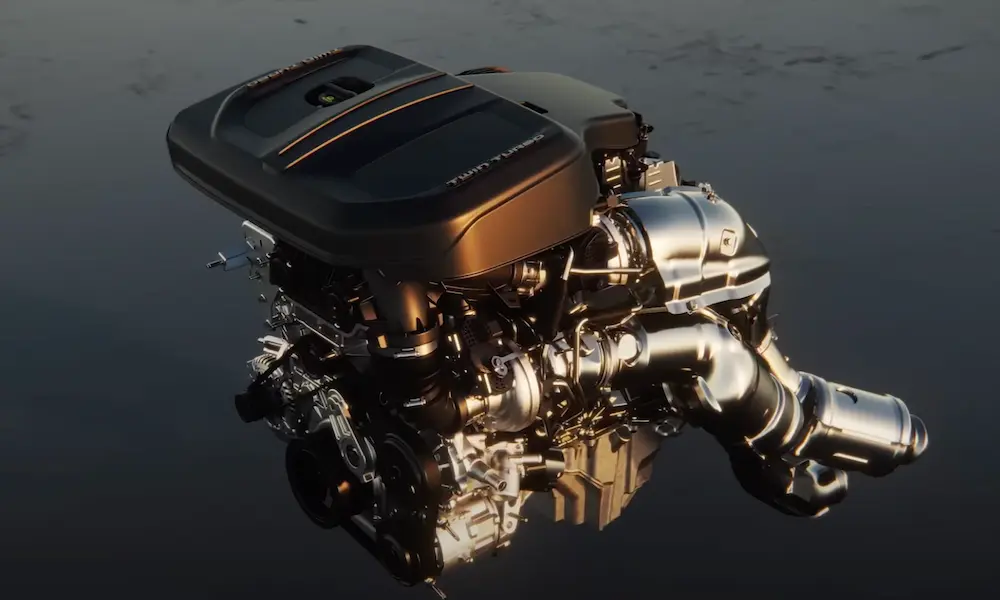
If you’re driving a 2019 or newer Silverado with the 2.7L turbo engine, your catalytic converter sits in a unique location. It’s built directly into the downpipe coming off the turbo, near the front suspension area.
This isn’t your traditional “somewhere in the middle” placement. Your cat sits much closer to the engine compartment than it does on other engines.
The good news? This forward position makes it trickier for thieves to access quickly. The bad news? Replacement becomes more complicated since you’re working in tighter quarters near other engine components.
Traditional V8 Engines: The Classic Setup
Got a 5.3L, 6.0L, or similar traditional V8? Your catalytic converter location follows the conventional path—positioned further back in the exhaust system.
These setups often require removing the transmission crossmember for proper access during replacement. It’s not complicated, just additional steps that add time to the job.
Your exhaust manifold connects to the converter through pipes that run along the frame rails. Follow those pipes back from the engine, and you’ll spot the bulkier converter section before the exhaust continues to the muffler.
Pre-Cat vs. Main Cat: The Two-Stage System
Many Silverado models run a two-stage catalytic converter system. Understanding the difference helps when diagnosing issues or ordering parts.
The pre-cat sits closer to the exhaust manifold. It heats up quickly after you start your truck, which improves efficiency during those first few minutes of driving. Cold engines produce more emissions, so this early converter starts working fast.
The main cat positions itself closer to the muffler. This handles the heavy lifting for emissions conversion once everything’s warmed up. It’s typically larger and does the primary cleanup work.
When your diagnostic code specifies “upstream” or “downstream,” it’s referring to these different converter positions. Upstream means closer to the engine; downstream means closer to the muffler.
How to Spot Your Catalytic Converter
Finding your specific converter requires getting underneath with good lighting. Here’s your identification checklist:
Visual markers:
- Cylindrical or oval-shaped bulge in the exhaust pipe
- Larger diameter than surrounding exhaust tubing
- Heat shield covering (on most models)
- “FLOW” stamped on OEM parts
- Serial numbers for identification
Location clues:
- Between exhaust manifold and muffler
- Often near the transmission crossmember on V8s
- Near front suspension on 2.7L turbos
- One on each side for V-configuration engines
The heat shield often covers the converter. You might need to remove this shield to see the actual converter body and any stamped identification numbers.
Engine-Specific Converter Positions
Different engines mean different locations. Here’s the breakdown by common Silverado powertrains:
| Engine Type | Number of Cats | Primary Location | Access Notes |
|---|---|---|---|
| 2.7L Turbo (2019+) | 1-2 | Built into turbo downpipe, front suspension area | Tight quarters, closer to engine |
| 4.3L V6 | 2-4 | Mid-undercarriage, one per bank | Standard underneath access |
| 5.3L V8 | 2-4 | Mid-to-rear undercarriage | May need crossmember removal |
| 6.0L/6.2L V8 | 2-4 | Mid-to-rear undercarriage | May need crossmember removal |
The “2-4” range depends on whether your truck has both pre-cats and main cats. Some configurations combine these into integrated units.
Model Year Variations Matter
Your Silverado’s year affects more than just the interior features. Catalytic converter placement has evolved through generations.
GMT800 platform (1999-2007): Converters sit further back in the system. These trucks typically have more accessible placements for DIY work.
GMT900 platform (2007-2014): Similar positioning to GMT800 but with updated emissions requirements sometimes adding pre-cats.
K2XX platform (2014-2019): Tighter packaging can make access trickier. The introduction of more efficient engines changed some converter locations.
T1XX platform (2019+): The 2.7L turbo brings that unique forward-mounted converter. Traditional V8s maintain conventional placement.
Your owner’s manual or a VIN-specific parts lookup will confirm your exact configuration.
What the Oxygen Sensors Tell You
Oxygen sensors thread into your catalytic converter at specific points. They’re actually helpful landmarks for finding your cat.
Your Silverado has O2 sensors before and after the catalytic converter. The upstream sensor (before the cat) measures what’s coming from the engine. The downstream sensor (after the cat) checks the converter’s work.
If you spot these sensors in your exhaust system, you’ve found your converter. The cat sits between them. When diagnostic codes reference “Bank 1 Sensor 2,” that second sensor is the downstream one, right after that bank’s converter.
Theft Protection Considerations
Catalytic converter theft skyrocketed in recent years. Knowing your converter’s location helps you understand your theft risk and protection options.
Higher risk locations:
- Converters positioned mid-undercarriage with easy access
- Trucks frequently parked in unsecured areas
- Models with converters that don’t require removing other components
Lower risk setups:
- The 2.7L turbo’s integrated, forward-mounted design
- Converters requiring crossmember removal for access
- Trucks with factory skid plates or guards
Cat shields and protective plates bolt to your frame, creating barriers around the converter. These work best when custom-fitted to your specific year and engine configuration.
Access for Replacement or Inspection
When it’s time to actually work on your catalytic converter, access requirements vary significantly.
Tools you’ll likely need:
- Jack and jack stands (properly rated)
- Socket set with extensions
- Penetrating oil for rusty bolts
- Oxygen sensor socket (special cutout for wires)
- Possibly a sawzall for seized converters
Common obstacles:
- Rusted exhaust clamps and bolts
- Heat shields blocking direct access
- Transmission crossmember in the way (V8 models)
- Oxygen sensor wires routing around components
Removing the transmission crossmember sounds intimidating but it’s usually four bolts. Just support the transmission with a jack before removing crossmember bolts—you don’t want it hanging on the mount.
Signs Your Cat Needs Attention
Knowing where your catalytic converter sits helps when diagnosing these common symptoms:
Rattling from underneath: A failing catalyst breaks apart inside the housing. If the rattle comes from the converter area, the internal honeycomb structure is probably deteriorating.
Check engine light with P0420/P0430 codes: These specific codes indicate “catalyst efficiency below threshold.” Your converter’s not processing emissions properly.
Reduced performance: A clogged cat restricts exhaust flow. If your truck feels sluggish and the exhaust is hot near the converter, you might have blockage.
Sulfur smell: A failing converter sometimes produces a rotten egg odor. This happens when it can’t properly process sulfur compounds.
The location affects how these symptoms present. A front-mounted converter might make smells more noticeable in the cabin, while rear converters might show heat issues near the fuel tank area.
DIY vs. Professional Replacement
Location complexity directly impacts whether you should tackle this yourself.
Good DIY candidates:
- Traditional V8 setups with standard mid-undercarriage placement
- Trucks from regions without road salt (less rust)
- Owners with proper tools and safe working space
- Direct-fit replacement converters (bolt-on)
Better left to pros:
- 2.7L turbo integrated converters
- Severely rusted exhaust systems
- Situations requiring welding
- When you lack proper safety equipment
Labor costs vary based on location difficulty. A straightforward V8 converter replacement might run 2-3 hours of shop time. The turbo engine’s integrated setup could push 4-5 hours.