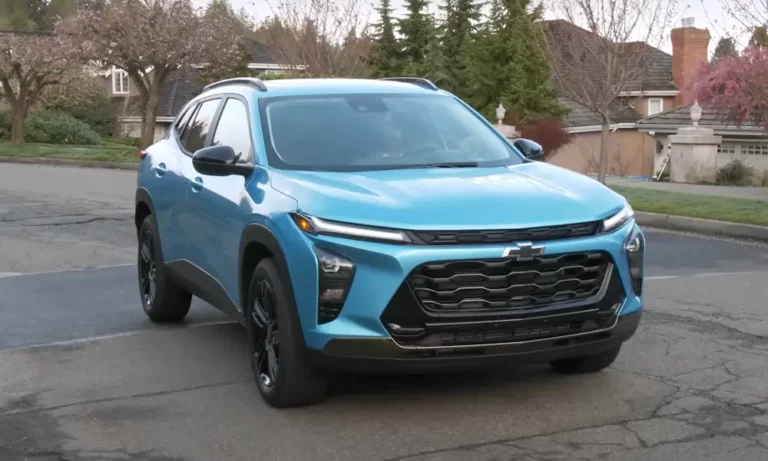
Your Chevy Trax’s AC just died in the middle of summer. You’re sweating, cranking the dial, and getting nothing but hot air. Don’t panic—this is fixable. This guide breaks down exactly why your AC stopped working and what you need to do about it, based on real failure patterns documented across thousands of Trax vehicles.
Why Your Chevy Trax AC Fails (It Depends on Your Model Year)
Here’s the truth: the AC problems in a 2016 Trax are completely different from those in a 2024 model. GM used two distinct platforms across the Trax production run, and each has its own Achilles’ heel.
First Generation (2013–2022): The Condenser Disaster
If you’re driving a first-gen Trax, your AC issue is probably sitting right behind the front bumper. GM built these models with a “combo-cooler” design—the AC condenser, radiator, and transmission cooler all brazed together into one assembly.
The problem? These components expand and contract at different rates when they heat up and cool down. Over time, the brazed joints crack, refrigerant leaks out, and your AC dies. You’ll usually see oily residue on the upper corners of the condenser if this is your issue.
The good news: GM acknowledged this defect. Special Coverage A192219310 extends warranty protection to 6 years or 72,000 miles for 2015–2019 Trax models with this specific leak. If your vehicle falls in this range, get to a GM dealer immediately—not an independent shop. You might get this $700+ repair for free.
Second Generation (2024–2025): The Evaporator Nightmare
If you bought a new 2024 or 2025 Trax, you’re dealing with something worse: evaporator core failures at absurdly low mileage. Owners report failures under 5,000 miles.
The telltale sign: a hissing noise from behind your dashboard. That’s refrigerant escaping through a leak you can’t even see without tearing apart the entire dash. The evaporator sits inside the HVAC housing, buried deep behind your instrument panel.
Fixing this requires 9 to 18 hours of labor—the steering column, dashboard, and cross-car beam all have to come out. Parts are on severe backorder, with some owners waiting months for repairs. If you’re out of warranty, you’re looking at $1,600 to $2,300 out of pocket.
The Refrigerant Switch That Changes Everything
Not all Trax models use the same refrigerant, and this matters more than you think.
Early models (2013–2016) used R-134a, the old-school refrigerant that’s been around for decades. Starting around 2017, GM switched to R-1234yf—an environmentally friendly alternative with a nearly zero global warming potential.
Why you should care:
- R-1234yf costs 3 to 4 times more than R-134a
- It requires specific service equipment (it’s mildly flammable)
- The service ports are physically different to prevent cross-contamination
- A recharge with R-1234yf can run $250–$400 just in materials
There’s one more critical detail for 2015–2016 owners. GM released TSB 16-NA-034 reducing the refrigerant charge from 0.570 kg to 0.440 kg. The original spec caused the system to build too much pressure in hot weather, triggering a safety shutoff. If a tech charges your system to the old spec on the underhood label, you’ll get intermittent cooling that cuts out on hot days. Make sure they check the TSB.
Is It Actually Broken? Three Tests You Can Do Right Now
Before you spend a dime, eliminate the easy stuff.
Test 1: The Fan Speed Check
Turn your AC to max and cycle through all four fan speeds. Does it work on High (speed 4) but go dead on speeds 1, 2, and 3? That’s a fried blower motor resistor—not the compressor. This is a $150–$300 fix, way cheaper than what you’re probably imagining.
The resistor sits behind the glove box and controls the lower fan speeds. It fails when the cabin air filter gets clogged, restricting airflow and causing the resistor to overheat. Before replacing the resistor, check the wiring harness connector. These frequently melt. If you replace the resistor without replacing a melted connector, it’ll fail again in days.
Test 2: The Clicking Noise Test
Start your Trax and listen carefully to the dashboard. Hear a rhythmic clicking or tapping when you turn the AC on or adjust the temperature? That’s not the compressor—it’s a blend door actuator. The plastic gears inside have stripped, and the motor is spinning uselessly trying to move a stuck door.
You can try a reset before spending money on a new actuator. Disconnect the battery or pull the HVAC fuse for 60 seconds. When you reconnect it, the system recalibrates and might fix itself. If the clicking continues, the actuator needs replacement.
Test 3: The Remote Start Mystery (2024–2025 Only)
Does your AC work fine when you start the car normally but refuses to turn on during remote start? You don’t have a mechanical failure—you have a software bug.
TSB 23-NA-198 addresses this exact issue in 2024–2025 Trax models with manual climate controls. The Body Control Module fails to send the “compressor on” command during remote start sequences. Your dealer can reprogram the BCM in about 30 minutes and fix it completely. This is a warranty repair—don’t let them charge you.
The Compressor: When It’s Actually Dead
If you’ve ruled out the simple fixes, it’s time to look at the compressor itself.
The Clutch Test
Pop your hood with the AC on max and the engine running. Look at the compressor pulley (follow the serpentine belt to the AC compressor on the front of the engine). Does the center hub spin with the outer pulley, or does only the outer rim spin?
If only the outer pulley spins, the electromagnetic clutch isn’t engaging. This could be:
- A blown fuse or bad relay (check the underhood fuse box for “AC CMPR”)
- A faulty pressure sensor telling the computer the system is empty
- A burnt clutch coil (use a multimeter—it should read 3–5 ohms)
Testing the clutch is straightforward with basic tools. If you have 12 volts at the compressor connector but no engagement, the coil is fried. Compressor replacement runs $1,021 to $1,402 installed.
The Black Death
If you ignored a refrigerant leak for too long, you might have killed the compressor internally. When the system loses refrigerant, it also loses the PAG oil that lubricates the compressor. Running it dry causes the pistons to seize, shattering internal components and sending metal debris throughout the entire system.
At this point, you need a total system overhaul: compressor, condenser, expansion valve, and flushing all the lines. The evaporator usually can’t be flushed effectively and may need replacement too. This is a multi-thousand-dollar repair.
Leak Detection: Finding Where Your Refrigerant Went
The most common cause of Chevy Trax AC failure is a refrigerant leak. The system is incredibly sensitive—losing just 2–3 ounces kills performance.
Visual Inspection First
Look for wet, oily spots on:
- The condenser face (first-gen models)
- Around the compressor body
- At the line connections near the firewall
PAG oil attracts dust, so leaks often appear as greasy dirt patches rather than liquid drips.
UV Dye Testing
A tech injects fluorescent dye into the system, runs it for a while, then scans with a UV light. For first-gen Trax, they’ll focus on the condenser/radiator interface. For second-gen, they’ll check the AC drain tube on the firewall—if there’s glowing dye coming out, your evaporator is leaking.
The Pressure Test
A mechanic connects manifold gauges to your AC’s high and low service ports. The pressure readings tell the story:
| Low Pressure | High Pressure | What’s Wrong |
|---|---|---|
| Low | Low | Refrigerant leak—system undercharged |
| High | Low | Compressor failure—not building pressure |
| High | High | Overcharged or blocked condenser airflow |
| Normal | Normal | Electrical issue or blend door problem |
On some 1.4L Turbo Trax models, accessing the low-side port requires removing the front splash shield. It’s hidden down low near the front of the engine bay.
The Fuel Line Rub (2013–2014 Models)
Early Trax models have a bizarre failure you won’t find in later years. GM’s manufacturing tolerances allowed the fuel line to contact the AC refrigerant line. Engine vibration caused the steel fuel line to saw through the softer aluminum AC pipe, creating a leak.
Service Bulletin 13395 addresses this by installing a swivel clip to separate the lines. If you own a 2013–2014 Trax and can’t find the leak, check for contact between these lines near the engine.
Parts Pricing: OEM vs. Aftermarket
When you’re facing a repair, parts choice significantly affects your bill.
Condensers (2015–2019)
- OEM (Part #95465726): $200+, guaranteed fitment with the transmission cooler mounting
- Aftermarket (TYC, UAC): $60–$100, but fitment on the combo-cooler design can be tricky
Labor to replace the condenser runs $400–$500 since the entire front bumper comes off. Total repair: $614 to $716.
Blower Motor Resistors
These are low-risk for aftermarket parts. OEM runs $19–$50. The repair is simple—accessed by removing the glove box—so labor is minimal.
What You Should Do Right Now
Your action plan depends entirely on your model year.
If you own a 2015–2019 Trax: Check your VIN against Special Coverage A192219310. If your condenser is leaking and you’re within 6 years/72,000 miles, GM covers it. Don’t go to an independent shop first—go straight to a dealer and reference the special coverage number. You could save $700+.
If you own a 2024–2025 Trax: Document everything. If you hear hissing from the dash or notice the AC struggling, get it to the dealer while you’re under the 3-year/36,000-mile bumper-to-bumper warranty. Make sure the complaint is written on the repair order. This creates a paper trail if the evaporator fails just after warranty expires.
For all model years: Run your AC for 10 minutes every two weeks, even in winter (use the defrost setting). This circulates the PAG oil and keeps the compressor seals lubricated. Seals that sit dry for months crack and leak.
Replace your cabin air filter every 15,000 miles. This protects the blower resistor and prevents evaporator icing.
The Bottom Line on Chevy Trax AC Repairs
Your Trax AC failure isn’t random—it follows predictable patterns based on your model year. First-gen models leak at the condenser, second-gen models leak at the evaporator, and both generations occasionally suffer electrical gremlins that mimic mechanical failures.
The most expensive mistake you can make is paying for a diagnosis without checking for special coverage first. The second most expensive is replacing parts without addressing the root cause (like replacing a resistor without checking the connector).
Start with the simple tests in this guide. Check your model year against the known issues. Reference the specific TSBs. And if your Trax qualifies for special coverage, use it—that’s what it’s there for.
Your AC is fixable. You just need to know which fix your specific Trax actually needs.