That check engine light just killed your mood. Your scanner says Ford P0430, and now you’re wondering if you need to spend $2,000 or if it’s something simpler. The answer depends on what’s actually causing the code — and most people skip straight to replacing parts without checking. Read to the end before you touch anything.
What Is the Ford P0430 Code?
Ford P0430 means your car’s powertrain control module (PCM) has flagged the catalytic converter on Bank 2 as underperforming. The full name is “Catalyst System Efficiency Below Threshold (Bank 2).”
Here’s the thing — your car doesn’t have a direct “catalyst sensor.” Instead, the PCM uses two oxygen sensors to estimate how well your catalytic converter stores and releases oxygen. When that oxygen storage capacity drops below a programmed limit, you get P0430.
It takes two consecutive failed drive cycles before your check engine light actually turns on. So by the time you see it, the PCM is pretty confident something’s wrong.
Where Is Bank 2 on a Ford?
Getting this wrong means diagnosing the wrong side of the engine. Here’s how Ford defines Bank 2 depending on your engine layout:
| Ford Model | Engine Type | Bank 2 Location |
|---|---|---|
| F-150, Mustang, Expedition | Longitudinal V-type | Driver’s side (left side of transmission) |
| Explorer, Edge, Flex | Transverse V-type | Radiator-side bank (cylinders 4-5-6) |
| Focus, Escape, Fusion (I4) | Inline-four | Usually shows P0420 instead of P0430 |
On V-type engines in trucks and muscle cars, Bank 1 sits on the passenger side (cylinder 1 side), so Bank 2 is the driver’s side. On transverse V-engines in crossovers, Bank 2 faces the radiator.
Get this right before you touch a single bolt.
How the PCM Actually Detects a Bad Catalyst
The PCM runs what Ford calls a Catalyst Efficiency Monitor. It compares the upstream oxygen sensor (before the cat) with the downstream sensor (after the cat).
- Healthy cat: The downstream sensor holds steady around 0.45–0.7 volts with minimal movement
- Failing cat: The downstream sensor starts mirroring the upstream sensor’s rapid voltage swings
When a catalytic converter works properly, it stores oxygen during lean conditions and releases it during rich conditions. That oxygen storage capacity is what the PCM measures. Lose it, and you get P0430.
The monitor only runs under specific driving conditions — it won’t fire during short trips or cold starts. That matters when you’re trying to clear the code after a repair.
The Real Reasons Your Ford Throws P0430
A catalytic converter doesn’t fail on its own. Something upstream kills it. Replacing the cat without fixing the root cause means you’ll be back at the parts store in 6 months.
Ignition System Misfires
This is the most common catalyst killer. A bad coil-on-plug (COP) or worn spark plug sends raw, unburned fuel into the exhaust. That fuel ignites inside the catalyst at temperatures that can exceed 2,000°F, melting the ceramic substrate into a crumbled mess.
Signs: rough idle, other misfire codes (P0300-P0308), reduced power.
Rich Fuel Conditions
Leaking fuel injectors or a faulty purge valve can flood the catalyst with excess hydrocarbons. The converter works overtime trying to burn it all off, which accelerates thermal aging of the precious metals inside.
Oil Burning
Engine oil contains phosphorus from anti-wear additives. When worn piston rings or valve seals let oil into the combustion chamber, that phosphorus deposits on the catalyst substrate and permanently blocks the active sites. No amount of drive cycles will fix phosphorus poisoning.
Coolant Leaks
A failing head gasket or cracked cylinder head introduces silicates into the exhaust stream. These form a glassy coating over the catalyst’s surface — essentially sealing it shut. This is also permanent damage.
Sulfur Contamination
High-sulfur fuel — especially common with Ford EcoBoost engines — temporarily bonds to the palladium and rhodium in the catalyst. Unlike phosphorus or silicate poisoning, sulfur masking is often reversible.
| Root Cause | Damage Type | Reversible? |
|---|---|---|
| Misfires (bad COPs/plugs) | Substrate meltdown | No |
| Rich mixture (leaking injectors) | Thermal overload | Sometimes |
| Oil burning (piston rings, PCV) | Phosphorus poisoning | No |
| Coolant leak (head gasket) | Silicate glazing | No |
| High-sulfur fuel | Sulfur masking | Yes — with drive cycle |
Ford-Specific TSBs You Should Know About
Ford has issued several Technical Service Bulletins directly related to P0430. These aren’t optional reading — they can save you thousands.
5.0L Coyote V8 — Oil Consumption and P0430
The 2018–2020 F-150 with the 5.0L Coyote engine has a documented issue covered under TSB 19-2365. During deceleration fuel shut-off events, the throttle plate closes fast and creates high vacuum that pulls oil past the piston rings and into the combustion chamber. That oil poisons both catalysts.
The fix: PCM reprogramming to soften the throttle strategy. If caught early, the cats can survive. If the vehicle ran 30,000+ miles with excessive oil consumption, the Bank 2 catalyst likely needs replacement.
EcoBoost F-150 and Expedition — Sulfur Contamination
TSB 22-2260 and TSB 21-2381 address P0420 and P0430 on 2018–2021 F-150s and Expeditions caused by high-sulfur fuel. Ford developed a specific sulfur removal drive cycle for these engines that can clear the code without any parts.
The Ford Sulfur Removal Drive Cycle
Before you replace anything on an EcoBoost, try this first. It’s what Ford dealers perform under TSB guidance for EcoBoost-equipped F-150s and Expeditions:
- Check your fuel level — keep it between ¼ and ¾ full
- Warm the engine fully to operating temperature
- From under 30 mph, do a wide-open throttle (WOT) acceleration to 65 mph
- Shift to manual mode (if equipped) and hold 4th gear. Drive 60–70 mph with repeated 25–50% throttle accelerations followed by fully closed-throttle deceleration — do this for 15–45 minutes
- Cool down with 15 minutes of normal highway driving at 55–65 mph
- Clear the DTC and run a full OBD-II readiness drive cycle
This pushes catalyst temperatures high enough to chemically strip sulfur from the palladium sites. It won’t work for phosphorus or silicate damage — those need hardware replacement.
How to Diagnose P0430 Like a Pro
Basic code readers only tell you P0430 is present. To confirm whether the catalyst actually failed — or if something else is mimicking the code — go deeper.
Mode $06 Analysis
Mode $06 is a built-in OBD-II diagnostic mode that shows the PCM’s own test results. On Ford vehicles, catalyst Bank 2 appears under Monitor ID $22. You’ll see a test value versus a minimum/maximum limit.
- If the test value is below the threshold → P0430 is legitimate
- If the test value is just above the threshold → the cat is marginal but alive; the sulfur cycle or a cleaning treatment might save it
Oxygen Sensor Graphing with FORScan
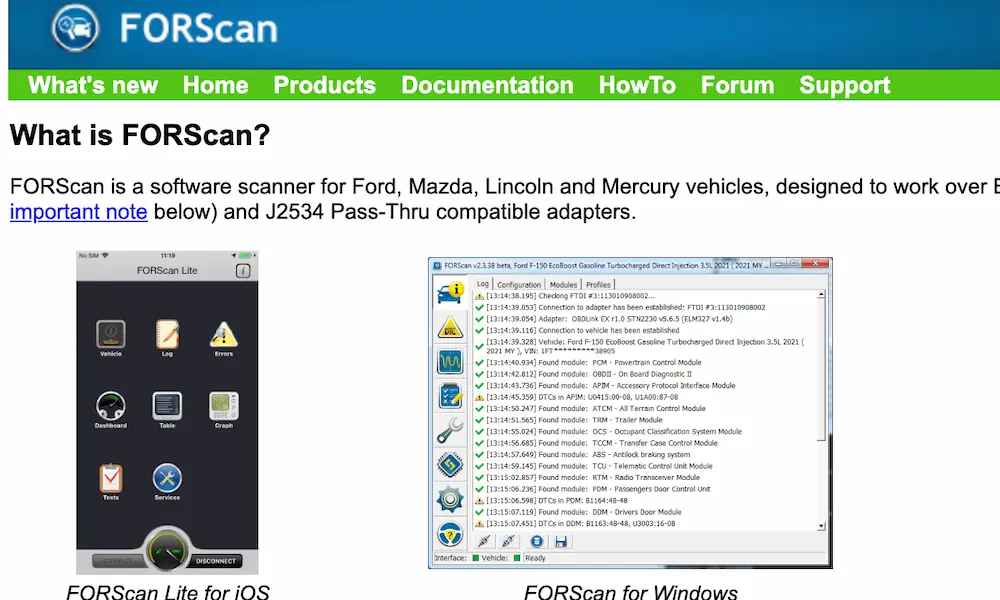
Using FORScan with a modified ELM327 adapter, graph both oxygen sensors simultaneously at highway speed:
- Upstream (S1): Should swing rapidly between 0.1V and 0.9V
- Downstream (S2): Should stay relatively flat, hovering between 0.45V and 0.7V
If S2 starts copying S1’s pattern in frequency and amplitude, the catalyst has genuinely failed and needs replacement.
OEM vs. Aftermarket Catalytic Converters
This is where people lose money. Ford’s PCM doesn’t just check emissions — it measures oxygen storage capacity with precision. Aftermarket catalysts often carry less precious metal and can’t meet Ford’s internal thresholds, even if they reduce raw emissions enough to pass a tailpipe sniffer test.
| Feature | OEM Ford Catalyst | Typical Aftermarket Catalyst |
|---|---|---|
| Precious metal loading | High Pt/Pd/Rh content | Lower precious metal content |
| Oxygen storage capacity | Optimized for PCM thresholds | Marginal storage |
| Expected lifespan | 100,000+ miles | 25,000–50,000 miles |
| Compliance | 50-state (EPA/CARB) | Often 46-state only |
The risk with cheap aftermarket cats on Ford: P0430 comes back within 500–1,000 miles of the repair. Spend the money once on the right part.
What Does a P0430 Repair Actually Cost?
Catalytic converters contain platinum, palladium, and rhodium. They’re not cheap.
| Ford Model | OEM Part Cost | Labor | Total Estimate |
|---|---|---|---|
| F-150 3.5L EcoBoost | $1,280–$1,600 | $450–$650 | $1,730–$2,250 |
| Mustang 5.0L | $1,400–$1,750 | $300–$550 | $1,700–$2,300 |
| Explorer 3.5L | $1,100–$1,450 | $500–$800 | $1,600–$2,250 |
| Focus 2.0L GDI | $850–$1,200 | $350–$600 | $1,200–$1,800 |
Bank 2 only. If the failure came from oil or coolant contamination, Ford often recommends replacing both catalysts — which doubles the part cost.
Before you pay anything, check your mileage. Under federal law, catalytic converters carry an 8-year/80,000-mile warranty. If your Ford falls within that window and there’s no tampering, Ford must replace it at no cost to you.
Why Clearing the Code Isn’t Enough
Ford vehicles built after 2010 store Permanent DTCs (PDTCs) in non-volatile memory. Disconnecting the battery or using a scan tool won’t clear a PDTC P0430.
The only way to erase a PDTC is to fix the actual problem and let the PCM’s Catalyst Monitor run successfully — typically across three complete warm-up and drive cycles. Until that happens, your car will fail an OBD-based emissions inspection even if the check engine light is off.
If you’re in California, New York, Illinois, or another state with strict OBD testing, this matters a lot.
The Bottom Line on Ford P0430
Ford P0430 isn’t always a death sentence for your catalytic converter. Start by checking for misfire codes, fuel trim data, and oil consumption before assuming the cat is gone. Use Mode $06 data or FORScan to confirm the failure is real. If you drive an EcoBoost, try the sulfur removal cycle first — it’s free and it works on sulfur-contaminated cats.
When replacement is unavoidable, go OEM. The cost difference between a cheap aftermarket cat and an OEM unit is often smaller than the cost of a comeback repair when P0430 returns three weeks later.