Your check engine light is on, you’ve scanned the code, and now you’re staring at “P0455” wondering what it’ll cost you. Good news — it’s often cheaper and simpler than you think. Read to the end and you’ll know exactly what’s broken, how to test it, and what you’ll pay.
What Is the Ford P0455 Code?
The Ford P0455 code means your vehicle’s Evaporative Emission (EVAP) system has a large leak — specifically, a hole 0.040 inches (1.0 mm) or bigger. The EVAP system captures fuel vapors from your gas tank before they escape into the air. When it can’t hold pressure, your car’s computer flags P0455.
It won’t stop your Ford from running. But it does mean raw gasoline vapors are escaping into the atmosphere — and that’s both an environmental problem and, in an enclosed garage, a fire hazard.
How Ford’s EVAP System Actually Works
Your fuel tank constantly produces vapors, especially on hot days. The EVAP system routes those vapors through rubber hoses into a charcoal canister packed with activated carbon pellets. The carbon traps the hydrocarbons until the engine’s running.
Once you’re driving, the Powertrain Control Module (PCM) opens the Canister Purge Valve (CPV) and draws those stored vapors into the engine to burn them. Clean, simple, effective — until something leaks.
Here’s how the key components behave:
| Component | Normal State (Engine Off) | What It Does |
|---|---|---|
| Fuel Tank | Sealed | Stores fuel and vapor |
| Charcoal Canister | Open to vent | Traps hydrocarbon vapors |
| Purge Valve (CPV) | Closed | Opens to send vapors to engine |
| Vent Valve (CVV) | Open | Seals shut during leak test |
| FTP Sensor | Monitoring | Measures tank pressure/vacuum |
How the PCM Detects a P0455
Your Ford’s PCM doesn’t run this test continuously. It waits for specific conditions before checking the EVAP system. According to Ford’s EVAP monitor logic, it needs:
- Fuel level between 15% and 85%
- Cold start with engine coolant temp close to intake air temp
- Barometric pressure above 70 kPa
Once those conditions are met, the PCM closes the vent valve, seals the system, and uses the purge valve to pull a vacuum. It then watches how fast that vacuum drops. If it drops too fast — a gross leak is confirmed and P0455 gets stored.
P0455 vs. P0456: What’s the Difference?
| Code | Leak Size | Urgency |
|---|---|---|
| P0455 | Large (≥ 0.040 inches) | Fix soon |
| P0456 | Small (≥ 0.020 inches) | Fix eventually |
A P0456 is a small leak — annoying but minor. A P0455 is a gross leak. Think disconnected hose, cracked canister, or a busted fuel filler seal.
Ford’s Capless “Easy Fuel” System and P0455
Starting with 2009 models, Ford replaced traditional gas caps with the “Easy Fuel” capless system. Two spring-loaded flaps open only when a fuel nozzle goes in. No cap to lose. Smart design — but it created new failure points.
What Goes Wrong With the Easy Fuel Inlet
- Debris buildup — dirt and road salt stop the flap from sealing fully
- Damaged spring or O-ring — using a fuel can without the emergency funnel tears the rubber gasket
- Corrosion — salt causes micro-pitting on the flap surface, breaking the seal
The $5 Fix That Works
Before buying anything, try this: spray WD-40 around the fuel inlet flap, then use the vehicle’s plastic emergency funnel to work the flap open and closed 20–50 times. This clears debris and re-seats the spring. It clears P0455 on a lot of Explorers, F-150s, and Fusions without spending a dollar on parts.
If that doesn’t work, the filler neck assembly needs replacing — a common repair on older F-150s and Explorers.
The Most Common Causes of Ford P0455
Canister Purge Valve (CPV) Stuck Open
The CPV should stay closed when the engine’s off. In Ford EcoBoost engines especially, internal contamination causes the valve to stick open. When it’s stuck, the engine pulls a constant vacuum on the fuel tank and the PCM can never stabilize a pressure reading. Secondary symptoms include rough idle or stalling right after you fill up.
Canister Vent Valve (CVV) Stuck Open
The vent valve lives under the chassis, near the charcoal canister. Because it sits exposed to road debris, mud, and moisture, it’s highly prone to failure. If it won’t close during the test, the system is open to atmosphere — instant gross leak reading. Blocked breather hoses (sometimes from spider webs) also trigger this and the related P1450 code.
Fuel Tank Pressure (FTP) Sensor Failure
The FTP sensor tells the PCM what’s happening inside the tank. If the sensor drifts or has an internal diaphragm failure, it reports atmospheric pressure even when the system is under vacuum. The PCM reads that as a gross leak — even if nothing’s actually leaking.
Cracked Charcoal Canister
Older vehicles — especially ones with rear-mounted canisters — can crack from road impacts or age-related brittleness. You might smell fuel from the back of the car if this is your issue.
Disconnected or Cracked Vapor Hoses
On the Ford Fusion and Focus, vapor lines run close to the exhaust system. Heat makes plastic brittle over time. A stress crack in one of those lines creates exactly the kind of gross leak that triggers P0455.
How Technicians Diagnose Ford P0455
Scan Tool + Bi-Directional Commands
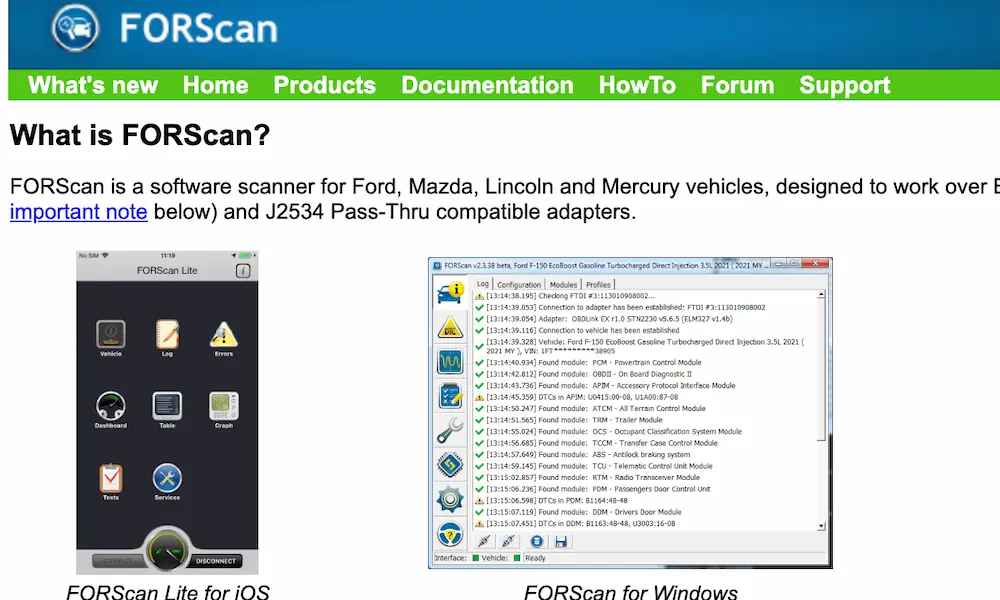
A professional-grade scan tool like Ford FDRS lets technicians manually command the vent valve closed and the purge valve open while watching FTP sensor voltage live. At atmospheric pressure, the FTP sensor reads around 2.5V. As vacuum builds, voltage drops. As pressure rises, voltage climbs. If voltage stays frozen during a commanded test, the leak’s confirmed and the hunt begins.
Smoke Testing
Low-pressure smoke testing is the gold standard for finding EVAP leaks. A smoke machine pushes dense, UV-dye smoke into the system at no more than 0.5 psi (3.5 kPa). The tech then scans every hose, fitting, and component with a UV light looking for smoke escaping. Common blind spots on Ford trucks include the top of the fuel tank — the fuel pump lock ring can corrode and lose its seal, and you won’t see it until the tank drops partially.
What Ford Says: TSBs and Recalls
Ford has issued specific guidance to prevent technicians from swapping parts based on the code alone.
SSM 50306 (covering 2018–2022 Ford vehicles) tells technicians to run a full EVAP leak test and a purge valve leak test before replacing anything. Why? Because a lot of purge valves returned under warranty were working fine. The real issue was an FTP sensor giving false readings.
Also worth knowing: Recall 25V455 affects over 850,000 Ford vehicles (2021–2023) for a fuel pump issue. The repair involves removing the Fuel Delivery Module from the tank — and if the vapor lines or lock rings aren’t reseated correctly afterward, you’ll end up with a fresh P0455 post-service.
How Much Does a Ford P0455 Repair Cost?
| Repair | Parts | Labor | Total |
|---|---|---|---|
| Easy Fuel inlet cleaning | ~$5 (WD-40) | $0 DIY | ~$5 |
| Purge Valve (CPV) | $65–$160 | $60–$120 | $125–$280 |
| Vent Valve (CVV) | $90–$320 | $80–$150 | $170–$470 |
| Fuel Filler Neck | $250–$410 | $150–$280 | $400–$690 |
| Charcoal Canister | $380–$440 | $140–$240 | $520–$680 |
| FTP Sensor | $120–$180 | $100–$300* | $220–$480 |
| Diagnosis only | — | $100–$160 | $100–$160 |
*Labor jumps significantly if the fuel tank needs to drop for access.
Why You Shouldn’t Ignore Ford P0455
A gross EVAP leak doesn’t just hurt your emissions test results. A vehicle with an active P0455 can release as many hydrocarbons in a week as a properly functioning vehicle emits over several years of driving. Those vapors react with sunlight to create ground-level ozone — the stuff that makes summer air quality warnings happen.
There’s also a safety angle. Park a vehicle with a gross EVAP leak in an enclosed garage and fuel vapors can accumulate to a flammable concentration near water heaters or appliances. On top of that, a stuck-open purge valve dumping vapors into the intake can drop your fuel economy by 2–5% over time.
Fix it early. Most of the time, it’s a $5 cleaning job or a $150 valve swap — not a $700 repair.