Ever noticed a small scratch on your Ford and wondered how to get the exact paint match? You’ll need your Ford paint code first. It’s the key to getting the right touch-up paint that blends perfectly with your vehicle’s finish.
Finding your Ford paint code isn’t complicated once you know where to look. I’ll walk you through the exact locations to check, decode what those mysterious letters and numbers mean, and show you what to do with this information.
What Are Ford Paint Codes?
Ford paint codes are specific alphanumeric identifiers that pinpoint the exact color of your vehicle. These codes ensure you get the perfect match when touching up scratches or repainting sections of your Ford.
Ford uses a standardized format for their paint codes, typically consisting of two characters. For example, “PQ” represents Race Red, while “J7” indicates Magnetic Metallic. Sometimes you’ll see extended formats like “PM/M6599” where only the first two characters are needed for paint matching.
The codes fall into four main formats:
- Basic two-character codes (letters and/or numbers)
- Extended formats with slashes
- Combination codes with multiple identifiers for the same color
- Complex alphanumeric codes (seven or more characters) on newer vehicles
Pre-1970 Fords present special challenges since the company used identical color names for different paint formulations across model years. That’s why having the actual code is crucial for vintage restorations.
Primary Location: Driver’s Door Jamb
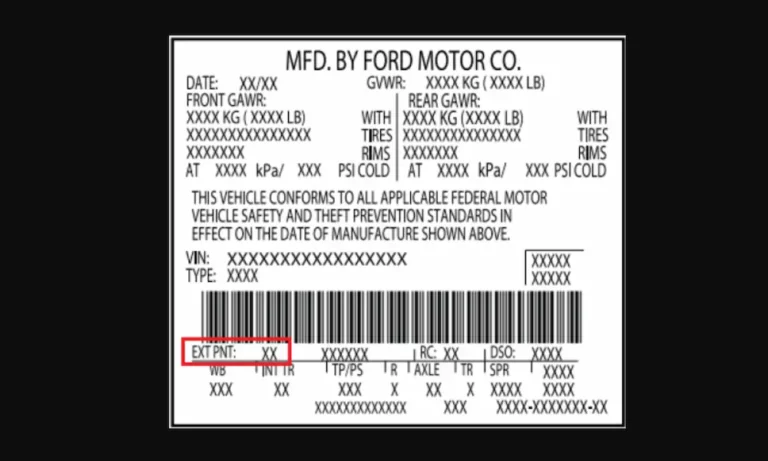
The most common place to find your Ford paint code is on the driver’s side door jamb. This location has remained consistent across most Ford models for decades, making it the first place to check.
Look for a comprehensive vehicle information sticker that contains your VIN, manufacturing date, tire specifications, and the exterior paint code. The paint code appears next to “EXT PNT” (Exterior Paint) or a similar designation.
When examining the sticker, don’t confuse “WB” (which stands for wheelbase) with your paint code. A marking like “WB 121” indicates a 121-inch wheelbase, not a color code.
Alternative Ford Paint Code Locations
Can’t find the code on your driver’s door jamb? Don’t worry – Ford provides several backup locations:
- Trunk or Boot Lid: Open your trunk and check for a sticker or metal plate, usually on the inside of the lid.
- Under the Hood: Look on the suspension mount or inner wing area for a duplicate information plate.
- Front Slam Panel: The panel where the hood latches might contain vehicle information.
- Spare Wheel Bay: Check the area around your spare tire for information stickers.
- Door Edge: Occasionally, paint codes appear on the actual edge of the driver’s door.
If the primary sticker is damaged or missing, these secondary locations often contain the same information or separate identification plates with your paint code.
How to Read Ford Paint Codes
Reading Ford paint codes correctly ensures you get the exact color match. Here’s how to decode them:
For standard two-character codes like “YZ” (Oxford White) or “J7” (Magnetic Metallic), you simply need the characters as they appear.
For extended formats with slashes like “YZ/Z1,” either code before or after the slash will typically work for paint matching, as they reference the same color.
Here’s a helpful table of popular Ford paint codes you might encounter:
| Paint Code | Color Name | Common Models |
|---|---|---|
| YZ/Z1 | Oxford White | F-150, Mustang, Explorer |
| J7 | Magnetic Metallic | Most models |
| PQ | Race Red | Mustang, F-150, Focus |
| H3 | Triple Yellow | Mustang |
| UG | White Platinum Pearl | Lincoln, high-trim Fords |
| CY | Competition Orange | Mustang, Focus ST |
| KU | Area 51 | Maverick, Bronco |
| UJ | Sterling Gray Metallic | F-150, Explorer |
Remember that metallic and pearl finishes use Ford’s basecoat/clearcoat system, requiring both components for proper repairs.
Using Your Ford Paint Code for Touch-Up Work
Once you’ve located your paint code, you can use it to purchase perfectly matched touch-up paint. Here’s how:
- Order the correct product: Using your paint code, you can order touch-up pens, spray bottles, or aerosol cans from Ford touchup paint suppliers or your local dealership.
- Understand the paint system: Modern Fords use a basecoat/clearcoat system. The basecoat provides color while the clearcoat adds protection and gloss. You’ll need both for professional results.
- Prepare the surface: Clean the area thoroughly and remove any rust or loose paint before applying touch-up paint.
- Apply in thin layers: Multiple thin coats work better than one thick application.
- Finish with clearcoat: For a factory-quality finish, apply the matching clearcoat after the basecoat has dried.
Special Cases: Two-Tone and Specialty Paints
Two-tone Ford vehicles present an additional challenge since you’ll need to identify both the primary and secondary paint codes. The vehicle sticker should list both colors, though sometimes the secondary color information may be incomplete.
Ford’s specialty finishes like metallic, pearl, and tri-coat paints require special attention. These multi-layer paints involve a basecoat color, sometimes a mid-coat for pearl effects, and a protective clearcoat. The paint code identifies the specific color formula, but the application process is more complex than solid colors.
The 2025 Ford lineup introduces several new colors worth noting:
- F-150: Eleven color options including the new Shelter Green (Raptor-exclusive)
- Maverick: Nine exterior colors featuring adventure-ready hues like Eruption Green
- Explorer: Sophisticated options like Vapor Blue Metallic
- Bronco: Rugged choices such as Marsh Gray and Desert Sand
What To Do If You Can’t Find Your Paint Code
If you’ve checked all possible locations and still can’t find your paint code, you have several options:
- Contact Ford Customer Service: Call Ford’s customer service line (1-800-392-3673) and provide your VIN number to get paint code information.
- Visit a Ford Dealership: A Ford service department can look up your paint code using your VIN.
- Use Online VIN Decoders: Some specialized websites can decode your VIN to reveal paint information.
- Consult Paint Suppliers: Companies like PaintScratch maintain databases that can identify Ford paint codes by make, model, and year.
- Professional Color Matching: As a last resort, auto body shops can use spectrophotometers to analyze your paint and create a custom match.
Ford Paint Code Evolution Through the Years
Ford’s paint coding system has evolved alongside their manufacturing processes. From the early Model T era through today’s computer-controlled painting technology, Ford has maintained a commitment to organized color identification.
The standardization of the door jamb placement for paint codes demonstrates Ford’s systematic approach to vehicle information management. This consistency extends globally, with similar coding systems used across Ford’s international operations.
Pre-1970s Fords used different color formulations even when the names were identical across model years. For example, “Ocean Blue” from 1966 would have a completely different paint code and formula than “Ocean Blue” from 1967, making accurate code identification critical for vintage restorations.
Modern Ford paint codes are part of a comprehensive quality control system that ensures consistency across global production facilities. The same color code on a Mustang built in Michigan will match the identical code on one assembled in Mexico.
Troubleshooting Common Ford Paint Code Issues
Even with the right paint code, you might encounter some challenges:
- Color Variation Over Time: Sun exposure can fade automotive paint, making new touch-ups appear brighter than surrounding areas. Consider polishing adjacent panels to blend repairs.
- Multiple Valid Codes: Some Ford colors have multiple valid codes (like Oxford White’s “YZ” and “Z1”). Either will work for matching purposes.
- Similar Shades: Codes like UJ (Sterling Gray Metallic) and J1 (Magnetic) look similar but aren’t identical. Always verify the exact code for your vehicle.
- Pre-1970 Challenges: Vintage Ford owners should consult with specialized paint suppliers that maintain historical color formulations.
- Clearcoat Confusion: Don’t forget that modern Ford finishes require both color and clearcoat. The paint code only identifies the color portion.
If you encounter unidentifiable codes or need additional help, professional paint suppliers often maintain cross-reference databases to address these complexities and ensure accurate color matching.