If your dashboard just lit up like a Christmas tree and your scan tool’s showing the Honda 85-01 code, you’re probably bracing for bad news. Here’s the thing: this code doesn’t always mean what mechanics think it means. You might save thousands by reading this first.
What Is the Honda 85-01 Code?
Here’s where it gets weird. The Honda 85-01 code has two different meanings depending on which part of your car is complaining.
When your scan tool reads this code from the VSA (Vehicle Stability Assist) module, it means “VSA System Malfunction.” That’s the source problem—your VSA modulator detected something wrong internally.
But here’s the twist: most of the time, you’ll find this code in your Electric Power Steering (EPS) module, where it means “VSA Signal Failure.” This is just a consequence code. Your EPS module is basically saying, “Hey, I can’t hear the VSA anymore.”
This distinction matters because replacing your EPS module would be totally wrong and incredibly expensive.
Why Your Steering Module Is Complaining
Your power steering isn’t broken—it’s just missing critical information. The EPS module needs constant data about wheel speeds, vehicle yaw, and lateral acceleration to adjust steering assist properly. All that data comes from the VSA modulator.
When the VSA modulator fails and stops broadcasting on your car’s communication network (the CAN bus), your EPS module suddenly goes blind. It shuts down as a safety measure, which is why your steering feels like you’re wrestling a bear.
The Dashboard Warning Light Symphony
You’ll know you’ve got the Honda 85-01 code when multiple warning lights gang up on you:
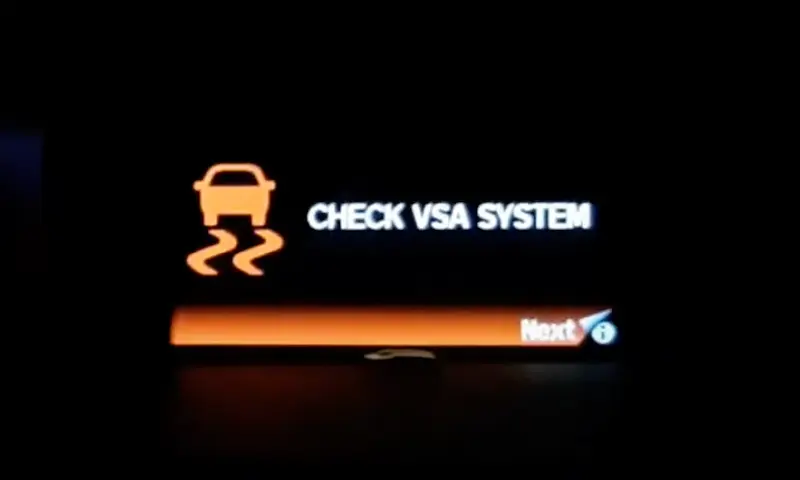
- VSA light (or “Check VSA System” message)
- ABS light
- Triangle exclamation point (traction control)
- EPS or steering wheel icon
- Sometimes the check engine light joins the party
And it’s not just lights. Your steering becomes ridiculously heavy because the power assist shut off. Some people report a jittery feeling when accelerating—that’s the malfunctioning traction control randomly tapping your brakes.
Before You Spend a Dime: Check These First
Here’s where most mechanics mess up. They see the Honda 85-01 code and immediately quote you $1,500-$4,300 for a new VSA modulator. But there are two common, cheap fixes they skip.
The Battery Terminal Trick
This sounds too simple to work, but it fixes the problem more often than you’d think.
Your VSA modulator is ridiculously sensitive to voltage drops. Even a tiny amount of corrosion on your battery terminals can cause the module to glitch and throw the 85-01 code.
Check your battery terminals for white or green crusty stuff. If you see any, disconnect them, scrub them clean with a wire brush, and reconnect everything tight. Clear the codes and take a test drive.
A 2015 Honda Accord came in with the Honda 85-01 code plus a bunch of other scary codes. The tech almost condemned the VSA modulator until he noticed heavily corroded battery terminals. Cleaned them up, codes never came back. That’s a $10 fix instead of $2,000.
Also check your alternator. With the engine running, your battery should read 13.8-14.4 volts. Anything less means your alternator’s dying and starving your electronics.
The Calibration Reset Nobody Tells You About
Your VSA system needs to know what “normal” looks like—specifically, what all the sensors read when you’re sitting level with the steering wheel straight.
This calibration can get wiped out when you:
- Replace your battery
- Get a wheel alignment
- Change suspension parts
If the stored calibration doesn’t match what the sensors are actually seeing, the system freaks out and logs the Honda 85-01 code.
You’ll need a decent scan tool (Autel, XTOOL, or YOUCANIC) to run the “VSA Neutralization Procedure” or “Zero Point Calibration.” It takes less than a minute. If the code disappears after this, you just saved yourself a fortune.
Which Honda Models Get Hit With This?
This isn’t random bad luck. The Honda 85-01 code hits specific model years hard:
| Model | Problem Years |
|---|---|
| Honda Accord | 2009-2017 |
| Honda CR-V | 2012-2016 |
| Honda Pilot | 2012-2015 |
| Honda Civic | 2012-2015 |
If you’re driving one of these, you’re in the high-risk zone.
Reading the Code Clusters (This Is Important)
The Honda 85-01 code rarely shows up alone. The other codes with it tell you what’s actually wrong.
When It’s Definitely the VSA Modulator
If you see 85-01 plus 121-11 (VSA Solenoid Valve Malfunction), your VSA modulator has failed internally. The 121-11 code specifically points to the hydraulic solenoid pack inside the unit.
You might also see U0416-68 (“Invalid Data Received From ABS Module”). This confirms that other modules are getting garbage data from the VSA, which means the VSA modulator’s communication has gone haywire.
When It’s Your Electrical System
If you see 85-01 with 61-11 (VSA Low Voltage) plus 83-11 (PCM Malfunction) plus P0562 (Low Voltage), stop everything. Don’t replace anything. This cluster screams “electrical problem.”
The 85-01 and other codes are just symptoms of your dying battery or failing alternator. Fix the power supply first.
What’s Actually Failing Inside the VSA Modulator
When the VSA modulator does fail for real, it’s almost always the same thing: internal wiring breaks or solder joints crack.
The aluminum wiring inside vibrates and heats up and cools down thousands of times. Eventually, microscopic cracks develop where the circuit board connects to the solenoid pack. These connections fail, you get the Honda 85-01 code, and your safety systems shut down.
This is a known design flaw that Honda never officially recalled. It’s why repair services exist specifically for this problem.
Your Three Options (And Why Two Suck)
Once you’ve confirmed the VSA modulator is toast (bad calibration won’t fix it, electrical system’s perfect, you’ve got the 121-11 code), you’ve got three choices.
Option 1: Dealer Replacement (Ouch)
The Honda dealer will install a brand-new OEM VSA modulator. Expect quotes between $1,400 and $4,300. One person got quoted over $3,000 just for the part and labor.
The new part alone costs around $1,500. You’re paying top dollar for a part that might have the same design flaw that killed your original one.
Option 2: Repair Service (The Smart Move)
Ship your VSA modulator to a specialist who repairs the internal defect and sends the same unit back. This costs $200-$350.
Services like XeMODeX charge $349 and claim a 75% savings over dealer replacement. Module Master in Idaho charges $250 with a 5-year warranty. You can even find repair services on eBay for $199.
The repair fixes the weak solder joints and broken wiring with better materials. Your repaired module often ends up more durable than it was from the factory.
Big advantage: it’s your original module, so it keeps your car’s VIN and programming. It’s plug-and-play—no expensive dealer recoding needed.
Downside: your car sits for about a week while the module ships out and back. Your mechanic will need to plug the brake lines during removal.
Option 3: Used Part Gamble (Don’t)
You could grab a used VSA modulator from a junkyard for maybe $500-$800.
Here’s why this is dumb: the VSA modulator has an “incredibly high fail rate.” A used part from another 2012-2017 Honda probably has the exact same internal defect developing. It might last a month or a year before you’re back where you started.
Plus, if the VIN doesn’t match, you’ll need special programming your local shop might not be able to do.
Cost Comparison Table
| Option | Cost | Pros | Cons |
|---|---|---|---|
| Dealer Replacement | $1,500-$4,300+ | New part, warranty | Financially insane for an older car |
| Repair Service | $350-$600 | Fixes the design flaw, plug-and-play, long warranty | Car’s down for a week |
| Used Part | $500-$1,200 | Cheaper than new | High failure risk, programming issues |
The Post-Repair Steps You Can’t Skip
Getting the VSA modulator back in isn’t the end. Skip these steps and your Honda 85-01 code comes right back.
The ABS Brake Bleed (Requires a Scan Tool)
When you remove the VSA modulator, air gets into the entire brake system. A regular brake bleed won’t cut it because you can’t reach the air trapped inside the modulator’s pump and solenoid valves.
You need a scan tool to activate the “ABS Bleed” or “Modulator Bleed” procedure. This electronically fires the internal pump and cycles all the solenoids, forcing the trapped air out.
Do a manual brake bleed first to get most of the air out. Then run the scan tool procedure. Then do another manual bleed to catch the air that just got purged.
Skip this and you’ll have a spongy brake pedal that goes to the floor. That’s dangerous.
The Mandatory VSA Calibration
After installation, with your car on level ground and the steering wheel dead straight, run the “VSA Neutralization Procedure” using your scan tool. Takes 30 seconds.
If you skip this, the VSA module wakes up, sees sensor readings that don’t match its default settings, assumes something’s broken, and immediately logs the Honda 85-01 code again. All your warning lights come back on.
You’ll think the expensive repair failed when really you just forgot to calibrate.
The DIY Reset Myths You Should Ignore
The internet’s full of “easy fixes” that don’t actually work for this problem.
The Ignition Cycle Reset
Some videos claim you can fix VSA lights by just turning your car off and on again. This only works for temporary glitches—like when you hit your brakes really hard on a cold day and momentarily confuse a sensor.
It won’t fix a hard Honda 85-01 code from actual hardware failure.
The Paperclip Trick
There’s a procedure involving shorting pins 4 and 9 on your OBD2 port with a paperclip, then doing a sequence of brake pedal presses.
This method is for older Hondas (2002-2008). It manually clears codes without a scanner. It’s not the same as the VSA calibration, and it doesn’t work on the 2012+ models affected by the Honda 85-01 code.
How to Diagnose This the Right Way
If your dash lights are on and you’re seeing the Honda 85-01 code, here’s your game plan:
Step 1: Don’t authorize any repairs yet. This code’s often misdiagnosed.
Step 2: Check your battery terminals for corrosion. Clean them thoroughly. Check battery voltage (load test, not just a voltage reading). Test your alternator output.
Step 3: If electrical’s good, get a proper scan tool that can read all modules (not just a cheap code reader). Pull codes from every module to see which one has the 85-01.
Step 4: Run the VSA calibration procedure. Clear the codes. Test drive.
Step 5: Only if the calibration fails or the code returns immediately, and you’ve got the 121-11 code alongside it, is the VSA modulator actually bad.
Step 6: Choose the repair service option. Ship your modulator out, get it repaired, reinstall it with the proper brake bleeding and final calibration.
The Bottom Line
The Honda 85-01 code looks scary and can cost thousands if diagnosed wrong. But it’s often fixable with corroded battery terminals or a simple recalibration.
Even when the VSA modulator truly has failed, you don’t need to drop $2,000-$4,000 at the dealer. A $300 repair service fixes the known internal defect and gets you back on the road.
Just make sure whoever installs it knows about the mandatory brake bleed procedure and final calibration. Without those steps, you’ll be right back where you started, wondering why you still have warning lights after spending all that money.
The NHTSA has documented VSA-related issues in Honda vehicles, particularly involving unexpected brake application. While that specific recall covered 2007-2008 Odysseys, it shows Honda’s VSA system has had its share of problems across multiple model years.
Don’t let a shop sell you parts your car doesn’t need. Start with the simple stuff, follow the diagnostic steps, and you’ll save yourself a pile of cash.