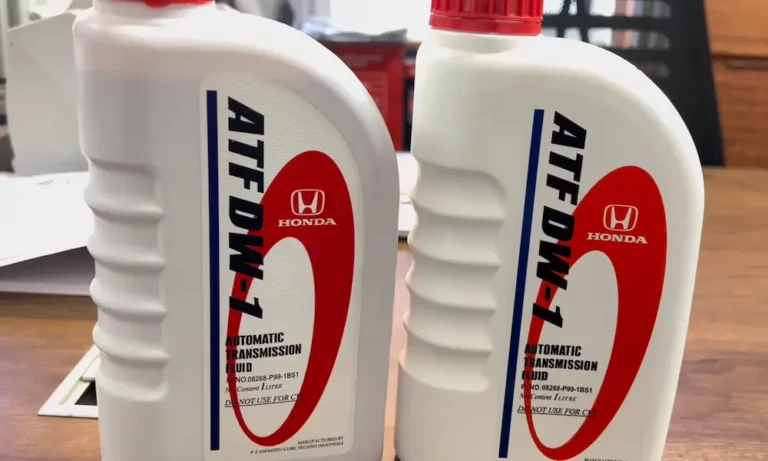
Your Honda’s transmission is acting up, or maybe you’re just trying to keep it running smoothly without paying dealership prices. Either way, you’re wondering if there’s a good alternative to the official Honda ATF DW-1 fluid. The good news? There are several solid options that won’t void your peace of mind. Let’s cut through the marketing and find what actually works.
What Makes Honda ATF DW-1 Different
Honda’s transmissions don’t work like most other automatic transmissions. While most automakers use planetary gearsets, Honda built something closer to a manual transmission that shifts itself. This parallel-axis design puts serious demands on your transmission fluid.
The fluid has to do two tough jobs at once. It needs to keep clutch packs from slipping while also protecting gears and bearings. That’s a tricky balance.
The Viscosity Story
When Honda introduced DW-1 in 2011, they weren’t just tweaking the formula for fun. Fuel economy regulations forced their hand. The new fluid flows easier when cold, which means less drag and better MPG numbers.
Here’s what changed from the old Z-1 to DW-1:
- Cold viscosity dropped from about 30-33 cSt to 25 cSt
- Hot viscosity stayed similar at around 6.8-7.0 cSt
- Viscosity Index jumped from 170 to an impressive 255
That sky-high viscosity index is the real trick. It means DW-1 stays consistent across temperature changes better than most fluids on the market. Getting that performance requires lots of synthetic polymers, which is why genuine Honda fluid costs what it does.
The True Clone: Idemitsu ATF Type-H Plus
Want the closest thing to dealership fluid without the dealership markup? Idemitsu ATF Type-H Plus is your answer.
Idemitsu supplies Honda’s OEM fluid in North America, so their aftermarket product shares the same DNA. The numbers prove it:
| Specification | Idemitsu Type-H Plus | Honda DW-1 |
|---|---|---|
| Viscosity at 40°C | 25.23 cSt | 25.09 cSt |
| Viscosity at 100°C | 6.91 cSt | 6.84 cSt |
| Viscosity Index | 258 | ~255 |
You’re getting essentially the same fluid for $8-10 per quart instead of $12-15. The shift feel, hydraulic response, and fuel economy stay exactly where Honda engineered them.
Who Should Use Idemitsu
This fluid makes sense if you:
- Own a newer Honda (2012 or later)
- Want to preserve factory shift characteristics
- Don’t have any existing transmission problems
- Prefer staying as close to OEM as possible
The Problem Solver: Valvoline MaxLife
Here’s where things get interesting. Valvoline MaxLife Multi-Vehicle ATF doesn’t match Honda’s specs on paper. But in the real world? It’s become legendary for fixing issues that Honda’s own fluid can’t solve.
The Viscosity Trade-Off
Valvoline MaxLife runs thinner at operating temperature—5.91 cSt versus Honda’s 6.84 cSt. That’s a 13% difference, which sounds scary until you look at what it actually does.
The fluid uses a different approach than Honda. Instead of heavy polymer additives, it relies on high-quality synthetic base oil. Lower viscosity index (156) but better shear stability over time.
Why It Fixes Shudder
If you’ve felt that annoying vibration between 20-45 mph, you know about torque converter shudder. Honda even issued TSB 17-043 addressing this exact problem in Odysseys and Pilots.
Honda’s official fix involves updating computer software and doing three drain-and-fills with fresh DW-1. That works… for about 15,000 miles. Then the shudder comes back.
Valvoline MaxLife uses friction modifiers that last longer under heat and stress. Hundreds of Honda owners report that switching to MaxLife eliminated shudder that kept returning with OEM fluid.
The Three-Drain Method
Honda transmissions don’t have a removable pan or easy filter access. A simple drain only removes about 3.5 quarts of the 8-9 quart total capacity.
Here’s how to do it right:
- Drain fluid from the drain plug
- Refill with new fluid to proper level
- Drive 10-15 miles, cycling through all gears
- Repeat two more times
After three cycles, you’ve replaced about 80-85% of the old fluid. Never use a powered flush machine—Honda specifically warns against this because it can dislodge debris that clogs solenoids.
Who Should Use Valvoline MaxLife
Switch to this if you:
- Have high mileage (over 80,000 miles)
- Experience torque converter shudder
- Tow occasionally but not constantly
- Want better value than premium synthetics
The Castrol Confusion You Need to Avoid
Castrol sells two different fluids that claim Honda compatibility. Get this wrong and you’ll regret it.
Castrol Transmax Import Multi-Vehicle (Wrong Choice)
This fluid in blue or green bottles is way too thick. At 36.6 cSt cold and 8.0 cSt hot, it’s formulated for older Toyota and Honda specs like Z-1. Using it in a modern DW-1 transmission means:
- Sluggish cold shifts
- Worse fuel economy
- Heavier steering feel
- Defeating the entire purpose of DW-1
Don’t buy this one for anything newer than 2010.
Castrol Transmax Full Synthetic Multi-Vehicle (Right Choice)
The red bottle or “Low Viscosity” labeled version is what you want. At 30.2 cSt cold and 6.0 cSt hot, it’s similar to Valvoline MaxLife in approach and performance.
Always check the label and verify you’re getting the full synthetic, low-viscosity formulation.
Premium Options for Extreme Conditions
If you need more than standard fluids can offer, two boutique brands deliver.
Amsoil Signature Series Fuel-Efficient (ATL)
Amsoil makes two transmission fluids. For Honda DW-1, you specifically want the Fuel-Efficient version (ATL), not the multi-vehicle ATF.
The standout feature? A pour point of -65°C compared to -48°C to -51°C for other fluids. If you live where winter temperatures regularly drop below zero, Amsoil ATL protects during cold starts better than anything else.
At 6.3 cSt operating viscosity, it splits the difference—thicker than Valvoline (5.91 cSt) but thinner than OEM (6.84 cSt).
Red Line D6 ATF
Red Line uses polyol ester base stocks that chemically bond to metal surfaces. Even when the transmission isn’t running, a protective layer remains on components.
The D6 formulation excels at maintaining viscosity under extreme shear forces. If you tow heavy loads or drive in mountains regularly, the $15-18 per quart cost makes sense.
Red Line guarantees the fluid won’t drop below 6.1 cSt over its service life, while standard specs allow degradation to 5.5 cSt.
When Premium Makes Sense
Consider these if you:
- Tow trailers regularly
- Live in extreme climates (very cold or very hot)
- Want extended drain intervals
- Don’t mind paying 2-3x the price
The Japanese Aftermarket Options
Two Japanese brands offer alternatives, but with important caveats.
Aisin ATF-DW1
Aisin supplies transmissions to Toyota and other manufacturers. Their ATF-DW1 measures 35.1 cSt cold and 7.23 cSt hot—noticeably thicker than Honda’s spec.
This conservative formulation prioritizes protection over efficiency. It’s a safe choice that sacrifices some of the fuel economy benefits Honda engineered into DW-1.
Eneos Eco-ATF
Japan’s largest oil company goes the opposite direction. At 5.73 cSt hot, Eneos Eco-ATF is the thinnest fluid in this comparison. It maximizes fuel economy but offers less protection margin for older transmissions originally designed for thicker Z-1 fluid.
Solving Common Problems
The Shudder Fix That Actually Works
If you’ve got shudder and want to stick with OEM viscosity, add Lubegard Platinum or Lubegard Shudder Fixx. These additives contain concentrated friction modifiers that restore smooth lock-up clutch operation.
One bottle treats the entire transmission. Many owners report immediate improvement after adding Lubegard to their existing fluid.
Mixing Fluids: What’s Safe
Honda officially approves mixing Z-1 and DW-1. They’re chemically compatible and won’t cause problems.
Mixing different brands is technically safe—they won’t gel or separate. But you’ll create an unpredictable viscosity profile. If you’re switching brands, do the full three-drain process to establish a clean baseline.
When Fresh Fluid Isn’t Enough
Sometimes a fluid change reveals problems instead of fixing them. If you notice:
- Slipping between gears
- Flashing “D” indicator light
- Harsh or delayed shifts after fluid change
- Metal particles in drained fluid
You’re looking at mechanical issues that fluid won’t solve. Fresh fluid with better detergents can actually dislodge debris that then clogs passages. That’s why Honda warns against powered flush machines.
Quick Reference: Which Fluid for Your Situation
Best OEM match: Idemitsu ATF Type-H Plus
Shudder problems: Valvoline MaxLife Multi-Vehicle
Extreme cold: Amsoil Signature Series ATL
Heavy towing: Red Line D6 ATF
Budget option: Valvoline MaxLife Multi-Vehicle
Conservative choice: Aisin ATF-DW1
Maintenance Intervals That Matter
Honda’s official recommendation is 30,000 miles for “severe service” (towing, mountains, hot climates, lots of stop-and-go). For normal driving, they say the fluid is lifetime.
Reality check: “lifetime” means the warranty period. If you want your transmission to last 200,000+ miles, change the fluid every 30,000-40,000 miles regardless of driving conditions.
Watch your fluid color. Honda fluids start red and gradually darken. If it’s brown or smells burnt, you’ve waited too long. If it’s black or has a burnt toast smell, damage has likely occurred.
What You Need to Know About Compatibility
All these fluids work in any Honda transmission that calls for DW-1. That includes:
- 2011+ Accord (V6 and 4-cylinder automatics)
- 2011+ Civic automatics
- 2011+ CR-V automatics
- 2011+ Odyssey
- 2011+ Pilot
- 2012+ Crosstour
- Acura models with similar transmissions (TLX, MDX, RDX)
If your Honda is 2010 or older and originally specced for Z-1, you can switch to DW-1. Honda approves this upgrade. Going the other direction (DW-1 transmission using Z-1) is not recommended.
The Bottom Line
You don’t need to pay dealership prices for good transmission fluid. Idemitsu gives you OEM performance at aftermarket prices. Valvoline MaxLife solves problems the factory fluid can’t fix. Premium options from Amsoil and Red Line deliver when conditions get extreme.
What you absolutely should avoid: cheap universal fluids that claim to work in everything, the wrong Castrol product, and stretching drain intervals past 40,000 miles.
Your transmission is expensive to replace but cheap to maintain. Spending $40-60 on quality fluid every 30,000 miles beats spending $4,000-6,000 on a rebuild any day of the week.