Your Honda’s cooling system is counting on the right fluid to keep things running smoothly. Using the wrong coolant—or mixing types—can lead to costly repairs down the road. Here’s what you need to know about Honda coolant Type 2 to protect your engine and your wallet.
What Makes Honda Coolant Type 2 Different
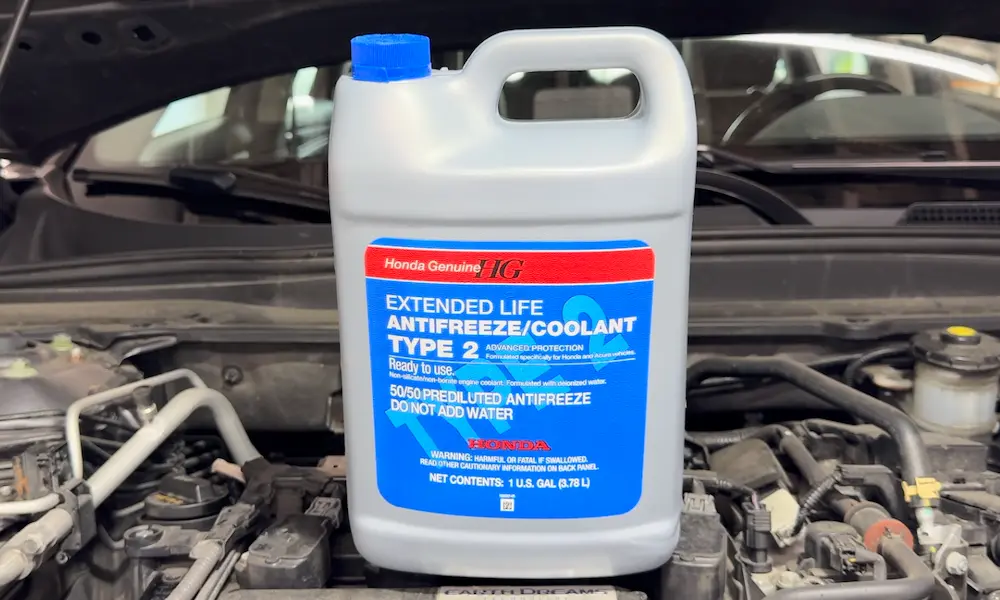
Honda coolant Type 2 isn’t just generic antifreeze in a fancy bottle. It’s a phosphate-enhanced organic acid technology (P-OAT) formula specifically engineered for Honda and Acura vehicles manufactured since the late 1990s.
The coolant comes pre-mixed at 50/50 with deionized water, so you don’t need to dilute it. You’ll recognize it by its distinctive blue color and packaging that clearly states “Do Not Add Water.”
What’s actually inside? The primary ingredients include ethylene glycol for freeze protection, diethylene glycol for enhanced performance, and phosphate-based organic acid inhibitors that fight corrosion. Honda also adds a bittering agent (over 30ppm) to discourage accidental ingestion.
The formula is manufactured by CCI Manufacturing IL Corporation in Lemont, Illinois, under contract with Honda. While Honda’s name is on the bottle, they don’t actually produce it themselves—a fact that becomes important when we talk about alternatives later.
Temperature Protection That Works Year-Round
Honda coolant Type 2 handles extreme temperatures without breaking a sweat. It boils at 265°F (129°C) and freezes at -34°F (-37°C), giving you reliable protection whether you’re dealing with Arizona summers or Minnesota winters.
This wide operating range meets or exceeds ASTM D3306 and SAE standards for automotive coolant performance. Translation? It’s been tested extensively and proven to work.
Here’s what sets it apart from older coolant formulations: it’s silicate-free, borate-free, amine-free, and nitrite-free. That chemistry is particularly important for aluminum engines (which most modern Hondas have). Silicates, for example, can form abrasive particles that damage water pump seals and other cooling system components over time.
Finding the Right Part Number
Honda coolant Type 2 has gone through several part number changes over the years. If you’re looking for it, here are the numbers you’ll see:
- OL999-9011 (original part number, now superseded)
- 08CLA-P99-0F0A8 (current primary part number)
- 08CLA-P99-0F0C8 (alternative packaging)
- 08CLA-G01-6S1 (international markets)
The packaging varies too. Gallon containers typically come in gray plastic bottles with blue caps, while quart sizes use blue plastic bottles with white caps. All legitimate Honda coolant clearly displays the “Type 2” designation.
When shopping at your local parts store or dealership, any of these part numbers will get you the same formula. The price, however, might vary significantly—which brings us to our next point.
How Long Does Honda Coolant Type 2 Last
One of the best features of Honda coolant Type 2 is its longevity. Honda’s official maintenance schedule specifies:
- Initial service: 120,000 miles or 10 years (whichever comes first)
- Subsequent services: Every 60,000 miles or 5 years after the initial change
You might notice the bottle says “5 years or 60,000 miles” and wonder about the discrepancy. That rating refers to replacement coolant, not the factory-installed fluid. The original coolant your Honda rolled off the assembly line with gets that extended 120,000-mile/10-year rating.
This is a massive improvement over traditional coolants that needed replacement every 30,000-50,000 miles. Even under severe service conditions, Honda doesn’t shorten these intervals—the advanced formula holds up remarkably well.
Official Equivalents and Cross-References
Here’s something most Honda owners don’t know: AISIN ACB003 is the OEM equivalent to Honda coolant Type 2. AISIN, a major Japanese automotive supplier, produces coolant for multiple manufacturers under various part numbers.
The same AISIN formula crosses to numerous OEM specifications:
| Manufacturer | Part Number |
|---|---|
| Honda/Acura | 0L999-9011 |
| Toyota/Scion | 00272-GTBC1 |
| Nissan/Infiniti | 999MP-L25500P |
| Subaru | SOA868V9270 |
| Mitsubishi | MZ320125 |
This cross-compatibility demonstrates how Japanese manufacturers have standardized phosphate-based OAT coolant formulations. It also means you can often find the same coolant under different brand names at different price points.
Can You Use Aftermarket Alternatives
Honda strongly recommends using genuine Type 2 coolant, but several aftermarket alternatives are chemically compatible. The key is knowing what to look for—and what to avoid.
What You Need in an Alternative
Any substitute must have these characteristics:
- Silicate-free formulation (critical for water pump protection)
- Phosphate-enhanced OAT technology
- Borate-free and amine-free composition
- Blue or clear coloring (never mix different colored coolants)
Acceptable Aftermarket Brands
These brands meet Honda’s specifications:
- Zerex Asian Blue (phosphate-based OAT)
- Prestone MAX Asian Vehicles Blue
- Peak Blue (Asian vehicle formulation)
- Pentofrost A3 (acceptable for emergency use)
What You Should Never Use
Don’t even think about using these in your Honda:
- Traditional green IAT coolants
- European HOAT coolants (they contain silicates)
- Dex-Cool or other orange OAT coolants
- Any coolant containing silicates or borates
Mixing incompatible coolant types can cause gel formation and system blockage. If you’re switching from one type to another, flush the system completely first.
How to Properly Change Honda Coolant
Changing coolant isn’t just about draining and refilling. Honda’s cooling systems need proper bleeding to prevent air pockets that cause overheating.
The Right Process
Start with a completely cool engine—never work on a hot cooling system. Remove the radiator cap and locate your drainage points.
Honda vehicles have three critical drainage points:
- Radiator drain plug (typically white plastic at the bottom of the radiator)
- Engine block drain bolt (19mm bolt with washer on the engine block)
- Coolant reservoir tank (should be drained or pumped out separately)
Many DIYers skip that engine block drain bolt and end up with an incomplete coolant change. Don’t make that mistake.
Once you’ve drained the system, install a no-spill funnel with the appropriate adapter for your specific Honda model. Fill the system slowly while watching for air bubbles.
Bleeding Air from the System
Here’s where proper technique matters. Run the engine with the heater on maximum heat until the cooling fans cycle multiple times. This helps push air pockets through the system.
Keep monitoring the coolant level and top off as air gets expelled. Some Honda models have bleeder valves on the cooling system—consult your service manual to locate them.
When reinstalling the engine block drain bolt, use a new washer and torque it to 44 ft-lbs. Reusing old washers often leads to leaks.
Honda Type 1 vs Type 2: Don’t Mix Them
If you’re working on an older Honda, you might encounter Type 1 (green) coolant. This was Honda’s traditional IAT formulation used in vehicles before the late 1990s.
Type 1 and Type 2 coolants should never be mixed. They use incompatible inhibitor packages that can react chemically and cause serious problems. If you’re converting from Type 1 to Type 2, you need to flush the entire system first.
This isn’t Honda being overly cautious—mixing these formulations can create gel-like substances that block cooling passages and damage components.
Working with Honda’s Temperature Sensor Systems
Honda coolant Type 2 is formulated to work optimally with Honda’s dual coolant temperature sensor systems. Many Honda vehicles use two separate sensors:
- ECT1: Primary sensor for engine management
- ECT2: Secondary sensor for fan control and diagnostics
Proper coolant chemistry ensures accurate sensor readings. Using the wrong coolant can affect electrical conductivity, leading to false temperature codes. You might think you’ve got a sensor failure when the issue is actually coolant-related.
If you’re troubleshooting coolant temperature sensor issues, verify you’re running the correct coolant type before replacing parts.
Cost Comparison: OEM vs Aftermarket
Honda coolant Type 2 typically costs $25-35 per gallon through dealerships. Aftermarket equivalents like AISIN ACB003 run $15-25 per gallon. That’s a significant price difference, especially if you’re doing a complete system flush.
When to Choose OEM
Stick with genuine Honda coolant if:
- Your vehicle is under warranty (some dealers scrutinize this)
- You want absolute certainty about compatibility
- The price difference doesn’t matter to you
When Aftermarket Makes Sense
Go with a quality aftermarket alternative when:
- You’re doing DIY maintenance and want to save money
- Your vehicle is out of warranty
- You’ve verified the product meets Honda’s specifications
A complete coolant change takes about 1.5 gallons for most Honda vehicles. At those quantities, you’re looking at saving $15-30 by choosing aftermarket—not huge, but it adds up over time.
Spotting Coolant Problems Before They’re Serious
Honda coolant Type 2 maintains its bright blue color throughout its service life when functioning properly. Color changes signal trouble.
Warning Signs
Watch for these indicators that your coolant needs replacement:
- Brown or rust color: indicates corrosion in the system
- Milky appearance: suggests oil contamination or head gasket issues
- Visible debris or particles: shows coolant breakdown
- Unusual odors: sweet smell is normal, but burnt or oily smells aren’t
Don’t wait until you see these signs. Follow Honda’s service intervals and you’ll avoid most coolant-related problems.
Common Cooling System Issues
Even with proper coolant, Honda owners sometimes experience cooling system problems. Here are the usual suspects:
Air Pockets
Improper bleeding during coolant service creates air pockets that prevent proper circulation. The engine overheats even though there’s plenty of coolant in the system.
Thermostat Malfunction
A stuck thermostat prevents coolant from circulating properly. This is a common failure point that’s often misdiagnosed as a coolant issue.
Water Pump Failure
Water pumps eventually wear out, but proper coolant maintenance extends their life significantly. The silicate-free formula in Honda coolant Type 2 is gentler on water pump seals than traditional coolants.
Sensor Failures
Coolant temperature sensor problems can cause incorrect engine management. Symptoms include poor fuel economy, rough idling, and check engine lights.
Understanding Coolant Testing
You don’t need to guess about coolant condition. Test strips are available that measure pH, freeze protection, and inhibitor levels.
Honda coolant Type 2 should maintain a pH between 7.5 and 11. If it drops below 7.5, the coolant has become acidic and is no longer protecting your engine properly.
You can also test freeze protection with an inexpensive hydrometer. The 50/50 pre-mix should protect to -34°F. If you’re getting different readings, something’s wrong—possibly coolant dilution from a leak.
What About “Universal” Coolants
You’ll see products marketed as “universal” or “works with all vehicles” coolants. Be skeptical. While some modern formulations claim broad compatibility, Honda’s phosphate-based chemistry is specific.
Universal coolants typically use different inhibitor packages than Honda coolant Type 2. Even if they don’t cause immediate problems, they might not provide the same long-term protection.
If you’re in an emergency situation and need to top off your coolant, using a small amount of distilled water is safer than adding incompatible coolant. Just get the proper coolant and do a complete change as soon as possible.
Fleet and Multi-Vehicle Considerations
If you maintain multiple Honda vehicles or run a fleet, buying AISIN ACB003 in bulk can provide substantial savings. The formula is identical to Honda’s specification but typically costs less.
Some fleet managers prefer stocking a single coolant type. If you’ve got both Honda and Toyota vehicles, AISIN ACB003 works for both, simplifying inventory management.
Storage and Handling
Unopened Honda coolant Type 2 has a shelf life of several years when stored properly. Keep it in a cool, dry place away from direct sunlight. Extreme temperature cycling can affect the formula over time.
Once opened, use the coolant within a year. The pre-mixed formula doesn’t go bad quickly, but exposure to air can affect the inhibitor package.
Always dispose of used coolant properly. It’s toxic to animals and the environment. Most auto parts stores and service centers accept used coolant for recycling.
DIY vs Professional Service
Changing Honda coolant is straightforward if you’re mechanically inclined, but proper bleeding technique is critical. If you’re not confident about removing air pockets from the system, professional service is worth considering.
The labor cost for a coolant change typically runs $100-150 at independent shops, less than half what dealers charge. If you’re buying your own AISIN ACB003 coolant and having a shop install it, you’re getting the best of both worlds—OEM-equivalent protection at aftermarket pricing.
Why This Matters for Your Honda
Your cooling system does more than prevent overheating. It also warms your cabin in winter, helps your engine reach optimal operating temperature quickly, and protects against corrosion.
Using the right coolant—whether genuine Honda Type 2 or a verified equivalent—ensures your cooling system performs all these functions properly for 120,000 miles or more.
The small investment in proper coolant pays dividends in reliability and longevity. It’s one of the easiest ways to protect your Honda’s engine and avoid expensive repairs down the road.