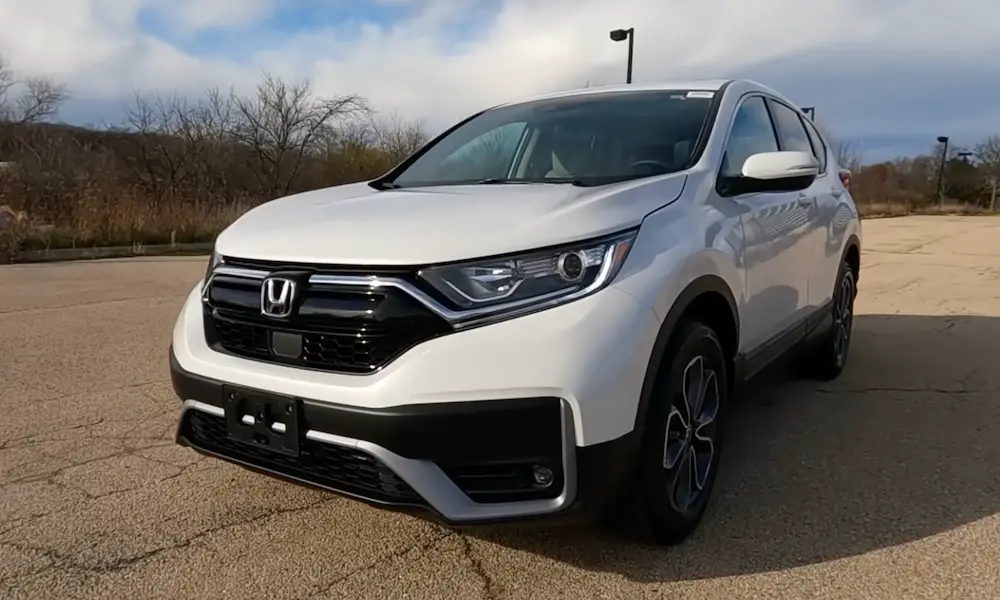
The Honda CR-V consistently ranks among America’s best-selling SUVs, with fuel economy being a major selling point. But how does the CR-V’s actual fuel mileage compare to its EPA ratings? Whether you’re considering the standard gasoline model or paying premium for the hybrid version, understanding real-world performance can save you thousands over your ownership period.
Let’s dig into what CR-V owners actually experience, when the hybrid is worth the extra cost, and how factors like driving style and weather affect your results.
Honda CR-V Fuel Economy Ratings: What Honda Promises
The current sixth-generation Honda CR-V (2023-2025) comes with two distinct powertrain options that define its fuel efficiency potential:
Gasoline Models (1.5L Turbo Engine)
- 2WD models (LX, EX, EX-L): 28 city/34 highway/30 combined MPG
- AWD models (LX, EX, EX-L): 27 city/32 highway/29 combined MPG
Hybrid Models (2.0L Two-Motor System)
- 2WD models (Sport, Sport-L): 43 city/36 highway/40 combined MPG
- AWD models (Sport, Sport-L, Sport Touring): 40 city/34 highway/37 combined MPG
The hybrid variants feature Honda’s sophisticated two-motor system paired with a 2.0-liter Atkinson-cycle engine, delivering a total of 204 horsepower. This setup is engineered to maximize efficiency in city driving, where the electric motors can handle more of the work.
All CR-V models come equipped with a 14-gallon fuel tank, giving the AWD hybrid models a theoretical range of approximately 518 miles between fill-ups based on combined EPA ratings.
Real-World CR-V Fuel Economy: What Owners Actually Experience
While EPA ratings provide a standardized benchmark, real-world performance often tells a different story. Here’s what professional testing and owner experiences reveal about the CR-V’s actual fuel economy:
The Highway Performance Gap
In Car and Driver’s standardized 75-mph highway test, the CR-V Hybrid AWD achieved only 31 MPG—3 MPG below its EPA highway rating. More surprisingly, the non-hybrid CR-V AWD also achieved 31 MPG in the same test.
This convergence in highway efficiency is significant—it suggests that at typical American highway speeds, the hybrid’s fuel economy advantage essentially disappears, despite costing thousands more.
City Driving: Where Hybrids Shine
In urban environments, the hybrid models generally perform much closer to their EPA ratings. Many owners report achieving 38-42 MPG in city driving when using gentle acceleration and maximizing regenerative braking. The hybrid system excels in stop-and-go traffic where it can:
- Operate in electric-only mode for short distances
- Capture energy through regenerative braking
- Minimize idling by shutting off the gas engine at stops
The Winter MPG Penalty
Perhaps the most significant finding from owner forums is the dramatic impact of cold weather on the CR-V Hybrid’s fuel economy. Numerous owners in northern climates report winter fuel economy dropping to the mid-to-high 20s MPG—a 25-30% reduction from warm weather performance.
This occurs because:
- Lithium-ion batteries are less efficient in cold temperatures
- The gas engine must run more frequently to generate cabin heat
- Cold engines generally operate less efficiently until warmed up
One owner from Chicago wrote: “My CR-V Hybrid averages 38-39 MPG in summer but drops to 26-27 MPG during winter months. That’s with identical commuting routes.”
Key Factors Affecting Your CR-V’s Fuel Economy
Your actual mileage will depend heavily on several factors:
1. Speed and Driving Style
The CR-V Hybrid’s efficiency drops noticeably at speeds above 70 mph. Aerodynamic drag increases exponentially with speed, requiring significantly more power to maintain higher velocities. Gentle acceleration and smooth driving can improve your results by 15% or more compared to aggressive driving.
2. Temperature and Climate Control
As mentioned earlier, cold weather significantly impacts hybrid efficiency. Using climate control aggressively (max A/C in summer or high heat in winter) can reduce fuel economy by 5-10%.
3. Trip Length and Type
Short trips under 5 miles prevent the engine from reaching optimal operating temperature and can reduce efficiency by 10-15%. The hybrid system provides maximum benefit in stop-and-go traffic and minimal advantage during steady highway cruising.
4. Vehicle Configuration
Adding roof racks, cargo boxes, or carrying heavy loads increases aerodynamic drag and weight, reducing fuel economy. CR-V owners report 2-3 MPG decreases when using roof-mounted accessories.
How CR-V Compares to Competitors
When comparing 2025 AWD models across the compact SUV segment, here’s how the CR-V stacks up:
| Model | City MPG | Highway MPG | Combined MPG |
|---|---|---|---|
| Honda CR-V (Gas) | 27 | 32 | 29 |
| Honda CR-V Hybrid | 40 | 34 | 37 |
| Toyota RAV4 (Gas) | 27 | 33 | 29 |
| Toyota RAV4 Hybrid | 41 | 38 | 39 |
| Hyundai Tucson (Gas) | 25 | 32 | 28 |
| Hyundai Tucson Hybrid | 38 | 38 | 38 |
| Mazda CX-5 (Gas) | 24 | 30 | 26 |
Key competitive insights:
- The Toyota RAV4 Hybrid holds a clear advantage with its 39 MPG combined rating versus the CR-V Hybrid’s 37 MPG
- The RAV4 Hybrid’s highway efficiency (38 MPG) significantly outperforms the CR-V Hybrid (34 MPG)
- The standard gasoline CR-V is slightly more efficient than most non-hybrid competitors
Maximizing Your CR-V’s Fuel Economy
Whether you own a CR-V or are considering one, these techniques can help you achieve the best possible fuel economy:
For All CR-V Models:
- Maintain proper tire pressure (check monthly)
- Remove unnecessary weight from your vehicle
- Use cruise control on highways to maintain steady speeds
- Avoid excessive idling
- Accelerate gradually and anticipate stops
For Hybrid Models:
- Use “B” mode (increased regenerative braking) in city driving
- Activate ECON mode for improved efficiency
- Monitor the power flow display to learn optimal driving techniques
- Pre-heat or pre-cool the cabin while plugged in when possible
Which CR-V Is Right For You? A Practical Guide
Based on this comprehensive analysis, here’s guidance for different types of drivers:
Urban/Suburban Commuters
If most of your driving is city and suburban with frequent stops, the CR-V Hybrid makes financial sense. You’ll likely achieve fuel economy close to the EPA city ratings, and the hybrid’s smooth, quiet operation adds to the experience.
Highway Commuters
If you primarily drive on highways at speeds of 70+ mph, the standard gasoline CR-V is likely your better option. The minimal highway efficiency difference between hybrid and non-hybrid models makes it difficult to justify the hybrid’s premium price through fuel savings alone.
Cold Climate Drivers
If you live in a region with harsh winters, approach the CR-V Hybrid with caution. The significant winter efficiency penalty may mean you’ll never recoup the price premium through fuel savings. Consider a standard gasoline CR-V or the Toyota RAV4 Hybrid, which some owners report handles cold weather more efficiently.
Mixed-Use Drivers
For those with varied driving patterns, calculate based on your typical mix. If more than half your miles are city driving, the hybrid likely makes sense. Otherwise, the standard model offers better value.
The Evolution of CR-V Fuel Economy
The CR-V’s efficiency has improved significantly since its introduction in 1997:
- First Generation (1997-2001): Achieved approximately 23 city/28 highway MPG with its 2.0L engine
- Second/Third Generations (2002-2011): Featured larger 2.4L engines with improved i-VTEC technology
- Fourth/Fifth Generations (2012-2022): Gradually improved efficiency with the fifth generation introducing the 1.5L turbocharged engine
- Hybrid Introduction (2020): The first CR-V Hybrid delivered 40 city/35 highway MPG (AWD)
- Current Generation (2023+): Features refined powertrains with improved city efficiency for hybrid models
This progression demonstrates Honda’s consistent commitment to improving the CR-V’s efficiency while maintaining its practical, family-friendly character.
The Bottom Line
The Honda CR-V offers competitive fuel economy in both its gasoline and hybrid variants, but real-world performance often differs from EPA ratings. The hybrid excels in city driving but loses much of its advantage on highways and in cold weather.
Before choosing between models, honestly assess your driving habits, local climate, and how long you plan to keep the vehicle. For many drivers, the standard gasoline CR-V delivers the best overall value when considering purchase price and real-world efficiency. However, for those with primarily urban driving patterns in moderate climates, the hybrid can deliver impressive efficiency that justifies its premium price.
Remember that driving style and maintenance have enormous impacts on your actual results—sometimes more than your choice of powertrain.