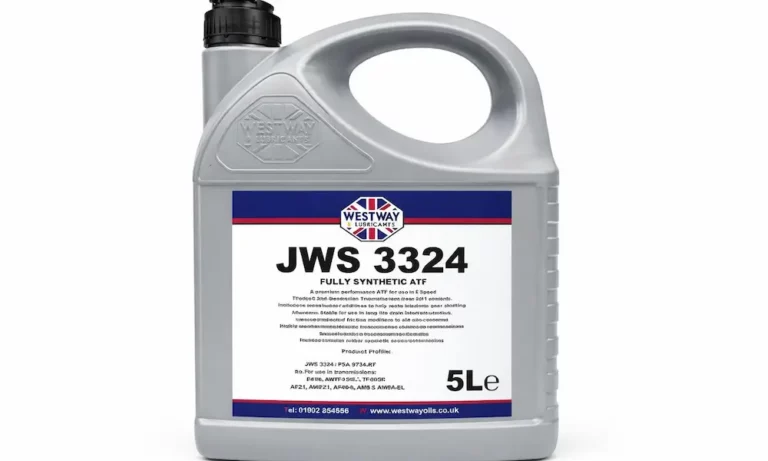
Searching for the right JWS 3324 equivalent can feel like decoding a secret language of part numbers and spec sheets. Use the wrong fluid, and you risk sluggish shifts, shudder, or worse — a damaged transmission. This guide breaks down every approved equivalent, the brands that meet the spec, and the mistakes you absolutely want to avoid.
What Is JWS 3324, Exactly?
JWS 3324 is a low-viscosity automatic transmission fluid specification created by Aisin Warner — the company behind many of the world’s most widely used automatic gearboxes. It’s the backbone of Toyota’s famous ATF World Standard (WS) fluid and supports Aisin’s 6-speed and 8-speed units like the TF-80SC and TG81SC.
What makes it special? It runs thin — really thin. We’re talking a kinematic viscosity of roughly 5.3 to 6.0 centistokes at 100°C, compared to older fluids that sat well above 7.0. That thinness cuts internal friction, improves fuel economy, and keeps modern slip-controlled lock-up clutches running smoothly.
It’s fully synthetic. It handles extreme cold starts and high-heat towing. And it carries a specific additive package that older fluids simply don’t have.
The JWS 3324 Equivalent by Brand: OEM Cross-Reference
If you’re looking at your owner’s manual and seeing a brand-specific name, here’s the translation. All of these fluids share the same JWS 3324 core specification.
Toyota and Lexus: ATF World Standard (WS)
Toyota was the first to roll out JWS 3324 commercially, calling it ATF World Standard or WS. It replaced the older Type T-IV around 2004. If you drive a Camry, RAV4, Corolla, Tundra, Tacoma, or most Lexus models, this is what you need.
Common Toyota WS part numbers:
- 08886-02305 — 4-liter canister
- 08886-81210 — 1-liter bottle
- 00289-ATFWS — 1-quart bottle
Toyota and Lexus hybrids that use a power-split device (e-CVT) also typically require WS-spec fluid for their internal gearsets and electric motor cooling.
Volvo: AW-1
Volvo’s AW-1 specification is functionally identical to JWS 3324. Volvo switched most models to AW-1 starting with the 2011 model year. The XC60, XC90, V70, S60, and V60 equipped with TF-80SC or TF-81SC transmissions all need this fluid.
Volvo part numbers: 31256774 and 31256775
General Motors, Vauxhall, and Opel: AW-1
GM uses Aisin Warner transmissions in many global platforms. Vehicles like the Vauxhall Insignia, Astra, and Zafira with the AF40-6 transmission specifically call for AW-1 — not just any Dexron VI fluid.
GM part numbers: 19256039 and 93165147
Ford: Premium ATF / Mercon LV
Ford’s JWS 3324 equivalent is usually listed as Premium Automatic Transmission Fluid. The part number to know is XT-8-QAW. Many aftermarket formulations also treat Mercon LV and JWS 3324 as compatible given their overlapping viscosity profiles.
Full OEM Cross-Reference Table
| Brand | Specification Name | Common Part Numbers |
|---|---|---|
| Toyota / Lexus | ATF World Standard (WS) | 08886-02305, 00289-ATFWS |
| Volvo | AW-1 | 31256774, 31256775 |
| General Motors | AW-1 / Dexron VI | 19256039, 93165147 |
| Ford | Premium ATF / Mercon LV | XT-8-QAW, XT-10-QLV |
| Saab | AW-1 | 93165147, 93165414 |
| BMW / Mini | ATF 3+ | 83 22 2 152 426 |
| Mazda | ATF FZ / ATF S-1 | 0000-FZ-113E-01 |
| Hyundai / Kia | SP-IV / SP-IV-RR | 00232-1904, 04500-00115 |
| Honda / Acura | ATF DW-1 | 08200-9008 |
| Mitsubishi | Diaqueen ATF-PA | MZ320261 |
Best Aftermarket JWS 3324 Equivalents
Don’t want to pay dealer prices? Good news — several aftermarket synthetics genuinely meet the spec.
Mobil ATF 3324
Mobil ATF 3324 is a dedicated, purpose-built fluid for JWS 3324 applications. It hits a kinematic viscosity of 5.3 cSt at 100°C, a Brookfield viscosity of 8,000 mPas at -40°C, and a viscosity index of 173. It’s not a multi-vehicle blend stretched thin across 30 specs — it’s made for this one job.
Pennzoil Platinum LV Multi-Vehicle ATF
Pennzoil Platinum LV holds GM Dexron VI and Ford Mercon LV approvals, but its technical data explicitly lists Toyota WS and JWS 3324 as covered applications. It runs 5.9 cSt at 100°C and performs well in cold-start conditions. Solid all-around choice.
Ravenol ATF T-WS Lifetime
German brand Ravenol goes deep on chemistry. Their ATF T-WS Lifetime uses hydrocrack and polyalphaolefin (PAO) base oils, which Ravenol claims gives it roughly twice the durability of standard ATFs. If you’re chasing a longer service interval, this is worth a look.
Valvoline MaxLife Multi-Vehicle ATF
Valvoline MaxLife explicitly lists Toyota WS and JWS 3324 compatibility. It’s a popular choice for high-mileage vehicles. Many technicians report it delivers a slightly firmer, more positive shift feel than factory Toyota WS — which isn’t a flaw, just a difference in tuning preference.
Castrol Transmax ATF/CVT Universal
Castrol’s Transmax Universal covers both traditional Aisin automatic transmissions and Toyota hybrid power-split units that call for WS fluid. Unusual range for one product.
Aisin ATF-0WS and Totachi ATF WS
Since Aisin builds the transmissions, their own ATF-0WS is often considered the factory-fill fluid — just sold under a different label. Totachi ATF WS is a fully synthetic alternative specifically targeting Aisin 6-speed systems, running 5.75 cSt at 100°C with a pour point of -51°C.
Technical Specs Side-by-Side
| Property | JWS 3324 Spec | Mobil ATF 3324 | Pennzoil Platinum LV | Totachi ATF WS |
|---|---|---|---|---|
| Viscosity at 40°C (cSt) | 23.0–28.0 | 23.0 | 25.0–29.0 | 27.97 |
| Viscosity at 100°C (cSt) | 5.3–6.0 | 5.3 | 5.9 | 5.75 |
| Viscosity Index | 154–178 | 173 | 160–170 | 154 |
| Brookfield at -40°C (mPas) | 8,000–10,200 | 8,000 | 10,000 | 9,500 |
| Pour Point (°C) | -45 to -53 | -50 | -48 | -51 |
| Flash Point (°C) | 175–210 | 175 | 190 | 200 |
What the Additive Package Actually Does
The base oil is only half the story. JWS 3324’s additive chemistry is what keeps modern transmissions from shuddering, leaking, or foaming.
- Friction modifiers — These ensure a smooth transition between clutch slip and full lockup. Without them, you get shudder — that rhythmic vibration during light acceleration that drives Toyota owners crazy
- Oxidation inhibitors — High-temp operation produces acids and sludge. These additives block that reaction and protect delicate solenoid valves
- Seal conditioners — Keep synthetic rubber seals pliable so they don’t shrink and leak
- Anti-foam agents — Spinning internal parts whip air into fluid. Foam is compressible, which means erratic shifts and poor lubrication — anti-foam agents collapse bubbles fast
- Corrosion inhibitors — Protect copper components and electrical systems from moisture damage
Fluid Maintenance: The “Lifetime” Fluid Myth
Your owner’s manual might say the fluid never needs changing. That’s not the full truth.
“Lifetime” typically means the warranty period or first 100,000 miles — not the actual life of the car. Three things degrade your fluid over time:
- Thermal breakdown — Towing, mountain driving, and summer heat oxidize even premium synthetics
- Particulate buildup — Clutch wear releases microscopic friction material into the fluid, which can clog hydraulic solenoids
- Additive depletion — Friction modifiers get consumed doing their job. Once they’re gone, shudder follows
Most experienced technicians recommend a fluid service every 60,000 to 100,000 miles. You can do a drain-and-fill (replacing only the 3–4 liters that drain from the pan) or a machine flush that replaces nearly the full volume. Repeat drain-and-fills are gentler on high-mileage transmissions.
Checking the Level Without a Dipstick
Most modern transmissions using JWS 3324 don’t have a dipstick. They use a check-bolt in the pan. Here’s the critical part: fluid level must be checked between 35°C and 45°C. Fluid expands significantly with heat, so checking it cold gives you a false reading. You need a scan tool to monitor the transmission temperature sensor in real time during the check.
Critical Mistakes to Avoid
Don’t Mix Up JWS 3309 and JWS 3324
These two specs look similar on paper but they’re not interchangeable. JWS 3309 (Toyota Type T-IV) is significantly thicker. Pour it into a modern 6-speed or 8-speed Aisin unit, and you’ll get sluggish shifts, reduced fuel economy, and possible fault codes as the transmission controller detects slow hydraulic response.
The reverse is also true — JWS 3324 in an older transmission designed for 3309 may not provide adequate film protection for the gear sets.
Keep JWS 3324 Away from CVT and DCT Units
Unless a multi-vehicle fluid’s data sheet explicitly lists CVT compatibility, don’t use JWS 3324 in a CVT or dual-clutch transmission. Toyota CVTs require a specialized FE fluid. Using WS fluid in a CVT causes belt or chain slippage — and that kind of damage isn’t cheap to fix.
Dark Fluid Isn’t Always Cause for Panic
Toyota WS fluid tends to darken quickly — sometimes turning dark maroon or near-black within 30,000 miles. That’s normal. The detergents are holding contaminants in suspension the way they’re supposed to. What you’re watching for instead: a burnt smell or visible metal flakes. Either of those signals a mechanical problem, not just old fluid.
Quick Summary: What You Actually Need to Know
- JWS 3324 equivalents include Toyota WS, Volvo AW-1, Ford Premium ATF, and GM AW-1 — they’re the same spec under different names
- Aftermarket options from Mobil, Pennzoil, Ravenol, Valvoline, and Castrol genuinely meet the spec — choose based on your service interval goals
- Never substitute JWS 3309 for JWS 3324 — viscosity mismatch causes real damage
- Check fluid level with a scan tool at 35–45°C — not with a cold engine and not with a dipstick that probably doesn’t exist
- Service every 60,000–100,000 miles regardless of what the “lifetime” label says