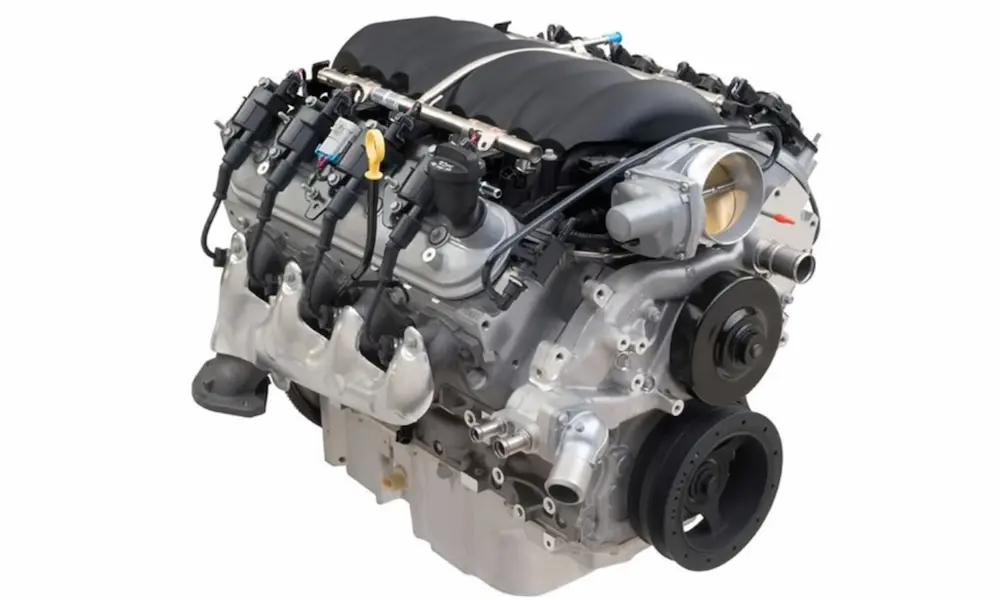
Getting LS engine torque specs wrong doesn’t just cost you time — it can cost you an engine. Whether you’re rebuilding a Gen III truck motor or assembling a track-ready Gen IV, the difference between a tight engine and a blown one often comes down to a few degrees of rotation. This guide covers every critical fastener, sequence, and spec you need to get it right the first time.
Why LS Engine Torque Specs Are Different From Older Engines
The LS isn’t your grandfather’s small-block. When GM introduced the LS family in 1997, they moved away from traditional friction-based torque methods and toward torque-to-yield (TTY) and torque-plus-angle fastening. This shift was driven by the deep-skirt block design and six-bolt main caps that define the LS architecture.
TTY bolts stretch into their plastic deformation range during installation. That stretch creates a consistent clamping load that thread friction alone can’t match. The catch? Once stretched, they’re done. TTY fasteners are single-use only — toss them after removal, no exceptions.
You’ll also need a digital torque-angle wrench. A standard click wrench won’t cut it here.
Main Bearing Cap Torque Specs
The six-bolt main cap system is one of the LS’s biggest structural advantages. Four vertical bolts plus two lateral side bolts per cap lock everything into the block’s skirt, turning the caps into part of the block itself.
The sequence matters as much as the numbers. Fully torque the vertical fasteners before you even touch the side bolts. Installing side bolts early pulls the cap out of alignment.
| Fastener Location | Pass | Spec |
|---|---|---|
| Inner Main Cap Bolts (M10/M11) | First Pass | 15 lb-ft |
| Inner Main Cap Bolts (M10/M11) | Final Pass | +80° |
| Outer Main Cap Studs/Bolts | First Pass | 15 lb-ft |
| Outer Main Cap Studs/Bolts | Final Pass | +53° |
| Side Main Cap Bolts (M8) | Final Pass | 18 lb-ft |
One thing worth knowing: the crankshaft may feel stiff after the vertical bolts are torqued. That’s normal. The side bolts complete the final bore geometry, and the crank will spin freely once they’re in.
For iron block variants like the LM7 and LQ4, the outer stud final angle drops to 51° instead of 53°. Small difference, but it matters. High-performance engines like the LS7 and LS9 use billet steel main caps with dowel pins for precise alignment — those require their own specific hardware and protocols per the GM service manual.
Connecting Rod Bolt Torque Specs
Rod bolts live in one of the harshest environments in the engine. They’re fighting reciprocating forces thousands of times per minute, so getting the tension right is non-negotiable.
The LS family used two main rod bolt designs over its production run, and they don’t share the same specs:
| Rod Bolt Type | ID | First Pass | Final Pass |
|---|---|---|---|
| First Design | No retaining sleeve (1997–1999) | 15 lb-ft | +60° |
| Second Design | Standard with sleeve | 15 lb-ft | +85° |
| Titanium Rods (LS7/LS9) | Lightweight ~464g | Refer to model year service manual | Refer to model year service manual |
For serious builds, many professional builders skip the angle method entirely on rod bolts and use a bolt stretch gauge instead. Measuring actual bolt elongation removes thread friction and lubricant variables from the equation — it’s the most accurate way to confirm proper tension.
Harmonic Balancer Torque Specs
The LS balancer is a press-fit on a keyless crank snout. This trips up a lot of builders. Never use the balancer bolt to pull the balancer onto the crank — you’ll strip the internal threads and ruin the snout. Use a proper installation tool to press it home first, then install the bolt.
The process uses an old bolt for seating, then a new bolt for final assembly:
| Step | Pass | Spec |
|---|---|---|
| Seating Pass | Old bolt | 240 lb-ft |
| Final Assembly | Pass 1 (new bolt) | 37 lb-ft |
| Final Assembly | Final Angle | +140° |
Late Gen IV engines add another wrinkle — the balancer bolt comes in two designs, and they don’t use the same final angle:
| Bolt Design | Initial | Loosen | Secondary | Final |
|---|---|---|---|---|
| Solid Flanged Head | 89 lb-ft | 360° | 59 lb-ft | +125° |
| Rotating Washer | 89 lb-ft | 360° | 59 lb-ft | +200° |
Check your bolt design before you start. Getting this wrong means pulling the balancer back off.
Cylinder Head Torque Specs and the 2004 Block Change
This is where most LS builds go sideways. In 2004, GM changed the cylinder head bolt design from a staggered-length system to uniform-length bolts. The specs are not interchangeable, and using the wrong angle on the wrong block can mean a blown head gasket.
Identify your block year before you touch a head bolt.
| Block Style | Position | Pass 1 | Pass 2 | Final |
|---|---|---|---|---|
| Pre-2004 | M11 Long (155.5mm) | 22 lb-ft | 90° | 90° |
| Pre-2004 | M11 Short (101mm) | 22 lb-ft | 90° | 50° |
| 2004+ / Gen IV | M11 (All, uniform) | 22 lb-ft | 90° | 70° |
| All LS Variants | M8 Top Row | — | — | 22 lb-ft |
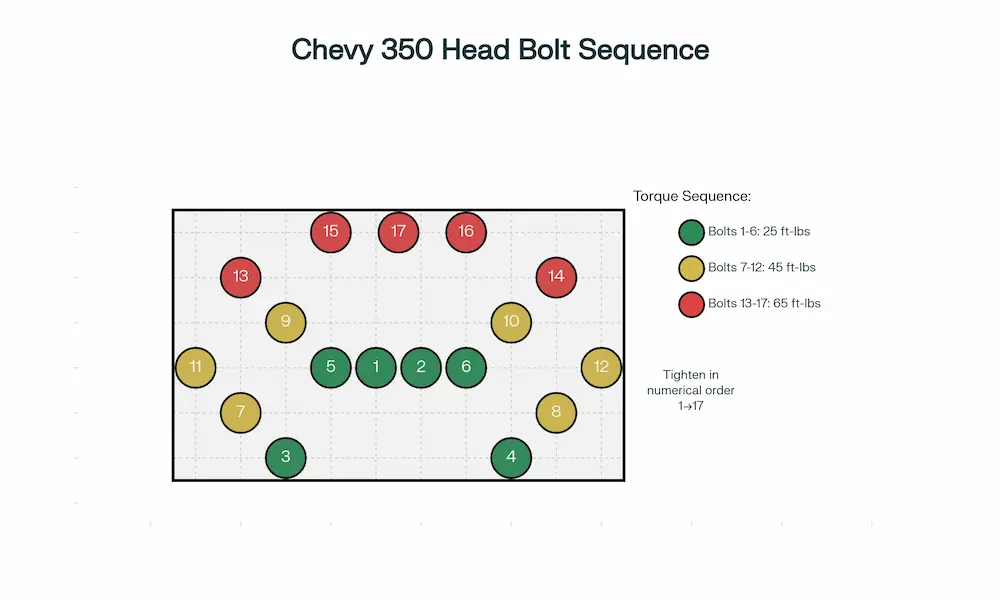
Always torque from the center outward in a circular pattern. The LS uses Multi-Layer Steel (MLS) head gaskets that need uniform clamping to seal properly. TTY head bolts act like stiff springs, maintaining that seal through heat cycles as aluminum heads and iron blocks expand at different rates. Reusing them kills that spring effect — don’t do it.
The LS9 steps things up further with M12 head fasteners to handle supercharged cylinder pressures. Those specs live in the LS9-specific service documentation.
Valvetrain and Camshaft Torque Specs
The LS valvetrain is a non-adjustable pedestal-mount system. Torque values here directly set lifter preload, so there’s no room for guessing.
| Component | Spec |
|---|---|
| Camshaft Retainer Plate (Standard) | 18 lb-ft |
| Camshaft Retainer Plate (Countersunk) | 11 lb-ft |
| Camshaft Sprocket (3-Bolt) | 26 lb-ft |
| Camshaft Sprocket (Single Bolt, Pass 1) | 55 lb-ft |
| Camshaft Sprocket (Single Bolt, Pass 2) | +50° |
| Rocker Arm Bolts (M8) | 22 lb-ft |
| Valve Cover Bolts (M6) | 106 lb-in |
| Lifter Guide Trays (M6) | 106 lb-in |
Use thread-locking compound on the cam retainer plate bolts. They’re a known failure point if they back out during operation. Also note the unit difference — valve covers and lifter trays are in inch-pounds, not foot-pounds. Over-tightening those small M6 fasteners in aluminum heads strips threads fast, and a thread insert repair isn’t cheap.
When installing rocker arms, confirm the cylinder is on the base circle of the cam (valve fully closed) before torquing. Tightening a rocker on an open valve damages the pushrod and lifter.
Gen IV VVT engines use a single large cam phaser bolt that’s also a TTY fastener. Replace it every time.
Intake and Exhaust Manifold Torque Specs
The composite intake manifold is efficient but fragile. Over-tightening cracks it. Always work center-out to compress the rubber port seals evenly.
| Intake Step | Spec |
|---|---|
| First Pass | 44 lb-in |
| Final Pass | 89 lb-in |
Exhaust manifold bolts deal with extreme temperature swings. The final torque is modest at 18 lb-ft, but the two-pass sequence keeps the manifold seated square against the head. Many builders re-check these after a few heat cycles.
| Exhaust Fastener | Pass | Spec |
|---|---|---|
| Manifold to Head | First Pass | 11 lb-ft |
| Manifold to Head | Final Pass | 18 lb-ft |
| Heat Shield Bolts (M6) | Single Pass | 80 lb-in |
Oil Pan, Covers, and Structural Components
The LS oil pan isn’t just a fluid reservoir — it’s a structural member. It stiffens the block assembly and provides a transmission bellhousing mounting surface. When installing it, the rear face must be perfectly flush with the block to avoid transmission misalignment.
| Component | Fastener | Spec |
|---|---|---|
| Oil Pan to Block/Front | M8 | 18 lb-ft |
| Oil Pan to Rear Cover | M6 | 106 lb-in |
| Front Timing Cover | M8 | 18 lb-ft |
| Rear Main Seal Cover | M8 | 18 lb-ft |
| Valley Cover | M8 | 18 lb-ft |
Flywheel, Flexplate, and Torque Converter Specs
Standard LS engines use a 6-bolt crank flange. The LSA and LS9 step up to 8 or 9-bolt patterns to handle their higher output. All flywheel and flexplate installations use a three-pass star pattern:
| Component | Pass 1 | Pass 2 | Final |
|---|---|---|---|
| Flywheel (Manual) | 15 lb-ft | 37 lb-ft | 74 lb-ft |
| Flexplate (Auto) | 15 lb-ft | 37 lb-ft | 74 lb-ft |
| Torque Converter | — | — | 44 lb-ft |
Some Gen IV automatic applications use a torque-plus-angle method on flexplate bolts (22 lb-ft + 45°). Confirm your specific transmission before assembly, since flexplate thickness and converter bolt patterns vary.
Sensor and Spark Plug Torque Specs
LS sensors are fragile. Strip the threads in the block and you’ve got a much bigger problem than a loose sensor.
| Sensor | Location | Spec |
|---|---|---|
| Knock Sensors | Valley or Block Side | 15 lb-ft |
| Camshaft Sensor | Front Cover or Rear | 18 lb-ft |
| Crankshaft Sensor | Rear Block Side | 18 lb-ft |
| Oil Pressure Sensor | Rear Valley | 26 lb-ft |
| Coolant Temp Sensor | Head Side | 15 lb-ft |
For spark plugs, aluminum heads are unforgiving. NGK recommends installing plugs only in a cold engine — hot metal expands and makes thread damage far more likely during both removal and installation.
| Condition | Spec |
|---|---|
| Spark Plugs (Dry) | 11 lb-ft |
| Spark Plugs (Maximum) | 15 lb-ft |
| Alternative Method | Hand tight + 1/12 turn |
Skip the anti-seize unless the plug manufacturer specifically calls for it. It acts as a lubricant and makes it easy to accidentally over-torque past the 15 lb-ft ceiling.
Aftermarket Fasteners: ARP and High-Tensile Hardware
Swapping to ARP or similar high-tensile fasteners gives you reusability and higher clamping potential — but the specs are completely different from OEM TTY values. Don’t mix them up.
| Application | Aftermarket (with lube) | OEM TTY |
|---|---|---|
| Main Cap Inner | 60 lb-ft | 15 lb-ft + 80° |
| Main Cap Outer | 50 lb-ft | 15 lb-ft + 53° |
| Head Studs (11mm) | 80 lb-ft (3 steps) | 22 lb-ft + 90° + 70° |
| Rod Bolts (7/16″) | 80 lb-ft (or stretch) | 15 lb-ft + 85° |
Aftermarket specs depend heavily on the lubricant used. A moly-based assembly lube can reduce required torque by up to 50% compared to a dry fastener while hitting the same clamping force. Always follow the fastener manufacturer’s lube recommendation — don’t substitute.
The LS engine rewards precision. Every spec in this guide exists because the engineering demands it, not because someone picked a number. Use the right tools, replace TTY fasteners every time, and confirm your block year before touching the head bolts. Do that, and you’ve got a foundation that’ll hold up to whatever you throw at it.