Your transmission is acting up, and you’re not sure which fluid to grab off the shelf. There are a dozen bottles staring back at you, and half of them claim to work in everything. This post breaks down the best Mercon LV equivalent options available right now — what’s licensed, what works, and what to avoid. Stick around to the end before you pour anything in.
What Is Mercon LV and Why Does It Matter?
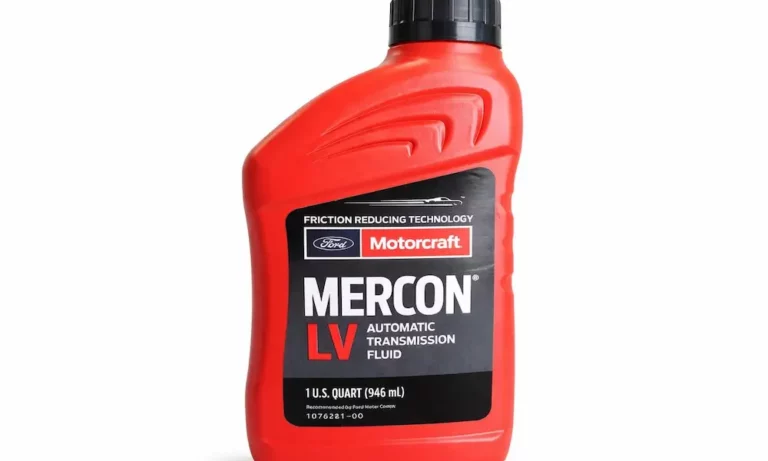
Mercon LV stands for Mercon Low Viscosity. Ford introduced it to meet tighter fuel economy standards and the demands of modern electronically controlled transmissions. It’s thinner than older fluids, which helps electronic solenoids respond faster and reduces the energy needed to push fluid through the hydraulic system.
According to Motorcraft’s official product page, Mercon LV is the factory-specified fluid for many Ford, Lincoln, and Mercury vehicles. It’s also used in transfer cases and post-2012 power steering systems on select Ford models.
Use the wrong fluid, and you’ll deal with harsh shifts, slipping, or worse — a ruined transmission.
The Key Numbers You Need to Know
Before grabbing any Mercon LV equivalent, understand what the original fluid actually looks like technically. These specs, pulled from the official Motorcraft product data sheet, set the benchmark.
| Property | Test Method | Motorcraft Value |
|---|---|---|
| Kinematic Viscosity at 100°C | ASTM D445 | 6.0 cSt |
| Kinematic Viscosity at 40°C | ASTM D445 | 29.6 cSt |
| Viscosity Index | ASTM D2270 | 155 |
| Pour Point | ASTM D97 | Below -48°C |
| Flash Point | ASTM D92 | 216°C |
| Brookfield Viscosity at -40°C | ASTM D2983 | 10,200 cP |
Any legitimate Mercon LV equivalent should land close to these numbers — especially the kinematic viscosity at 100°C. That 6.0 cSt figure is what separates Mercon LV from older, thicker fluids like Mercon V.
Licensed vs. “Suitable for Use” — What’s the Difference?
This is where most people get confused. Ford runs a formal licensing program. A fluid with an MLV license number has gone through Ford’s internal validation and passed standardized testing. A “suitable for use” (SFU) product means the manufacturer tested it independently and believes it meets the spec — but hasn’t obtained official certification.
Why does this matter?
- Licensed fluids protect your factory powertrain warranty
- SFU fluids can still perform excellently — especially for out-of-warranty vehicles
- Neither is automatically better in terms of real-world protection
Think of it this way: a licensed fluid gives you paperwork. An SFU fluid might give you slightly better performance in specific conditions but without the official stamp.
The Best Licensed Mercon LV Equivalents
Castrol Transmax Full Synthetic Multi-Vehicle ATF
Castrol holds dual licensing for both Ford Mercon LV and GM Dexron VI. The Transmax Full Synthetic delivers a kinematic viscosity of 5.9 cSt at 100°C, a viscosity index of 161, and a pour point of -54°C — beating the Motorcraft baseline on cold-weather performance.
Castrol’s “smooth drive technology” focuses on keeping friction modifier properties stable over time, which directly fights shift shudder. If you’ve ever felt your Ford shake slightly during light throttle highway cruising, degraded friction modifiers are often the culprit.
Chevron Havoline Full Synthetic Multi-Vehicle ATF
Havoline carries license number MLV190802 and is one of the cleanest technical matches to the Motorcraft spec. It hits 6.0 cSt at 100°C and 30.0 cSt at 40°C — essentially identical to the factory fluid.
Its shear-stable viscosity modifier package means the fluid stays within spec even after miles of hard use. Shear degradation — where the long polymer chains in viscosity modifiers get torn apart under pressure — is a real problem in high-gear-count transmissions. Havoline’s formulation resists this well.
Pennzoil Platinum LV Multi-Vehicle ATF
Shell’s Pennzoil division offers this fluid as its licensed Mercon LV equivalent. The product data sheet highlights exceptional oxidation resistance as its standout trait.
Oxidation builds sludge. Sludge clogs hydraulic passages. Clogged passages cause erratic shifting and, eventually, total transmission failure. Pennzoil’s fully synthetic base oils resist oxidation longer than conventional alternatives, making this a strong pick for vehicles operating in hot climates or doing regular highway miles.
Comparative Physical Properties — Licensed Equivalents
| Product | Viscosity at 100°C | Viscosity at 40°C | Viscosity Index | Pour Point |
|---|---|---|---|---|
| Motorcraft Mercon LV | 6.0 cSt | 29.6 cSt | 155 | -48°C |
| Castrol Transmax FS | 5.9 cSt | 30.2 cSt | 161 | -54°C |
| Havoline Multi-Vehicle | 6.0 cSt | 30.0 cSt | 160 | -51°C |
| Service Pro FS | 5.8 cSt | 29.1 cSt | 148 | -54°C |
| Performance Plus FS | 5.9 cSt | 28.7 cSt | 154 | N/A |
All of these stay within roughly 2% of the Motorcraft baseline for operating viscosity — which is exactly what you want.
The Best Non-Licensed (Suitable for Use) Equivalents
Valvoline MaxLife Multi-Vehicle ATF
Valvoline doesn’t hold an official Ford license for MaxLife, but its technical documentation confirms independent testing against the Mercon LV performance requirements. What sets MaxLife apart is its seal conditioner package.
Seals harden as they age. Hardened seals crack. Cracked seals leak. Valvoline’s conditioners restore elasticity to rubber seals and gaskets, making this one of the best options for high-mileage transmissions. If your Ford has north of 75,000 miles, MaxLife deserves serious consideration.
Amsoil Signature Series Fuel-Efficient Synthetic ATF
Amsoil targets the enthusiast and severe-duty crowd. Its Signature Series product sheet recommends this fluid for Mercon LV, Mercon SP, and even the newer Mercon ULV applications. Amsoil claims their synthetic base oils can handle double the manufacturer’s severe-service drain intervals.
For towing, that matters. Transmission temps frequently exceed 200°F under heavy load, and fluid oxidation rate doubles for every 20°F increase above that baseline. Amsoil’s robust additive chemistry is built for exactly this kind of punishment.
Mobil Multi-Vehicle ATF
ExxonMobil offers a solid mid-range option with their Mobil Multi-Vehicle ATF. It’s a reliable daily driver fluid with strong shift consistency and decent wear protection. For the premium tier, Mobil 1 Synthetic LV ATF HP steps up with low-temperature fluidity down to -61°C — impressive for anyone dealing with harsh winter driving.
Retail House Brands Worth Considering
Walmart Super Tech Dexron VI/Mercon LV
Here’s the one that surprises people. Super Tech isn’t just “suitable for use” — it’s a fully licensed product. That’s rare for a house brand and makes it one of the best value options in the entire market.
At around $6–$7 per quart, Super Tech provides the same fundamental warranty protection as Motorcraft or Castrol at roughly half the price. For budget-conscious DIY maintenance, it’s hard to argue against.
Advance Auto Parts and AutoZone Options
Advance Auto Parts carries Carquest Multi-Vehicle ATF for Mercon LV applications, plus Motorcraft Mercon LV direct from their shelves. AutoZone stocks Valvoline Dexron VI/Mercon LV alongside STP Multi-Vehicle ATF. These stores give you the full spectrum — OEM, licensed, and SFU — all under one roof.
Professional and Specialty-Grade Options
For shops handling fleet vehicles or severe-duty applications, a few professional brands stand out.
| Brand | License Number | Key Strength |
|---|---|---|
| Schaeffer #205A | MLV150202 | Low volatility, exceptional film strength |
| Service Pro FS | MLV200503 | Multi-vehicle, high-performance focus |
| Performance Plus FS | MLV160802 | Copper corrosion and sludge protection |
| Kendall VersaTrans LV | MLV140201 | Frictional durability for smooth lock-ups |
Schaeffer’s formulation is particularly strong on film strength — critical for protecting precision gears and hydraulic pumps from metal-to-metal contact. Kendall VersaTrans LV is a proven performer in fleet environments that need consistent torque transfer through clutch packs.
What You Must Never Mix With Mercon LV
This section could save your transmission. Mercon LV is not interchangeable with these:
- Mercon V — It’s high-viscosity. Using LV in a Mercon V transmission causes clutch slipping. Using Mercon V in an LV transmission overloads the solenoids.
- Mercon ULV — Ultra-Low Viscosity is even thinner than LV. They don’t swap.
- Type F — No friction modifiers at all. Incompatible with modern transmissions.
- CVT Fluid — Completely different friction profile. Don’t do it.
- Dual-Clutch Transmission Fluid — DCTs need specialized fluid. Mercon LV won’t cut it.
| Spec | Compatible With Mercon LV? |
|---|---|
| Mercon V | No |
| Mercon SP | No |
| Mercon ULV | No |
| Type F | No |
| CVT Fluid | No |
Check your owner’s manual before you buy anything. If it says Mercon LV, you need Mercon LV — not something close.
Which Fluid Should You Actually Buy?
Your choice depends on one thing: your situation.
Still under factory warranty?
Go licensed. Motorcraft, Castrol Transmax, Havoline Full Synthetic, or Pennzoil Platinum LV. Any of these protect your warranty and match the spec precisely.
High-mileage vehicle (75,000+ miles)?
Valvoline MaxLife or Mobil Multi-Vehicle ATF. The seal conditioners in MaxLife alone can justify the choice for aging transmissions showing any early signs of slipping or minor leaks.
Towing, hauling, or severe-duty use?
Amsoil Signature Series or Schaeffer #205A. Both are engineered to handle sustained high temperatures without breaking down.
Budget-conscious DIY?
Super Tech from Walmart. It’s licensed, it works, and it won’t break the bank. There’s no shame in it — the specs back it up.
Whatever you choose, keep the fluid red (all proper Mercon LV equivalents are dyed red), check your level regularly, and stick to your service intervals. The fluid is only as good as the maintenance habits behind it.