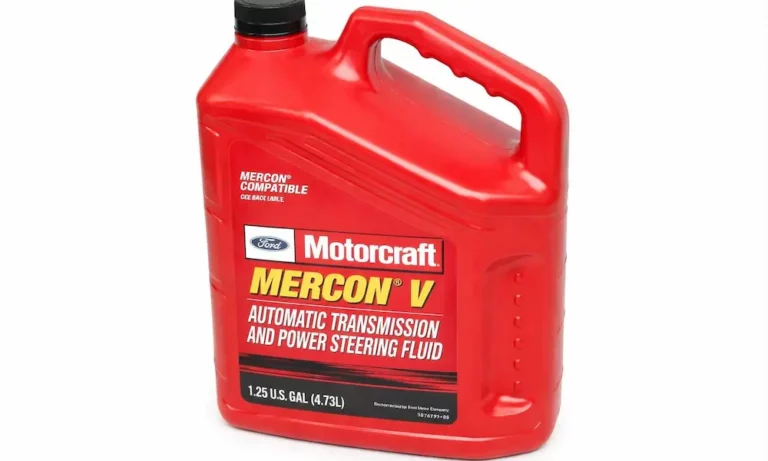
Picking the wrong transmission fluid can quietly destroy your gearbox — and it often happens because someone grabbed a bottle that looked right but wasn’t. This guide breaks down every major Mercon V equivalent on the market, explains what makes them different, and helps you avoid the costly mistakes that trip up even experienced DIYers. Stick around — the transfer case section alone could save you a serious repair bill.
What Exactly Is Mercon V?
Mercon V is Ford’s automatic transmission fluid specification, introduced in 1996 to handle the demands of newer electronically controlled gearboxes. It replaced the original Mercon standard, and Ford officially killed the original Mercon license on July 1, 2007.
Since then, Mercon V has become the approved fluid for nearly every Ford, Lincoln, and Mercury automatic transmission built between 1987 and the mid-2000s.
The benchmark product is Motorcraft Mercon V (XT-5-QM) — a synthetic blend using hydroprocessed base oils with an additive package that fights wear, foam, sludge, and varnish.
Here’s why its physical properties matter:
| Property | Motorcraft Mercon V Value |
|---|---|
| Viscosity Index | 205 |
| Kinematic Viscosity at 100°C | 7.5 cSt |
| Pour Point | Below -48°C (-54°F) |
| Flash Point | 196°C (385°F) |
| Brookfield Viscosity at -40°C | 10,000 cSt |
That viscosity index of 205 means the fluid stays stable whether you’re driving in Minnesota in January or Arizona in August. The pour point below -48°C ensures the fluid stays pumpable on cold starts — protecting your transmission before it even warms up.
The Friction Modification That Changed Everything
The biggest leap Mercon V made over older fluids was its friction modification system. Modern torque converter clutches need to slip slightly — it smooths out shifts and improves fuel economy. Older ATFs caused these clutches to grab and release rapidly, which drivers felt as a shudder or vibration while cruising.
Mercon V’s additive package specifically targets this problem. It keeps frictional properties stable as the fluid ages, which means smooth shifts for the life of the service interval — not just when the fluid is fresh.
The fluid is dyed red, making it easy to spot transmission leaks versus an engine oil drip or coolant trail.
Mercon V vs. Original Mercon: What Changed?
Ford’s original Mercon specification launched in January 1987. For years, it ran alongside General Motors’ Dexron-III, and manufacturers sold “Dex/Merc” dual-use products that handled both.
Mercon V changed that equation. Early bottles of Mercon V actually carried warnings against mixing it with original Mercon — the early formula wasn’t compatible with older seal materials. If you owned a late-1990s or early-2000s Ford, you probably saw that warning in your owner’s manual.
By 2007, Ford reformulated Mercon V to address the compatibility issue. Today, Mercon V is fully backward compatible for any Ford automatic transmission that previously ran on original Mercon. Ford’s Technical Service Bulletin 06-14-04 made it official.
The Best Mercon V Equivalents on the Market
Motorcraft Mercon V — The OEM Standard
This is the fluid Ford engineers actually designed the specification around. It’s a synthetic blend, it meets every requirement out of the box, and there’s no guesswork about compatibility. For anyone who wants zero uncertainty, Motorcraft is the default choice.
Valvoline Mercon V ATF — Best for Everyday Drivers
Valvoline consistently ranks as the top-selling ATF brand in the US, and their Mercon V formula earns it. Their anti-shudder additive package holds up as the fluid ages — not just when it’s fresh out of the bottle.
Valvoline Mercon V also covers Ford, Lincoln, Mercury, most pre-2006 GM vehicles, and several Nissan applications (Matic D, J, and K), making it a versatile option if you’re maintaining multiple vehicles.
Mobil 1 Synthetic ATF — Best for Extreme Conditions
ExxonMobil offers two Mercon V options. The Mobil Multi-Vehicle ATF carries the official Mercon V license. The Mobil 1 Synthetic ATF is a step up — full synthetic, with a flash point of 220°C and a pour point of -51°C.
Compare the two side by side:
| Property | Motorcraft Mercon V | Mobil 1 Synthetic ATF |
|---|---|---|
| Viscosity Index | 205 | 176 |
| Flash Point | 196°C | 220°C |
| Pour Point | Below -48°C | -51°C |
| Kinematic Viscosity at 100°C | 7.5 cSt | 7.4 cSt |
Mobil 1’s lower viscosity index means slightly more viscosity change across temperature swings, but its superior flash point and pour point make it the stronger choice for towing, track use, or extreme climates.
Castrol Transmax Mercon V — Best for Classic Fords
Castrol Transmax Mercon V holds Ford certification for both Mercon and Mercon V applications, making it a popular choice for older trucks and classic cars. Its “enhanced friction durability” claim means the shifting quality holds up across the full service interval — not just at first fill.
Red Line D4 ATF — Best for Performance Vehicles
Red Line D4 ATF is a full synthetic that meets Mercon V standards while also delivering GL-4 gear protection. That dual rating makes it outstanding for manual transmissions that share fluid with gears, and for any performance application where varnish buildup from heat is a concern.
Red Line also covers a wide range of imports — BMW, Audi, Volkswagen, Toyota, and Honda — making it one of the most versatile options on this list.
Value Options: Retail House Brands
Super Tech (Walmart) — Best Budget Pick
Super Tech Mercon V meets the same Ford spec as the premium brands but costs significantly less. For high-mileage vehicles needing a full flush — which can use 12 to 16 quarts — that price difference adds up fast. It’s a legitimate option when the specification is confirmed and budget matters.
STP Full Synthetic (AutoZone) — Best Multi-Vehicle Value
The STP Mercon V from AutoZone is a full synthetic multi-vehicle fluid covering an impressive range of applications beyond Ford:
| Application | Compatibility |
|---|---|
| Ford (Mercon V) | XT-5-QM, XT-5-DM |
| Honda | DW-1, Z-1 |
| Nissan | Matic-D, J, K, 402 |
| Toyota | T-II, T-III, T-IV, WS |
| BMW | 7045E, LA2634, LT71141 |
| Volkswagen | G 052 162, 055 025 A2 |
| Allison | C-4, TES-389 |
This breadth makes STP Mercon V a strong choice for households with multiple vehicles across different brands.
NAPA, Carquest, and O’Reilly MasterChem
NAPA offers two tiers — a conventional Premium and a full synthetic Premium Performance. The full synthetic variant handles a wide compatibility list including Acura, BMW, Chevrolet, and nearly every Ford truck from the early 2000s.
Carquest CQ450 emphasizes oxidation stability and smooth shifting. O’Reilly’s MasterChem line is full synthetic, targeting both older transmissions and modern anti-shudder requirements.
Mercon V Beyond the Transmission
Power Steering Systems
Ford recommended Mercon V for power steering systems in vehicles built after 1998. In this role, the fluid’s cold-weather fluidity prevents steering whine on winter mornings, while its thermal stability protects the pump under engine bay heat. Motorcraft even sells a dedicated 12-ounce version (XL-14) specifically labeled for Mercon V power steering applications.
Manual Transmissions
Mercon V’s shear stability — its ability to hold viscosity under gear grinding — makes it the required fluid for specific Ford manual gearboxes. These include the Mustang’s G1 manual and the F/E-Series trucks with TR 3650 and ZF S5-47 transmissions. It provides wear protection for gears and bearings while allowing smooth synchronizer engagement.
The Transfer Case Trap: Don’t Make This Mistake
This is where people damage expensive hardware. Despite Mercon V’s wide compatibility, you cannot use it in Ford transfer cases. The friction modifiers in Mercon V are not compatible with the internal clutch packs and chains in most Ford transfer cases. Using it there will cause mechanical failure.
After the original Mercon was discontinued, Ford introduced Motorcraft XL-12 Transfer Case Fluid for chain-driven transfer cases. Then in May 2019, Ford discontinued XL-12 and made Mercon LV the official transfer case fluid replacement.
Here’s the complete fluid map:
| Component | Correct Fluid | Do Not Use |
|---|---|---|
| Automatic Transmission (Pre-2007) | Mercon V | Mercon LV, Type F |
| Automatic Transmission (Post-2007) | Mercon LV / SP / ULV | Mercon V |
| Power Steering (Post-1998) | Mercon V | Type F |
| Manual Transmissions (ZF, Tremec) | Mercon V | Mercon LV |
| Transfer Cases | Mercon LV (replaced XL-12) | Mercon V |
Mercon V and Mercon LV are not interchangeable. Don’t mix them, and don’t substitute one for the other based on availability.
Mercon V vs. Type F: A Hard Line
Type F is the oldest Ford ATF still sitting on store shelves — it was standard on pre-1970s Ford vehicles. It’s non-friction modified, meaning it’s designed to grab clutches hard and fast.
Mercon V does the opposite. It’s highly friction modified for smooth, controlled engagement.
Using Mercon V in a Type F transmission causes clutch slippage and heat buildup. Using Type F in a Mercon V transmission causes violently harsh shifts that crack internal components. These two fluids are completely incompatible — no exceptions.
Normal vs. Severe Service: How Long Does Mercon V Last?
Ford defines two maintenance tracks based on real-world driving behavior:
Normal driving — commuting, highway cruising, no load, no extreme temperatures — allows Mercon V to last up to 150,000 miles.
Severe driving means you need a fluid change every 30,000 miles. You fall into this category if you:
- Tow trailers or haul heavy loads
- Drive in mountains or off-road
- Spend time in stop-and-go traffic
- Idle frequently (deliveries, work vehicles)
- Drive in extreme hot or cold climates
Fluid condition tells you more than mileage does. If the fluid has turned brown or smells burnt, replace it regardless of where you are on the schedule. Oxidized ATF forms varnish on internal parts, which blocks the valve body and causes shifting problems.
Full synthetic fluids from Mobil 1, Red Line, and Valvoline offer a wider safety margin here — they resist oxidation better under sustained high-heat conditions like towing.
How to Pick the Right Mercon V Equivalent
Before you buy, run through this checklist:
- Check the bottle explicitly states “Mercon V.” A generic “Dex/Merc” label isn’t enough unless the fine print confirms Mercon V compliance.
- Confirm the application. Automatic transmission or power steering — Mercon V is correct. Transfer case — use Mercon LV instead.
- Match the base oil to your driving. Synthetic blend works fine for normal driving. Full synthetic makes sense for towing, track use, or extreme temperatures.
- Know your quantity. A drain and refill takes 4 to 6 quarts. A full flush needs 12 to 16 quarts. The cost difference between budget and premium brands becomes significant at that volume.
Getting this choice right protects a transmission that can easily cost $3,000 or more to rebuild. The fluid itself is the cheapest part of the equation.