Finding the right motorcraft orange coolant equivalent shouldn’t feel like a chemistry exam. But with shelves full of orange, yellow, and “universal” jugs, it’s easy to grab the wrong one. This guide cuts through the noise and tells you exactly what works, what doesn’t, and why it matters for your Ford’s cooling system.
What Is Motorcraft Orange Coolant, Exactly?
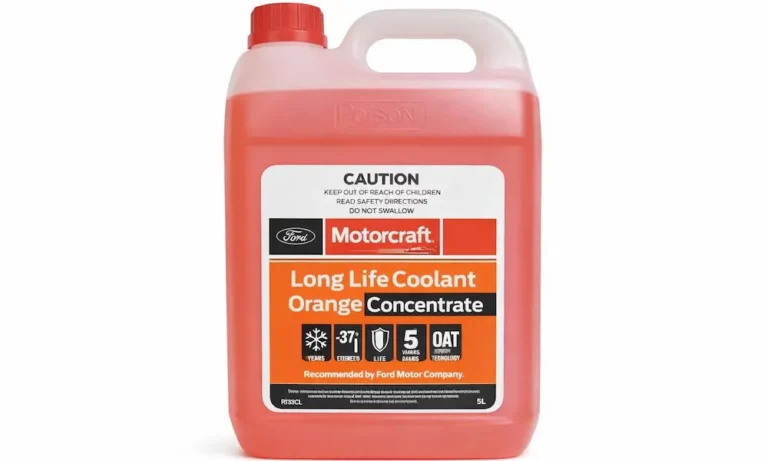
Motorcraft Orange is Ford’s factory-fill coolant, officially spec’d as WSS-M97B44-D (or WSS-M97B44-D2 for the pre-diluted version). Ford introduced it with the 2011 model year as a major upgrade over the older green and gold formulas.
It’s an Organic Acid Technology (OAT) coolant. That means it uses carboxylate-based chemistry instead of silicates or phosphates to protect your engine’s metal surfaces. Rather than coating everything with a thick inorganic layer, OAT coolants bond selectively where corrosion actually starts — keeping heat transfer efficient while still protecting aluminum, cast iron, steel, copper, and brass.
Key specs from the official Motorcraft product page:
| Property | Value (50/50 Mix) |
|---|---|
| Freezing Point | -34°F (-37°C) |
| Boiling Point (15 psi cap) | 265°F (129°C) |
| pH Range | 8.5 – 9.0 |
| Specific Gravity | 1.070 – 1.080 |
| Rated Service Life | 5 years / 150,000 miles |
No silicates. No phosphates. No nitrates. That’s what makes it different from older green coolants — and why you can’t just mix them.
Which Vehicles Use Motorcraft Orange?
If your Ford was built between 2011 and 2018, there’s a good chance it came from the factory with orange coolant. Here’s a quick reference:
| Vehicle | Model Years | Factory Spec |
|---|---|---|
| F-150 | 2011–2018 | WSS-M97B44-D2 |
| Explorer | 2011–2018 | WSS-M97B44-D2 |
| Mustang | 2011–2018 | WSS-M97B44-D2 |
| Edge / MKX | 2011–2018 | WSS-M97B44-D2 |
| Transit | 2015–2018 | WSS-M97B44-D2 |
| Escape | 2011–2018 | WSS-M97B44-D2 |
There’s one tricky exception: the Ford E-Series (E-450). According to Ford transition documentation, vehicles built before June 24, 2016 got Motorcraft Gold (WSS-M97B51-A1). Those built after July 11, 2016 got Orange. If your E-Series sits in that window, check your actual fluid color before adding anything.
The same applies to the 2017 F-350 and other transition-year platforms — always verify visually before topping off.
The Best Motorcraft Orange Coolant Equivalents
Here’s what you actually need to know: Motorcraft Orange shares the same underlying OAT chemistry as GM’s Dex-Cool standard (GM 6277M / GMW 3420). That means any product labeled “Dex-Cool Approved” is a legitimate equivalent for Ford’s WSS-M97B44-D — provided it’s silicate-free, phosphate-free, and carboxylate-based.
Valvoline Zerex Dex-Cool
This is the gold standard for aftermarket equivalents. Zerex Dex-Cool is a patented carboxylate OAT formula that explicitly meets Ford’s WSS-M97B44-D spec. It’s available in concentrate and 50/50 pre-diluted versions. Service life matches the OEM: 5 years or 150,000 miles.
It’s arguably the closest aftermarket match to the original Ford fluid in terms of inhibitor chemistry and long-term pH stability.
PEAK OET North American Orange
PEAK’s Original Equipment Technology Orange is specifically engineered for Ford and Lincoln vehicles from 2011–2018. It’s silicate-free, phosphate-free, and color-coded for your exact application. PEAK claims up to 15 years or 400,000 miles on a complete flush-and-fill — significantly beyond the OEM interval.
Prestone Dex-Cool and American Orange
Prestone’s American Orange Antifreeze + Coolant covers Ford and Lincoln vehicles from 2002 onward that require OAT. They also offer a Platinum series that’s compatible with all coolant colors and technologies, including current Ford specs. Their Dex-Cool formulation is specifically listed for Ford vehicles from 2011–2018.
O’Reilly, Havoline, and Shell Rotella Options
| Brand | Product | Spec Met | Notes |
|---|---|---|---|
| O’Reilly | Orange Dex-Cool (ORDEX50/50) | WSS-M97B44-D | Solid budget pick |
| Havoline | Xtended Life | WSS-M97B44-D | GM 6277M approved |
| Shell Rotella | ELC Nitrite Free | WSS-M97B44-D | Red color, nitrite-free OAT |
Don’t let the color fool you. Shell Rotella ELC NF is red, not orange — but it’s chemically compliant with the Ford OAT specification.
The “Universal Coolant” Problem
You’ve seen those jugs that claim to work with every color, every make, every model. Brands like Prestone and Valvoline market universal formulas that technically meet ASTM D3306 minimums.
Here’s the catch: universal coolants achieve compatibility through a “compromise” inhibitor package. They might meet the baseline spec, but they often don’t deliver the precise carboxylate concentration found in a dedicated WSS-M97B44-D equivalent. For everyday driving, it probably won’t cause immediate problems. But for high-stress engines like Ford’s 3.5L EcoBoost — which runs hot and cycles heat aggressively — a spec-matched fluid is the smarter call.
The Bigger News: Motorcraft Orange Is Being Phased Out
Ford officially began transitioning away from Orange in late 2018 and into 2019. The replacement is Motorcraft Yellow (WSS-M97B57-A1/A2), which uses Phosphated Organic Acid Technology (P-OAT).
The reason for the switch: P-OAT adds phosphates to the carboxylate base. This speeds up how quickly the inhibitor passivates fresh metal surfaces, which matters in modern aluminum-heavy cooling jackets. The Motorcraft Yellow spec extends the initial change interval to 10 years or 200,000 miles, with subsequent changes every 5 years or 100,000 miles.
Can You Mix Orange and Yellow?
Yes — but you should understand what happens. According to Ford’s official backward compatibility documentation, Motorcraft Yellow is approved to top off systems that contain Orange. You don’t need a specialized flush first, as long as the system isn’t contaminated with other fluids.
The downside? Mixing creates a muddy dark-orange or brownish color that makes it harder to assess fluid condition visually. It won’t damage your engine, but it does complicate maintenance checks. Ford F-150 owners on Reddit have confirmed this transition works fine in practice.
If your Ford is still under powertrain warranty, skip the aftermarket options entirely and use Motorcraft Yellow. It’s the current OEM standard, and it removes any room for warranty disputes.
Mixing Rules You Can’t Ignore
One thing that will cause real damage: mixing OAT (orange) coolant with older IAT (green) or HOAT (gold) fluids. These have completely different inhibitor chemistry. Combining them causes the inhibitors to drop out of solution and form a thick, jelly-like sludge. That sludge clogs your radiator, heater core, and coolant passages — and overheating follows quickly.
Here’s the short version:
- ✅ OAT Orange + OAT Orange → Fine
- ✅ OAT Orange + P-OAT Yellow → Fine (with a color change)
- ❌ OAT Orange + IAT Green → Sludge risk
- ❌ OAT Orange + HOAT Gold → Sludge risk
Always check the current fluid color in your reservoir before adding anything. Ford compatibility discussions on Reddit confirm that color matters — even between Ford’s own product generations.
Always Use Distilled Water
If you’re working with concentrated coolant, don’t dilute it with tap water. Municipal water contains calcium, magnesium, and chlorides that react with OAT inhibitors to form scale deposits. These deposits act as insulation on your radiator and heater core, reducing heat transfer and creating hotspots in your cylinder head.
The AutoZone antifreeze buying guide is clear on this: always use distilled or demineralized water. A 50/50 mix is the standard starting point for most climates.
How to Know When Your Coolant Is Done
Coolant doesn’t just “run out.” It degrades chemically. Over time, the organic acids get consumed protecting your engine’s metal surfaces, and the glycol itself breaks down into acidic byproducts. When the pH drops below 7.0, the coolant becomes corrosive — and aluminum components like your water pump impeller and radiator fins take the hit.
Motorcraft Orange is designed to hold a pH between 8.5 and 9.0. Once it falls out of that range, it’s time for a change regardless of mileage. Pick up a coolant test strip or a refractometer to check concentration and chemical health before winter hits — that’s the kind of check most people skip and later regret.
The Bottom Line on Equivalents
If your Ford runs WSS-M97B44-D from the factory, here’s your priority order:
- Still under warranty? Use Motorcraft Yellow. It’s backward-compatible and keeps you warranty-compliant.
- Out of warranty, want the best aftermarket option? Go with Valvoline Zerex Dex-Cool or PEAK OET Orange.
- On a tighter budget? O’Reilly’s Dex-Cool or Prestone American Orange both meet the spec at a lower price point.
- Avoid generic universals in high-performance or turbocharged applications where spec precision actually matters.
The chemistry is what counts — not the brand name on the jug. Any silicate-free, phosphate-free, carboxylate-based OAT fluid that meets WSS-M97B44-D will protect your Ford’s cooling system the way it was engineered to be protected.